


Robots have become increasingly capable of handling tasks such as moving packages, sorting goods and assembling products in factories. Some advanced machines can even walk and run in ways that resemble human movement. However, working with soft, slippery and unpredictable materials remains one of the biggest challenges in robotics.
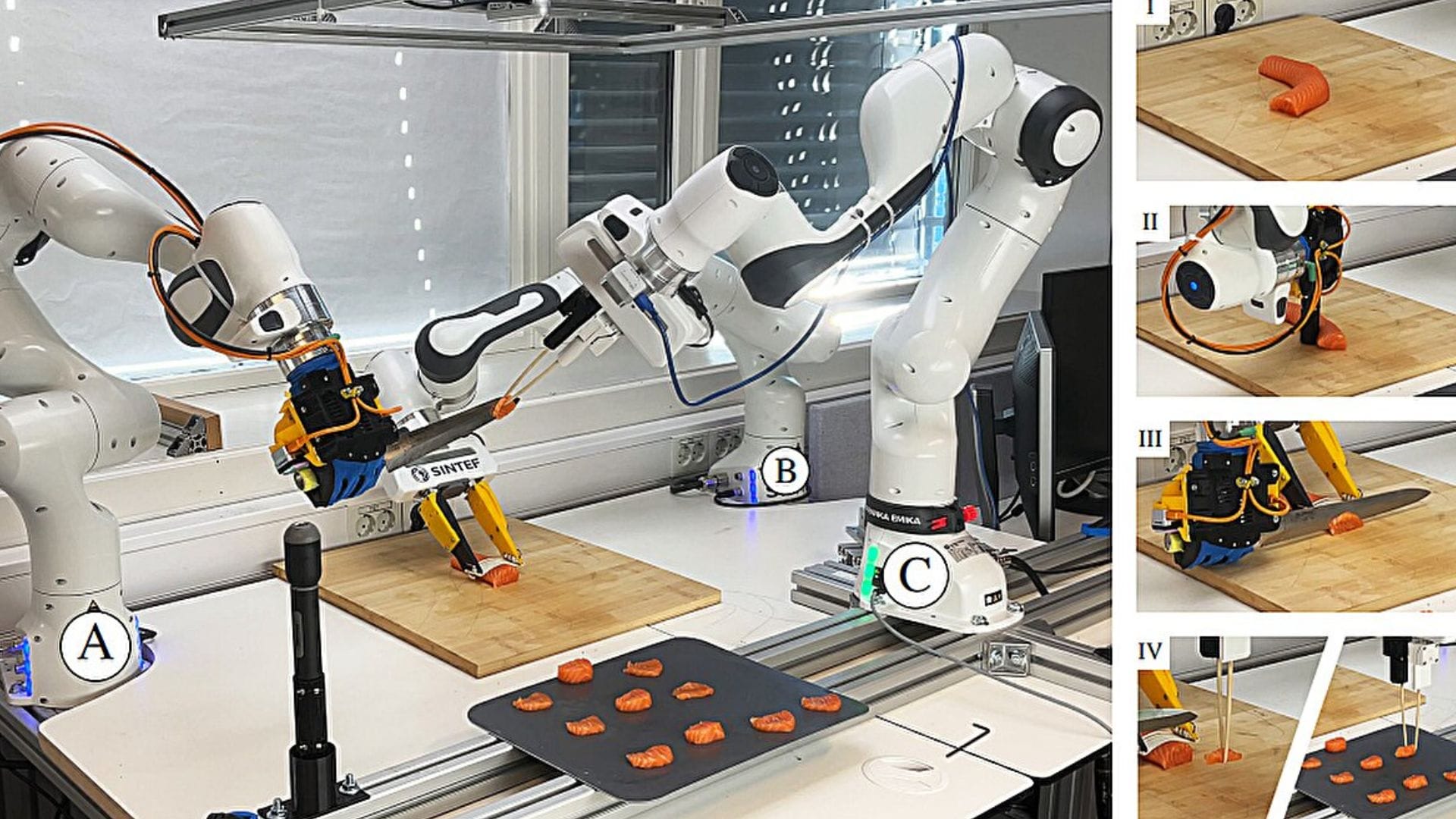
Researchers at the Norwegian University of Science and Technology have developed a solution to overcome that obstacle. Their creation, known as the Sashimi-Bot, is a three-armed robotic system designed to prepare sashimi from a raw salmon loin without human assistance.
The project highlights how robotics technology is advancing beyond structured industrial environments into tasks that demand precision, adaptability, and delicate handling. While the robot was designed for food preparation, the technology behind it could have wider applications in industries where fragile or irregular materials must be manipulated carefully.
Three robotic arms share the preparation process
The Sashimi-Bot divides the sashimi preparation process between three separate robotic arms, each assigned a specific role. One arm is responsible for stabilising and positioning the salmon on a cutting surface. A second arm holds a chef’s knife and performs the slicing operation. The third arm uses chopsticks to pick up completed slices and place them onto a serving tray.
The arrangement allows the robot to coordinate multiple actions simultaneously while maintaining control over the delicate fish. Unlike rigid industrial components, raw salmon can change shape easily and move unexpectedly during handling, making accurate cutting far more difficult.
According to the research team, the robot’s capabilities were developed through deep reinforcement learning. Lead researcher Sverre Herland and colleagues trained the system inside a virtual simulation rather than using real fish during the learning process.
This approach enabled the robot to perform thousands of practice movements in a digital environment. Through repeated trial and error, it gradually learned how to position, cut and transfer slices effectively. By relying on simulation-based training, the researchers avoided the need for extensive real-world testing during the learning phase.
The training method demonstrates how modern artificial intelligence techniques can help robots acquire complex physical skills before being deployed in real environments. Such approaches may reduce development costs and accelerate the creation of machines capable of handling more challenging tasks.
Tactile sensing improves cutting accuracy
A key feature of the Sashimi-Bot is its ability to detect contact during the cutting process. The knife arm is equipped with a GelSight tactile sensor, which consists of a soft gel surface and an embedded camera.
The sensor enables the robot to detect when the knife has precisely reached the cutting board. This information helps improve cutting consistency and reduces the likelihood of errors during operation.
Handling food products presents unique challenges because texture, shape and resistance can vary between individual pieces of fish. Traditional robotic systems often struggle in such environments because they rely heavily on visual information and pre-programmed movements.
By incorporating tactile sensing, the researchers added a layer of feedback to the robot. This enables it to make more informed decisions during the slicing process and react more accurately to physical contact.
The use of touch-sensitive technology is becoming increasingly important in robotics research, particularly in applications where machines must interact with fragile objects. Combining tactile information with artificial intelligence enables robots to achieve a level of precision that would be difficult to achieve through vision alone.
The researchers believe that advancements in sensing technology could help robots perform a wider range of tasks that currently require human dexterity and judgment.
Test results highlight potential beyond food preparation
During testing, the Sashimi-Bot produced 34 salmon slices. Of the 28 slices that landed on the cutting board, the robot successfully picked up 26 using its chopstick-equipped arm.
In addition, six slices that remained attached to the knife blade were successfully retrieved directly from the blade itself. These results demonstrated the robot’s ability to adapt to different situations during the preparation process.
The average time per cutting cycle was 27.9 seconds. The findings were published in the journal npj Robotics and later reported by TechXplore.
Although the robot’s performance may not yet match the speed of an experienced sushi chef, researchers view the project as an important step forward in robotic manipulation. Most robotic systems perform best when handling rigid and predictable objects in controlled environments. Soft and irregular materials remain far more difficult to manage.
The significance of the Sashimi-Bot, therefore, extends beyond preparing sashimi. The project demonstrates how robots can make real-time adjustments while interacting with delicate materials that exhibit unpredictable behaviour.
Such capabilities could eventually prove useful in food processing, healthcare, manufacturing and other sectors where careful handling is essential. As robotic systems continue to improve their ability to sense and respond to their surroundings, they may become capable of taking on a wider variety of complex tasks that have traditionally depended on human skill.