

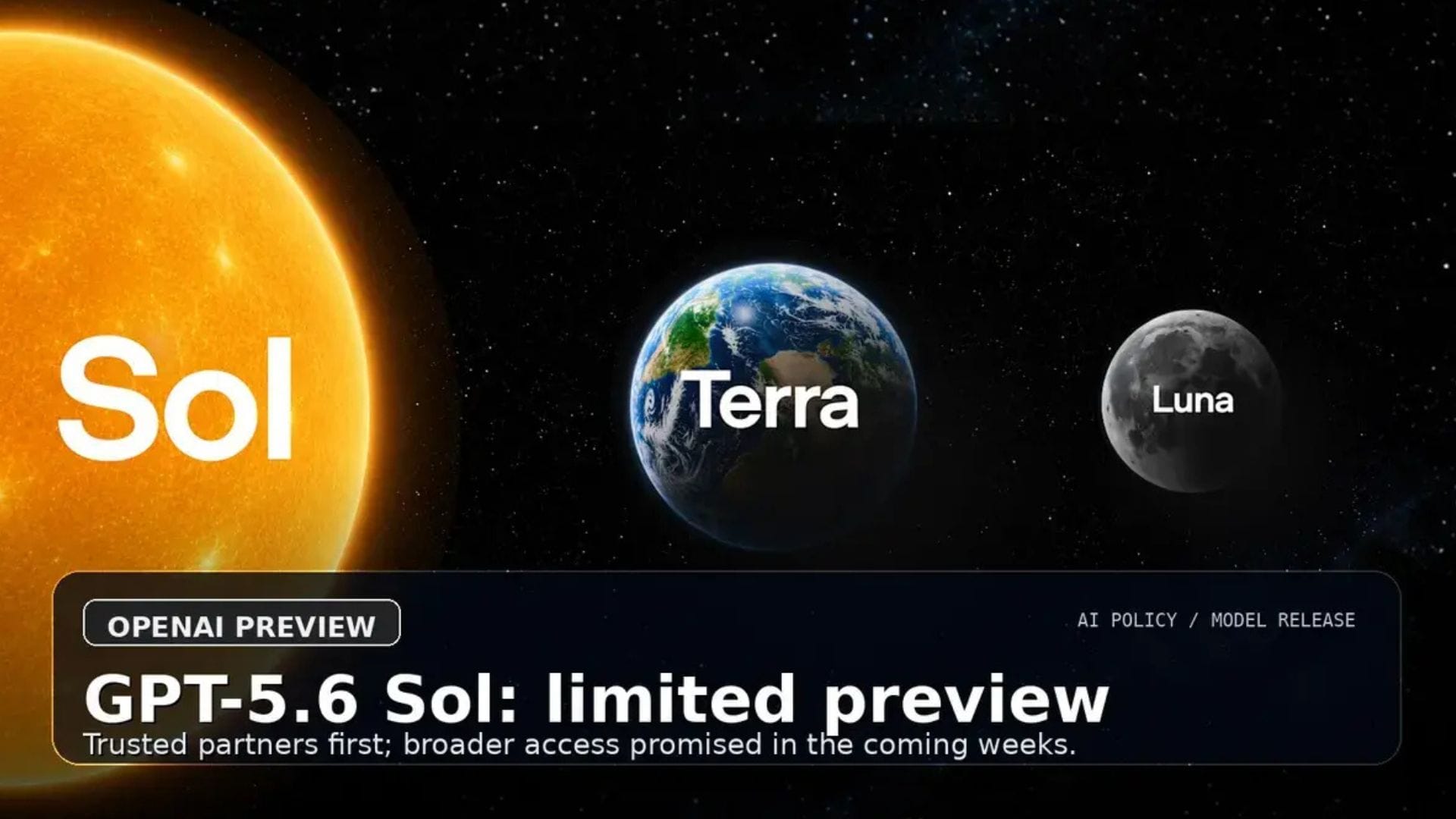
OpenAI has started a limited preview of its new GPT-5.6 artificial intelligence model series, giving access to a small group of trusted partners ahead of a wider public launch expected in the coming weeks.
The new model family includes three versions designed for different use cases. Sol is positioned as the company’s most advanced model; Terra is aimed at everyday tasks and offers similar performance to GPT-5.5 at a lower cost; and Luna is the most affordable option in the range. The company said the staggered release will allow it to prepare for a broader rollout after gathering feedback from early participants.
OpenAI previews GPT-5.6 ahead of wider release
Before announcing the limited preview, OpenAI also presented GPT-5.6 to the United States government. The early access follows a request from the administration for selected artificial intelligence companies to share their latest models before public release.
OpenAI said the trusted partners involved in the preview had been disclosed to the government as part of the process. However, the company stressed that it does not believe this level of government access should become the standard going forward. Instead, it described the arrangement as a temporary measure designed to support a timely public launch of the GPT-5.6 series.
The preview comes after President Donald Trump signed an executive order on artificial intelligence cybersecurity earlier this month. The order encourages companies to voluntarily provide their most advanced AI models for government review at least 30 days before making them publicly available.
Reports from The New York Times suggest that OpenAI, Anthropic, Google, xAI and Microsoft had already been giving the US government early access to new AI models before the executive order was introduced. Meta was reportedly the only major company that had not participated, with officials said to be encouraging the company to submit its latest models for assessment.
OpenAI’s latest announcement highlights how government oversight of advanced AI systems is becoming more common as policymakers seek to understand potential risks before powerful models become widely available.
GPT-5.6 introduces stronger reasoning and enhanced security
Among the three new models, Sol is described as the flagship offering. It introduces a new “max” reasoning mode that allows the model to spend additional time analysing complex requests before generating a response. According to OpenAI, this deeper reasoning process improves its ability to solve difficult problems and strengthens its cybersecurity capabilities.
The company said Sol is its most capable model for identifying software vulnerabilities and helping users fix security issues. At the same time, it includes stronger protections against requests involving high-risk or sensitive activities. OpenAI explained that engineers spent several weeks identifying weaknesses in the model and reinforcing it against attacks that could occur in real-world environments.
The security improvements extend across the entire GPT-5.6 family rather than being limited to Sol. OpenAI said every model has been tested against adversarial attacks to ensure they remain resilient under pressure.
The company also confirmed that GPT-5.6 has been trained to refuse prohibited cyber assistance, including attempts to bypass safety restrictions via jailbreaking. OpenAI revealed that it invested around 700,000 GPU hours in searching for universal jailbreak methods to develop stronger defences.
It also pledged to maintain what it described as a “rapid-response process to reproduce, assess, prioritise, and remediate newly discovered jailbreaks.” This approach is intended to allow security teams to react quickly if new methods emerge that could compromise the models after release.
Pricing reflects OpenAI’s push for wider adoption
OpenAI’s emphasis on cybersecurity comes shortly after rival AI developer Anthropic temporarily suspended access to its Mythos 5 and Fable 5 models following a government directive.
Although Anthropic did not publicly confirm the reason, reports indicated that Amazon and several other organisations had informed authorities that the models could potentially be jailbroken and exploited for harmful purposes. The company has since begun restoring access after receiving US government approval to redeploy Mythos to a limited group of organisations.
The incident has highlighted the growing importance of AI safety testing as governments and technology companies work to reduce the risks associated with increasingly capable language models. OpenAI’s investment in security testing and jailbreak prevention appears to reflect this changing regulatory environment.
Alongside the technical improvements, OpenAI has also introduced competitive pricing for the GPT-5.6 family. Sol is priced at US$5 per million input tokens and US$30 per million output tokens. The company noted that this is significantly lower than the pricing previously offered for Anthropic’s Fable model, which cost US$10 per million input tokens and US$50 per million output tokens before it was withdrawn.
Terra is priced at US$2.50 per million input tokens and US$15 per million output tokens, making it a lower-cost alternative for general workloads while maintaining performance comparable to GPT-5.5. Luna, the most economical option in the series, costs US$1 per million input tokens and US$6 per million output tokens, providing developers with an entry-level model for less demanding applications.
With its combination of enhanced reasoning, stronger security safeguards and lower pricing, OpenAI is positioning GPT-5.6 to appeal to a broad range of developers and businesses as it prepares for a wider release in the coming weeks.