


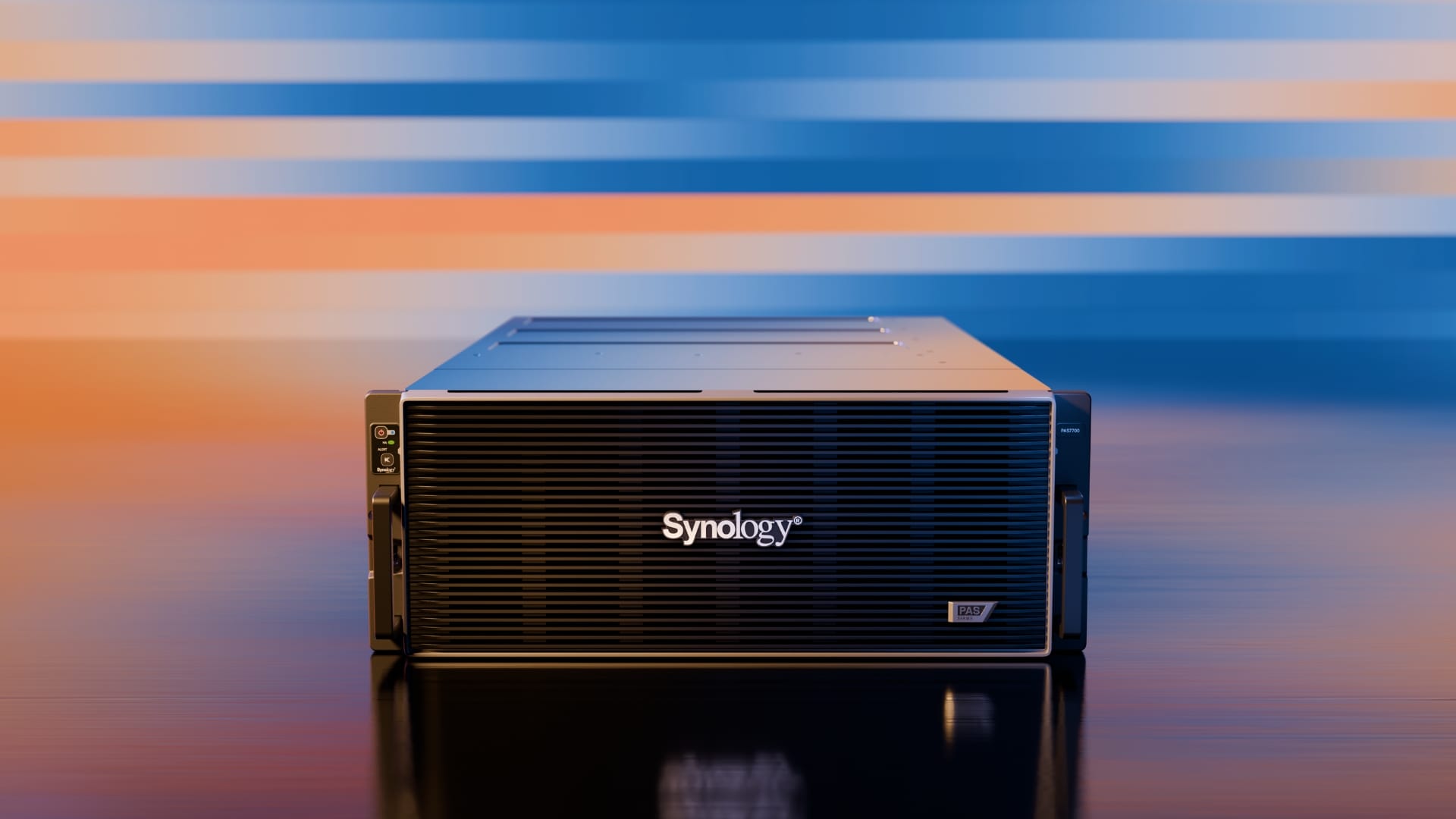
AI, analytics and virtualisation workloads are increasing the pressure on enterprise storage systems, particularly where access speed and uptime directly affect operational applications. Synology is addressing that demand with PAS7700, its first active-active, all-flash NVMe storage system.
The system is designed for mission-critical workloads that require low latency, high throughput and continuous service availability. It is now available globally through Synology’s network of partners and distributors.
Storage becomes part of operational resilience
PAS7700 arrives as enterprises place greater weight on storage performance across data-intensive environments. Synology is targeting use cases such as virtualisation, databases, VDI, electronic design automation and AI, where delays or service interruption can affect production systems rather than secondary IT functions.
The system uses dual controllers and 48 NVMe SSD bays in a 4U chassis. It can scale up to 1.65 PB of raw storage capacity with up to seven expansion units, giving enterprises room to support larger pools of active data.
Performance claims include up to 2 million IOPS, latency of under 1 millisecond and sequential throughput of up to 30 GB/s, supported by up to 2,048GB of memory across the full system and 100GbE networking. PAS7700 supports both file and block storage, with protocol support across NVMe-oF, iSCSI, Fibre Channel, SMB and NFS.
Synology has named data centres, manufacturing, semiconductor design, game development and healthcare among the sectors suited to the system. These are environments where large volumes of data are processed concurrently and where storage consistency can affect service delivery.
Active-active architecture reduces failover risk
The central design choice is PAS7700’s active-active architecture, which allows both controllers to operate simultaneously. This differs from an active-standby model, where a secondary controller waits to take over when the primary system fails.
For enterprise IT teams, the appeal is reduced exposure to disruption. If one controller or a network component fails, PAS7700 is designed to continue delivering services while failover mechanisms manage the incident.
The system also includes triple-parity RAID, mirrored write cache protection, IP failover and automatic failover. Continuous Availability Manager gives IT teams a way to monitor the health of system components and respond to issues before they affect services.
Bie-i Chu, Executive Vice President of the Synology NAS Group, said the system follows more than a year of enterprise validation. “PAS7700 reflects Synology’s 25+ years of experience in storage and our close collaboration with enterprise customers to address evolving requirements for high availability, performance, and scalability,” said Chu. “After a year of extensive real-world validation through our enterprise proof-of-concept programme, PAS7700 is field-proven to deliver high reliability and performance, while helping customers lower total cost of ownership (TCO).”
Data protection and efficiency remain part of the pitch
Beyond performance and availability, PAS7700 includes several data protection features aimed at enterprise environments. The system supports Self-Encrypting Drives for hardware-level protection, as well as WORM folders and immutable snapshots to reduce the risk of unauthorised modification or deletion after snapshots are created.
Synology has also included Snapshot Replication and Hyper Backup, allowing enterprises to build recovery layers between production environments and secondary systems. These capabilities are intended to support data recoverability in the event of incidents or cyberattacks.
Storage efficiency is another part of the system’s positioning. PAS7700 supports inline and offline deduplication to reduce unnecessary data usage and extend SSD lifespan. Synology also plans to add Synology Tiering, which will move infrequently accessed data to high-capacity storage systems so that NVMe resources can be reserved for active applications and hot data.
The platform runs on DSM Enterprise, Synology’s operating system for enterprise storage. For organisations expanding AI, analytics or virtualised infrastructure, PAS7700 places Synology further into performance-sensitive enterprise storage, where uptime, latency and management overhead are increasingly tied to operational risk.