

Xreal has revealed new details about its Android XR-powered Project Aura smartglasses, a device that aims to deliver a more immersive augmented reality experience than many rivals. Demonstrated at Google I/O, the headset-style glasses signal the company’s intention to move beyond simple entertainment features into more advanced productivity and development applications.
The company has long positioned itself differently within the smartglasses market. While several competitors have focused on lightweight eyewear with limited smart functions, Xreal has concentrated on delivering immersive augmented reality experiences designed for media consumption and interactive applications. Project Aura appears to continue that strategy while significantly expanding the device’s capabilities.
Unlike more discreet Android XR glasses currently being developed by brands such as Warby Parker and Gentle Monster, Project Aura adopts a larger and more technically ambitious design. The glasses are not intended to blend seamlessly into daily wear but instead function as a high-powered wearable computing device with enhanced visual and spatial features.
Project Aura focuses on immersive augmented reality
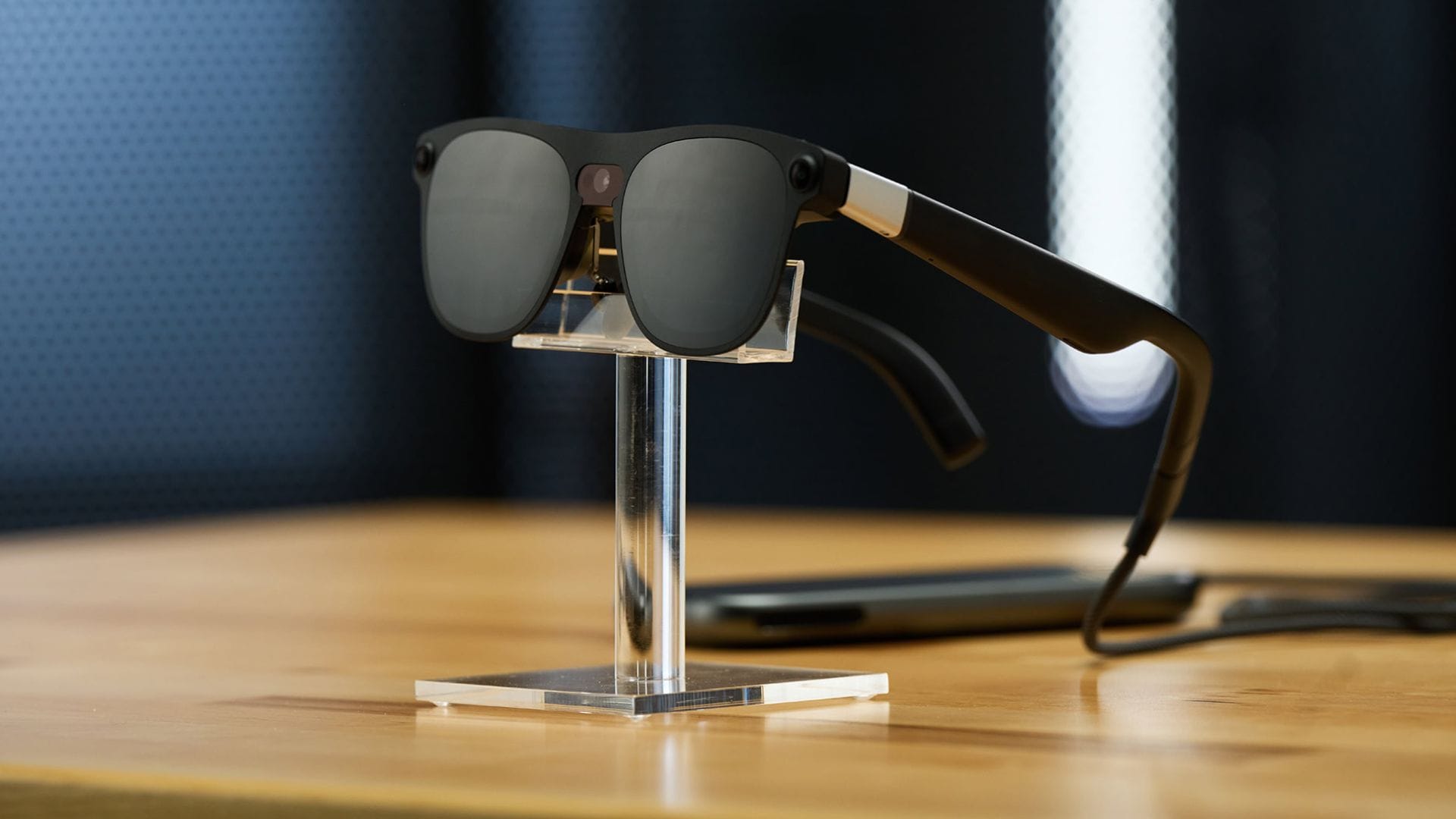
The design of Project Aura closely resembles Xreal’s existing One Pro smartglasses, though the new model adds several hardware features. Three cameras are integrated into the frame, including one positioned on each side for hand tracking and a central camera for capturing photographs and video.
While Xreal has not yet disclosed full technical specifications, the company confirmed that the device includes a 70-degree field-of-view display. During hands-on demonstrations at Google I/O, the display appeared bright and sharp, even under strong outdoor sunlight. The wider viewing area also reduced the sense of content being cut off while browsing websites or watching videos.
The interface relies heavily on gesture controls, allowing users to interact with applications through hand movements. A pinching gesture is the primary method for selecting and manipulating virtual windows. During demonstrations, hand tracking appeared responsive and accurate, enabling users to resize and reposition content with relative ease.
Project Aura differs from the One Pro glasses in another significant way. Instead of functioning independently, the device requires a wired connection to an external processing puck, similar to the setup used by Apple’s Vision Pro headset. The companion puck, roughly the size of a smartphone, includes a built-in trackpad and fingerprint sensor.
Although these additional controls were not fully demonstrated, the external unit reportedly became noticeably warm during testing sessions. However, the demonstrations took place outdoors in temperatures approaching 32°C, which may have contributed to the increased heat.
Xreal highlights experimental apps and productivity features
To showcase the platform’s capabilities, Xreal demonstrated several internally developed applications designed for augmented reality interactions. One example was a basic AR drawing application, while another, called Gemini Molecule, highlighted the device’s multimodal features.
The Gemini Molecule app allowed users to view a physical object, select it with a hand gesture, and receive information about its material composition, along with a visual representation of its molecular structure. According to Xreal, both applications were rapidly created using Google’s Gemini tools.
While the demonstrations were relatively simple, they provided an early indication of how developers could use Android XR for more advanced mixed-reality experiences in the future. The company suggested that broader third-party development support may unlock significantly more sophisticated applications once the platform becomes available to external creators.
Xreal also appears to be positioning Project Aura as a productivity-focused device rather than purely an entertainment product. Users can reportedly connect the glasses to a laptop and use them as an external virtual display. Combined with a Bluetooth keyboard, the setup could potentially function as a portable workstation.
One Xreal engineer involved with the demonstrations claimed he had replaced his conventional monitor setup entirely with Aura glasses. Although such productivity scenarios were not fully tested during the demonstration period, the company clearly intends to market the device as more than a media-viewing accessory.
The focus on productivity may also help distinguish Project Aura from rival wearable devices that are currently centred primarily on entertainment or lightweight smart assistant features.
Premium pricing is likely, as Xreal targets enthusiasts and developers
Despite the strong technical demonstration, questions remain about the device’s target audience. Xreal has yet to announce official pricing details, with a full launch expected later in 2026. However, industry expectations suggest the device will occupy the premium end of the market.
The company’s existing One Pro smartglasses are priced at around US$650, and Project Aura’s more advanced hardware and expanded capabilities are likely to push its price considerably higher. The inclusion of multiple cameras, advanced displays, and external processing hardware may position the product closer to premium mixed-reality headsets than to traditional smartglasses.
Even so, the device could appeal strongly to developers, early adopters and users interested in experimental augmented reality experiences. Its lighter form factor compared with larger mixed-reality headsets may also make it attractive to users seeking an alternative to devices such as Samsung’s upcoming Galaxy XR headset.
Project Aura reflects a broader effort within the technology industry to define how Android XR devices could evolve beyond simple wearable displays. Rather than focusing solely on lightweight everyday glasses, Xreal appears to be exploring a more powerful, feature-rich approach that combines immersive entertainment, productivity, and experimental AI-driven interactions.
Although several unanswered questions remain about pricing, battery performance, and mainstream appeal, the early demonstrations suggest that Xreal is attempting to carve out a distinct position within the growing extended reality market.