


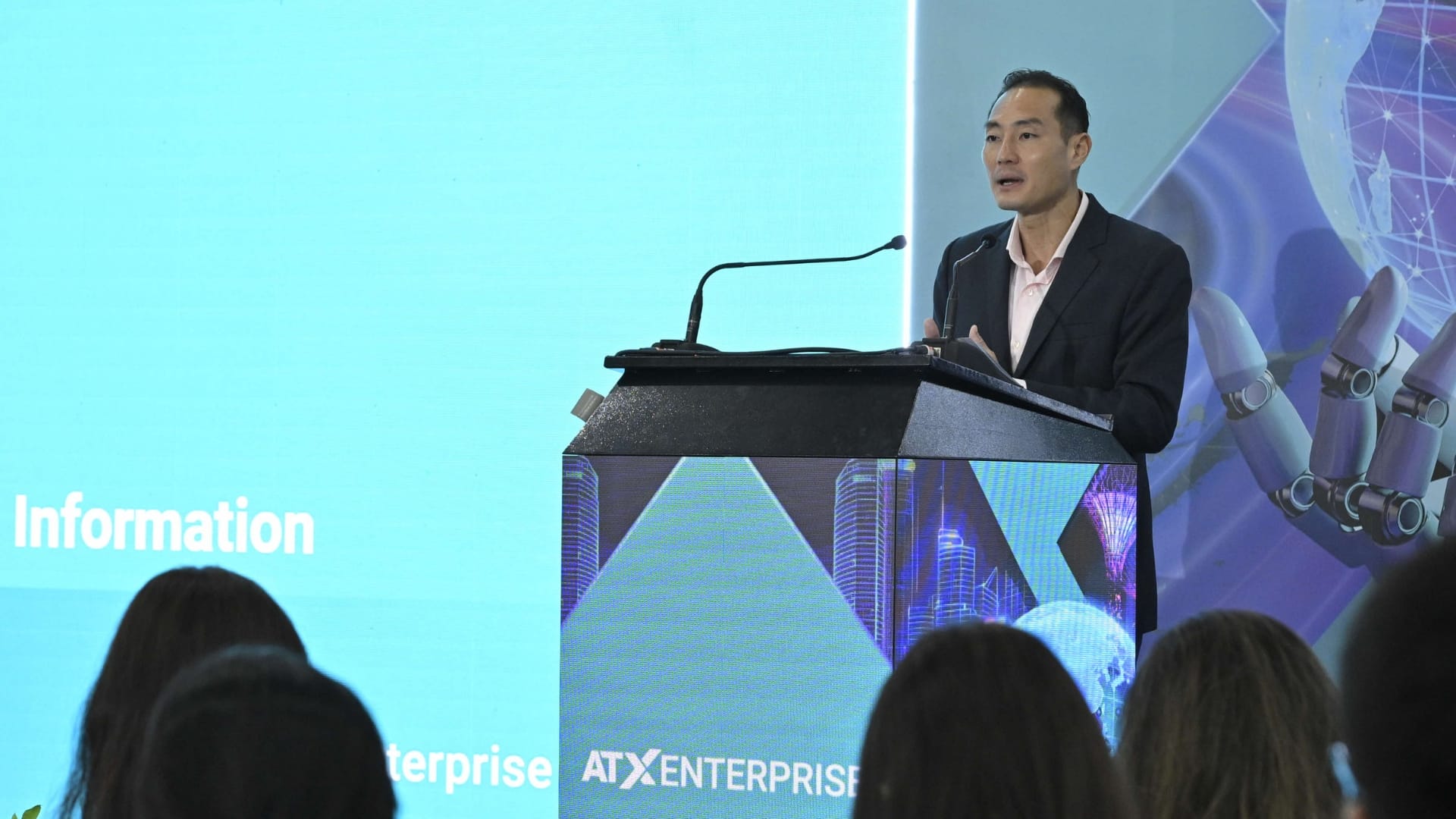
Singapore is adding new AI and cybersecurity support for small and medium-sized enterprises under the Digital Enterprise Blueprint, as enterprise AI adoption rises from 4.3% in 2023 to 23.5% in 2025.
Senior Minister of State for Digital Development and Information Tan Kiat How announced the updates at the ATxEnterprise 2026 Opening Ceremony at Singapore EXPO on 21 May. The new measures include the addition of Grab and RSM Stone Forest as Digital Enterprise Blueprint partners, the launch of an AI for Enterprise Impact Playbook, and the inaugural SME AI Impact Awards.
AI adoption grows among enterprises
Tan said digital adoption among enterprises in Singapore is now near universal, with 96.4% adopting at least one digital solution in 2025, compared with 84.6% in 2019. The average number of digital technologies adopted per enterprise also rose from 1.7 in 2019 to 2.5 in 2025.
The Digital Enterprise Blueprint, launched in May 2024, has benefitted more than 26,000 SMEs, crossing the midpoint of its five-year target of 50,000 SMEs. The blueprint covers four areas for enterprises in the AI era: using AI, scaling through integrated digital solutions, strengthening cyber resilience, and upskilling workers.
AI usage among workers has also grown. In 2025, 73.8% of surveyed workers used AI tools at work, with most using them several times a week or daily. Among firms already using AI, 68% plan to train and upskill workers in AI capabilities, while 63% plan to redesign jobs and workflows around AI.
Grab and RSM Stone Forest join the blueprint
Grab will work with IMDA to help 10,000 F&B, e-commerce, and retail SMEs strengthen AI literacy and adopt AI tools. Its contribution includes a two-day AI programme developed with SUTD for SME merchant partners, covering AI’s business value, use case identification, and practical roadmap development. Grab will also run masterclasses and webinars co-curated with IMDA around AI capability gaps among Singapore’s SMEs.
RSM Stone Forest will support cybersecurity adoption through the RSM Cyber2SME Programme, developed with IMDA. The programme targets phishing, which Tan identified as a persistent vulnerability for SMEs.
Up to 2,000 SMEs will receive a complimentary phishing simulation exercise customised to employees’ job functions. Business owners will also receive a performance report and a one-to-one advisory session with RSM cybersecurity practitioners to review the results and identify steps to manage cyber risks.
New playbook and awards focus on business outcomes
IMDA, SkillsFuture Singapore, and Workforce Singapore have jointly developed the AI for Enterprise Impact Playbook to help enterprises assess their AI transformation journey. The playbook evaluates enterprises across five dimensions: Strategy & Leadership, Talent & Culture, Data & Governance, Tech Deployment & Integration, and Value Creation. It then maps them to relevant support programmes and resources.
The playbook builds on existing support for more advanced enterprises. Tan said more than 1,200 enterprises have benefitted from GenAI support, with close to 300 AI projects committed as of April 2026 and more under discussion with IMDA.
IMDA and the Singapore Business Federation will also open nominations for the inaugural SME AI Impact Awards on 1 June. The awards will recognise SMEs that have built proprietary AI solutions or implemented off-the-shelf AI tools and achieved measurable business outcomes. Winners will receive the SME AI Impact Awards Trustmark.