

Tesla is seeking to expand its technology portfolio with plans for a modular artificial intelligence (AI) data centre platform and has filed a trademark application for the name “Megapod”. The move signals the company’s continued efforts to diversify beyond electric vehicles, battery storage and solar energy into AI infrastructure.
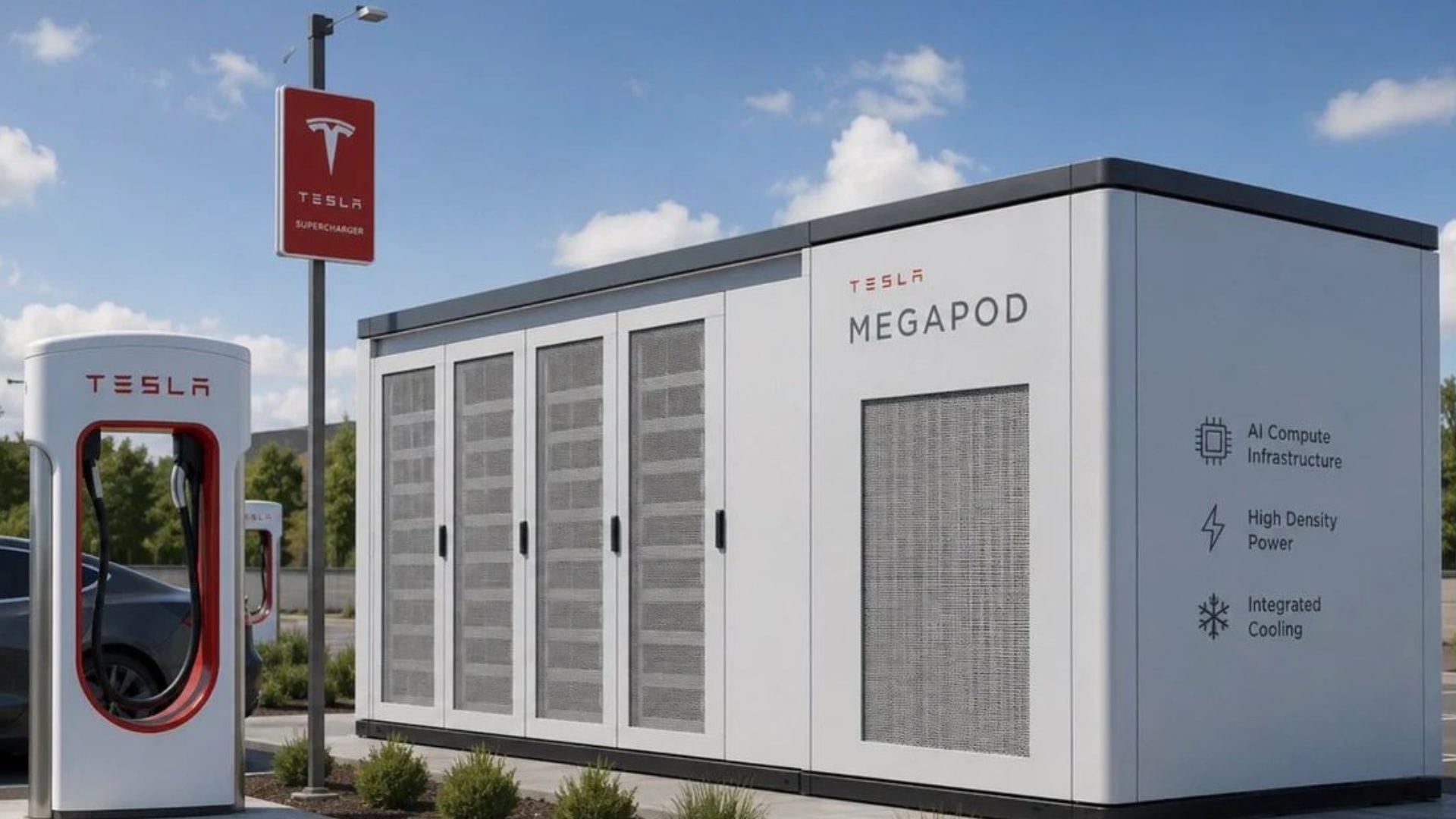
Although the trademark application is currently filed on an intent-to-use basis, meaning no commercial product has been announced, the filing outlines a self-contained AI computing platform. The proposed system would combine servers, AI hardware, networking equipment, power distribution, cooling systems and management software into a single modular solution designed for rapid deployment.
Tesla targets modular AI infrastructure market
Tesla has increasingly adopted the “Mega” branding across its energy products, most notably with its Megapack battery storage system. Industry observers believe a future Megapod platform could follow a similar approach, delivering factory-built AI data centre modules that require minimal assembly upon arrival on site.
Instead of requiring organisations to source and integrate servers, networking equipment, cooling systems and power infrastructure separately, a Megapod unit could provide a ready-to-use AI computing platform. Customers could then expand computing capacity simply by adding additional modules as demand grows.
The latest development comes roughly a year after reports suggested Tesla had scaled back work on its Dojo AI training computer project. That move appeared to reduce the company’s ambitions in developing AI chips internally. Rather than competing directly in semiconductor design, Tesla now appears to be considering infrastructure that could support AI workloads using commercially available processors.
However, the proposed branding has already encountered obstacles. Mitsubishi already owns the MegaPod trademark, while data centre cooling specialist Submer markets its own MegaPod product, describing it as a “data centre in a box”. These existing products could complicate Tesla’s efforts to secure exclusive rights to the name.
Trademark challenges are not unfamiliar to Tesla or its chief executive, Elon Musk. The company previously encountered difficulties registering the Robotaxi trademark after authorities considered the term too generic. It also experienced delays securing the Cybercab trademark after another applicant filed first.
Strong competition awaits any commercial launch
Even if Tesla resolves potential trademark issues, entering the AI infrastructure market would place the company against well-established technology suppliers with mature enterprise offerings.
Nvidia has already built a significant presence with its DGX and HGX AI computing platforms, which are widely deployed across research institutions and commercial enterprises. Huawei has also expanded its AI infrastructure portfolio with systems based on its Ascend accelerators. At the same time, server manufacturers, including Dell Technologies and Hewlett Packard Enterprise, continue to supply AI-ready hardware to business customers.
Despite the crowded market, Tesla may still possess advantages that could appeal to some organisations. The company has extensive experience designing integrated energy systems, battery storage and industrial-scale manufacturing. Combining an AI computing platform with its Megapack energy storage products could create an attractive solution for customers seeking reliable power for demanding AI workloads.
This possibility appears particularly relevant given that xAI has already purchased approximately US$1 billion worth of Tesla Megapack systems. Such deployments demonstrate that Tesla’s energy products are already being used to support AI-related infrastructure, potentially providing a foundation for broader integrated solutions.
Tesla’s manufacturing scale and purchasing power could also help lower production costs. By leveraging existing supply chains and production expertise, the company may be able to offer competitively priced infrastructure to organisations looking to build AI computing capacity.
Cooling technology and integration could become key advantages
Thermal management has become one of the most important considerations in modern AI data centres, with cooling technology now playing an increasingly critical role alongside processing performance.
As AI systems continue to consume more power, efficient cooling has become essential to maintain reliability and reduce operating costs. Technology companies are investing heavily in advanced cooling solutions, with Nvidia already introducing next-generation liquid cooling systems for its upcoming Rubin AI platform.
If Tesla integrates cooling into a modular Megapod system, it could provide customers with a simplified deployment process while improving operational efficiency. Delivering computing, power distribution and cooling as a single package may reduce installation complexity compared with building conventional AI data centres from multiple suppliers.
Tesla may also find opportunities among AI start-ups and emerging technology companies that are building new computing infrastructure rather than expanding existing enterprise environments. Although Tesla has limited experience serving traditional enterprise customers, younger AI-focused businesses may be more receptive to integrated solutions that combine energy storage, power management and computing infrastructure.
For now, however, the Megapod project remains at an early stage. The trademark application does not confirm that a commercial product will reach the market, and several legal and competitive challenges remain before any launch becomes possible.
Given Tesla’s history of unexpected product unveilings, future developments may emerge through announcements on X or surprise product presentations rather than through traditional corporate communications. Until then, the Megapod name represents another indication of Tesla’s ambition to broaden its role within the rapidly expanding AI ecosystem.