


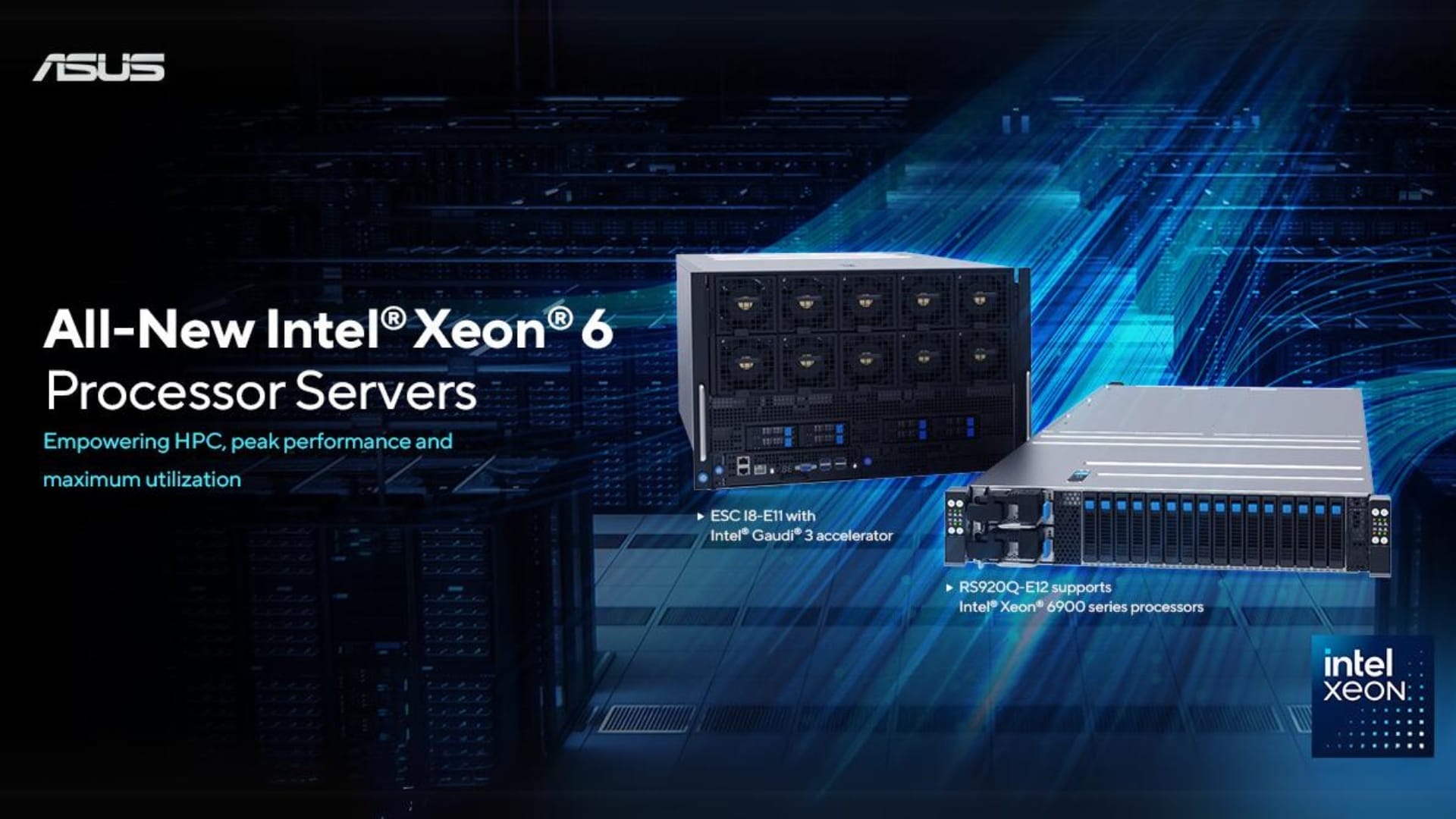
ASUS has introduced a new series of servers featuring Intel Xeon 6 processors, designed to meet the rising demand for high-performance computing (HPC). The servers, part of ASUS’s ongoing commitment to innovation, aim to boost performance and scalability for modern data centres and various industries.
The line-up includes several server models, each optimised for different computing needs, offering enhanced integration and seamless operation across diverse IT environments. These servers are built on ASUS’s reputation for trusted design and high-quality engineering, promising reliable solutions for clients aiming to scale up their infrastructure.
Next-gen servers for HPC
On 25 September 2024, ASUS announced the release of the RS920Q-E12, a multi-node server equipped with Intel Xeon 6900 series processors, specifically designed for HPC applications. Alongside this model, the RS720Q-E12, RS720-E12, and RS700-E12 servers were also launched. These servers feature Intel Xeon 6700 series processors with E-cores, with plans to support Intel Xeon 6700/6500 series with P-cores in early 2025.
The servers are built for performance and flexibility, allowing clients to customise data centres and scale their operations to reach the highest computing potential. With their robust architecture, these servers are ideal for industries that require efficient, large-scale data processing and management.
AI and data acceleration
ASUS’s ESC I8-E11 server caters to the growing need for artificial intelligence (AI) training and inference. This model supports eight Intel Gaudi 3 AI OCP Accelerator Module (OAM) mezzanine cards, along with 24 RoCE 200GbE RDMA NICs integrated into each Intel Gaudi 3 accelerator. Powered by the latest 5th Gen Intel Xeon processors, it features a modular design, reducing cable clutter and improving thermal management.
With its efficient use of power, thanks to its 3000W 80 PLUS redundant power supply units (PSUs), the ESC I8-E11 ensures reliable performance for AI applications, while offering energy savings and versatility. Its design is particularly suited for deep learning tasks that require both power and precision.
Servers designed for peak performance
Two other models, the RS920Q-E12 and RS720Q-E12, have been designed to maximise performance in HPC environments. The RS920Q-E12 is equipped with Intel Xeon 6900 series processors and supports up to 96 DDR5 RDIMM 6400 MT/s or MRDIMM Gen1 8800 MT/s per 2U system. This makes it a solid choice for managing heavy workloads while ensuring data is processed efficiently.
Additionally, the RS920Q-E12 uses advanced liquid-cooling technology to prevent overheating, providing stability even under high workloads, such as those required in cloud computing environments. Similarly, the RS720Q-E12 supports the Intel Xeon 6700 series processors, making it suitable for balancing resource utilisation and optimising I/O throughput. This model is particularly beneficial for handling complex tasks such as semiconductor electronic design automation (EDA).
Flexible deployment and seamless integration
ASUS’s RS720-E12 and RS700-E12 models offer flexibility and seamless integration for modern data centres. Built using a modular DC-MHS architecture, these servers are designed to handle varied data centre demands, providing smooth operation and optimisation across platforms. Both models support Intel Xeon 6700 and 6500 series processors, delivering a balance of flexibility, security, and performance.
The RS720-E12 is optimised for GPU support, making it suitable for tasks that require both graphical and computational power. Its innovative fan-bar design enhances ease of maintenance, while the server’s improved I/O throughput ensures rapid data transfer and processing, reducing bottlenecks. On the other hand, the RS700-E12 focuses on efficient multitasking, offering high-speed data access through all-NVMe storage and multi-core processors.
These general-purpose servers provide a cost-effective solution for enterprises looking to improve their data handling, processing, and storage capabilities. With large memory capacities and advanced features, the RS720-E12 and RS700-E12 ensure that businesses can manage extensive data needs while maintaining optimal performance.