

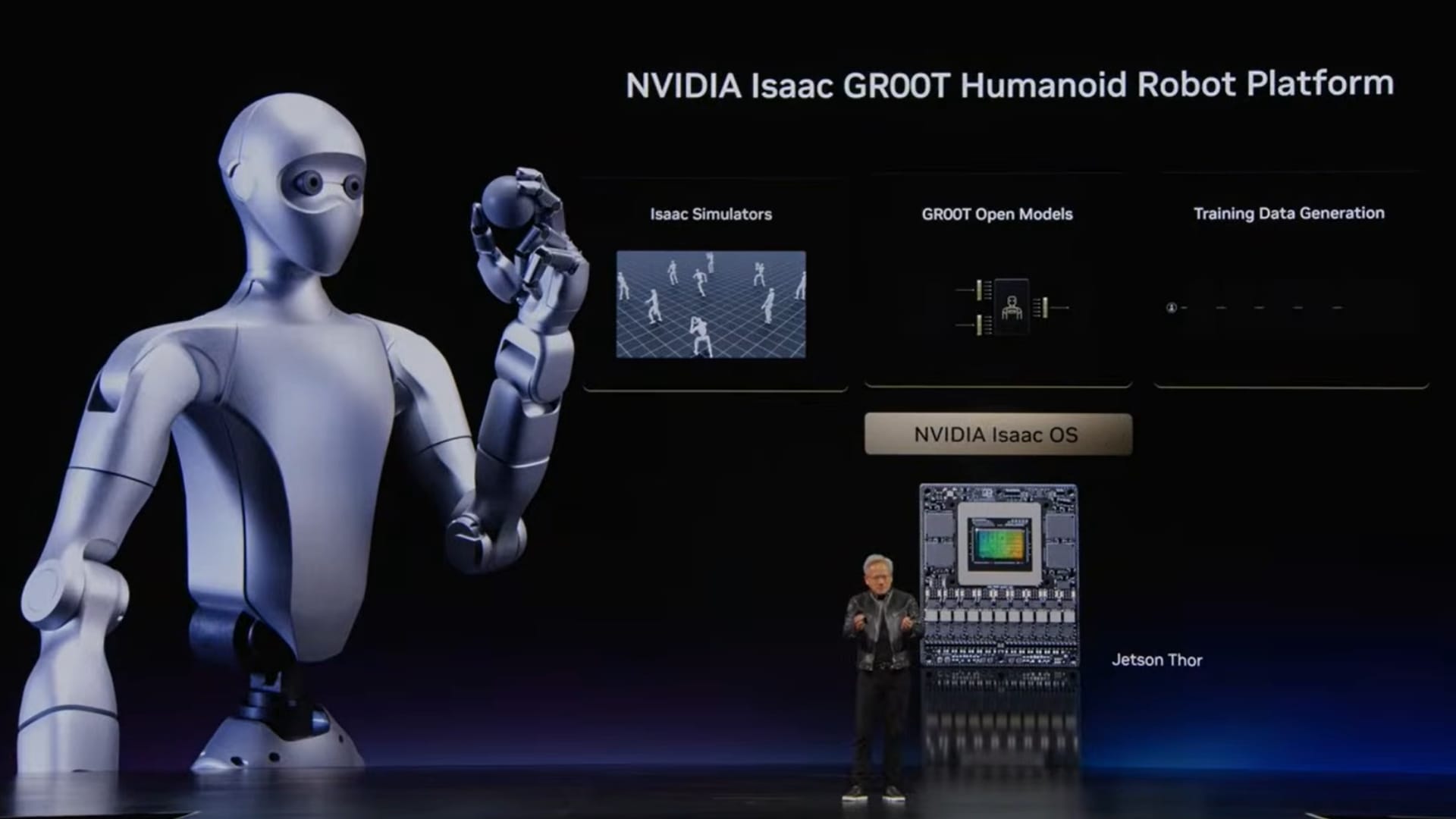
NVIDIA has announced the NVIDIA Isaac GR00T Reference Humanoid Robot, an open humanoid robot reference design built on Jetson Thor and the Isaac GR00T development platform.
The system is designed for academic and frontier robotics research, combining a Unitree H2 Plus humanoid robot, Sharpa Wave tactile five-finger hands, NVIDIA Jetson Thor onboard compute, and Isaac GR00T software and models. NVIDIA said the reference design is intended to give researchers access to advanced hardware and an open software stack without relying on proprietary platforms.
The launch comes as humanoid robotics development remains split across hardware integration, data collection, simulation, training, evaluation, and deployment. NVIDIA’s reference design brings those components into a single platform to help research teams move from robot bring-up to skill development and real-world testing.
“Humanoid robots will bring physical AI to the world’s largest industries, opening a multitrillion-dollar economic opportunity,” said Jensen Huang, founder and CEO of NVIDIA. “The NVIDIA Isaac GR00T Reference Humanoid Robot gives researchers a single, open platform to make breakthrough discoveries toward general-purpose physical intelligence.”
A human-scale platform for physical AI research
The Isaac GR00T Reference Humanoid Robot pairs a human-scale robot body with dexterous manipulation, sensing, control, and onboard AI compute. The Unitree H2 humanoid chassis stands nearly 6 feet tall, weighs 150 pounds, and has 31 degrees of freedom across the body.
The system adds dual Sharpa Wave tactile five-finger hands, bringing the robot to 75 degrees of freedom across the body and hands. The hands are intended to support dexterous manipulation, while multi-view sensing includes a head-mounted stereo camera with a 140-degree horizontal and 102-degree vertical field of view, wrist cameras for close-range manipulation, and an inertia measurement unit for motion tracking.
For movement and handling, the platform supports whole-body control with arm torque of up to 120 Newton-metres and leg torque of up to 360 Newton-metres. It has a rated arm payload of 7kg and a peak payload of 15kg, giving research teams more room to test lifting, reach, and manipulation tasks.
Onboard compute is handled by the NVIDIA Jetson AGX Thor T5000, which features an NVIDIA Blackwell GPU with 2,070 FP4 teraflops of AI performance, a 14-core Arm CPU, 128GB of unified memory, and a configurable 40W to 130W power range. The system also includes Ethernet, Wi-Fi 6, Bluetooth 5.2, USB, microphones, speakers for voice interaction, a 15Ah 0.972kWh battery with about three hours of life, and an on-remote emergency stop function.
Isaac GR00T brings the software stack into the robot workflow
NVIDIA said the Isaac GR00T platform provides the development environment for simulation, training, evaluation, and deployment, while researchers retain control of robot data, training data, telemetry, and logs.
The platform includes NVIDIA Isaac Teleop for capturing robot demonstration data, Isaac GR00T open foundation models for humanoid reasoning and multitask behaviour, Isaac Sim and Isaac Lab for simulation and policy testing, accelerated Isaac ROS middleware for moving trained policies onto robots, and Jetson Thor for real-time on-robot inference and control.
Its modular design allows robotics teams to use the full platform or integrate selected capabilities into existing development pipelines. NVIDIA said this approach can help teams scale humanoid development without rebuilding infrastructure for each robot or task.
The Isaac GR00T developer platform will also support the Unitree G1 humanoid robot, extending the same development approach to another robot used by researchers and humanoid developers.
Research institutions to use the reference design
Ai2, ETH Zurich, Stanford Robotics Center, and UC San Diego’s Advanced Robotics and Controls Laboratory will use the reference design to support humanoid robotics research. NVIDIA Research will also use the platform to advance Isaac GR00T open models, frameworks, and hardware.
“Robotics moves fastest when researchers can build on open platforms, share code and test ideas on real machines,” said Steve Cousins, executive director of the Stanford Robotics Center. “The NVIDIA Isaac GR00T Reference Robot gives our students and collaborators an open humanoid reference design with dexterous hands, onboard AI compute and the NVIDIA Isaac GR00T development platform for creating, comparing and sharing robot behaviours on physical hardware.”
The NVIDIA Isaac GR00T Reference Humanoid Robot will be available from Unitree in late 2026.