

Hyundai is reportedly preparing to take complete control of robotics company Boston Dynamics by acquiring SoftBank’s remaining stake, according to Bloomberg. The move would strengthen the South Korean carmaker’s position in the rapidly expanding field of artificial intelligence-powered robotics as businesses increase investment in physical AI technologies.
Hyundai acquired an 80 per cent stake in Boston Dynamics from SoftBank in 2020, while the Japanese investment firm retained a minority holding. Bloomberg reports that Hyundai is now reviewing its contractual rights and obligations before purchasing SoftBank’s remaining 9.9 per cent stake, which is valued at approximately US$325 million. If the transaction is completed, Hyundai would become the sole owner of the robotics company.
Hyundai expands its robotics ambitions
Hyundai’s reported move comes as manufacturers and technology companies race to develop robots capable of working alongside people in industrial and commercial settings. Full ownership of Boston Dynamics would allow Hyundai further to integrate robotics with its wider artificial intelligence strategy.
The company told Bloomberg that it intends to create an end-to-end AI robotics ecosystem by combining its expertise across hardware, software and manufacturing. Hyundai said: “Through this integrated approach, the group aims to accelerate the development, validation and commercialisation of Physical AI technologies and robotics solutions.”
Industry interest in physical AI has grown significantly in recent years as advances in machine learning have made robots more capable of understanding and interacting with real-world environments. Analysts believe companies with both AI expertise and manufacturing capabilities could gain an advantage as demand for intelligent robotic systems in factories, warehouses and other workplaces increases.
The reported acquisition would also give Hyundai greater freedom to shape Boston Dynamics’ future direction without another major shareholder’s involvement. While the deal has not yet been confirmed, gaining full ownership could simplify long-term investment decisions and accelerate development programmes already underway.
Atlas remains at the centre of Hyundai’s plans
A key focus of Hyundai’s robotics strategy is Atlas, the humanoid robot developed by Boston Dynamics. The company has spent years refining the machine through extensive testing, with demonstrations often highlighting its balance, mobility and agility.
Earlier this year at CES, Boston Dynamics unveiled what it described as a production-ready version of Atlas, signalling that the robot had moved beyond experimental development and towards commercial deployment. The announcement marked an important milestone after years of research and public demonstrations showcasing the robot’s capabilities.
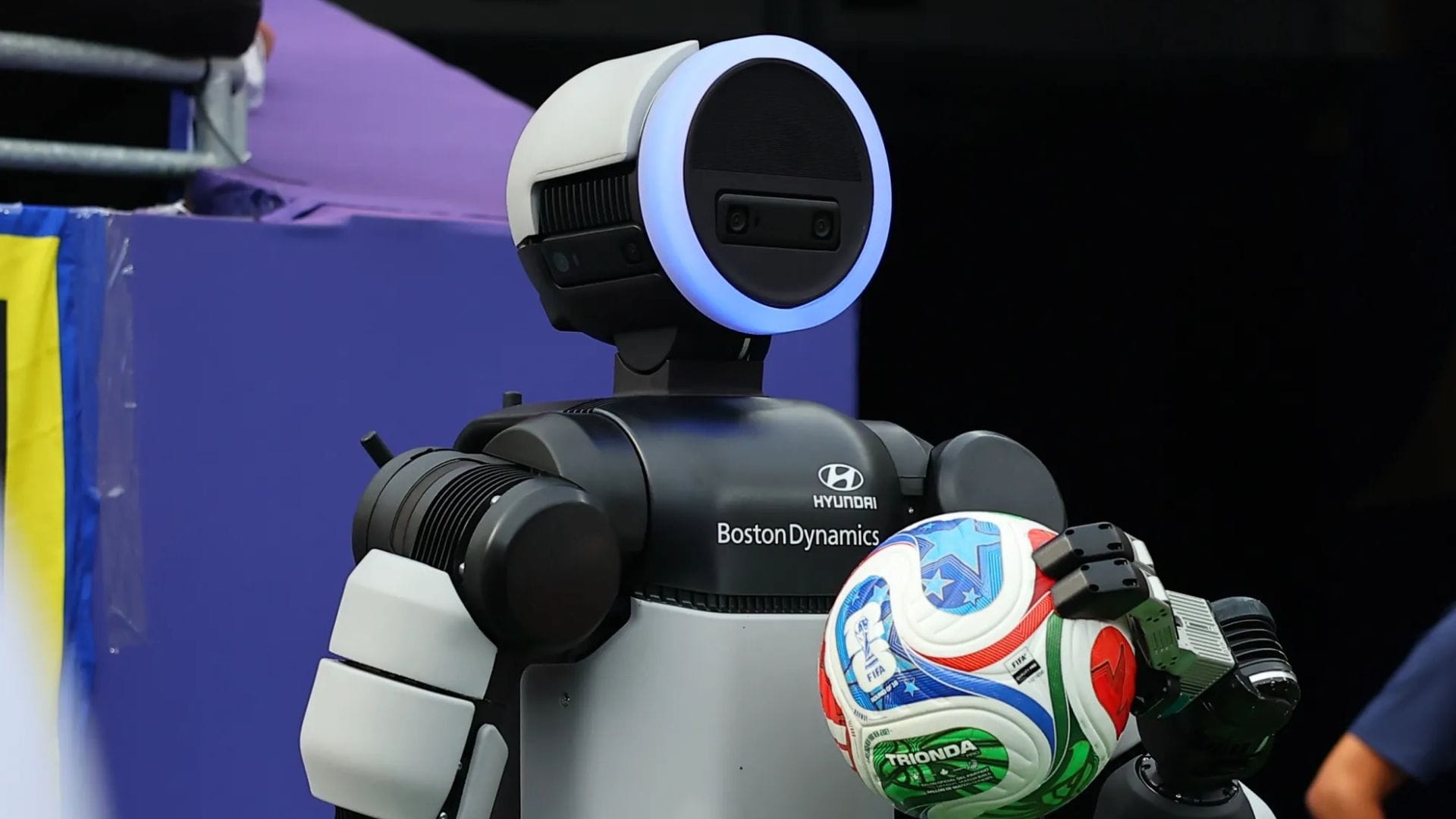
Atlas has also attracted attention outside the technology sector. More recently, the humanoid robot appeared at the FIFA World Cup, where it walked through the players’ tunnel before delivering the match ball to the referee. The appearance served as a high-profile demonstration of the robot’s ability to move confidently in public environments.
Although Atlas has become known for entertaining demonstrations, including videos of the robot performing complex movements and dancing, Hyundai’s longer-term objective is to use the platform in practical industrial settings where automation can improve efficiency and productivity.
Manufacturing roadmap targets large-scale production
Hyundai is continuing development of Atlas in partnership with NVIDIA and Google DeepMind, combining robotics engineering with advanced AI technologies. The collaboration is intended to improve the robot’s ability to perform increasingly sophisticated physical tasks in real-world environments.
The company plans to begin manufacturing Atlas robots at its Georgia facility in 2028. Over time, Hyundai hopes to scale production to as many as 30,000 humanoid robots annually, reflecting growing confidence that intelligent robots could become a significant part of future industrial operations.
During the early stages of deployment, Atlas is expected to perform relatively straightforward tasks, including logistics support and welding. These tasks provide opportunities to validate the robot’s reliability while reducing repetitive work in manufacturing environments.
Boston Dynamics expects the robot’s capabilities to expand considerably over the coming years. By 2030, Atlas is anticipated to undertake more advanced manufacturing processes, including complex component assembly, as improvements in artificial intelligence and robotics software enable greater precision, adaptability and autonomy.
If Hyundai completes its acquisition of SoftBank’s remaining stake, the company would be well positioned to align Boston Dynamics’ robotics expertise with its broader ambitions in AI-driven manufacturing. As industries increasingly adopt intelligent automation, full ownership could help Hyundai accelerate product development and strengthen its role in the emerging physical AI market.