


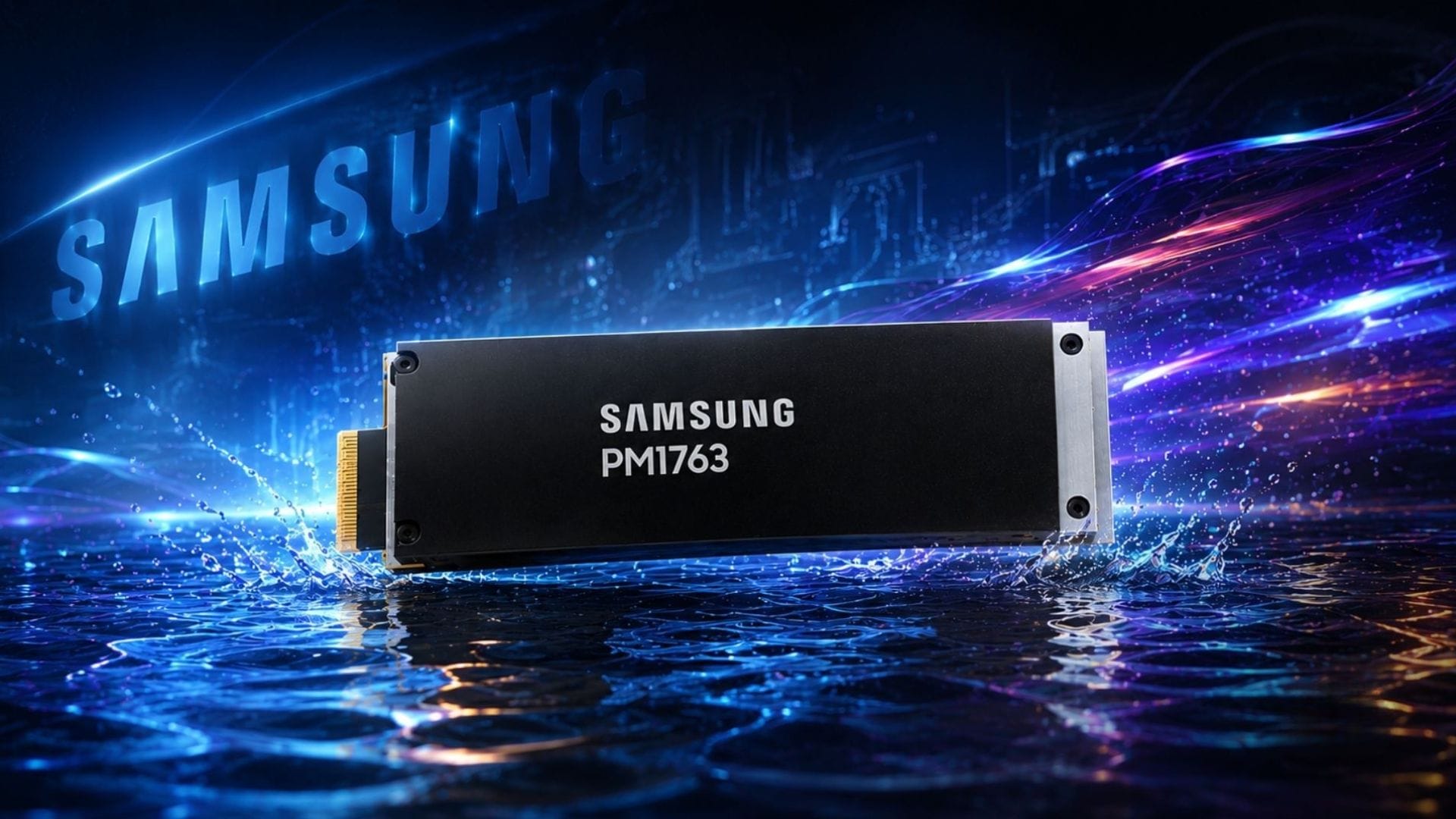
Samsung has started mass production of the PM1763, a new enterprise solid-state drive designed to meet the growing storage demands of artificial intelligence systems and data centres.
The PM1763 replaces the PM1753 as Samsung’s most advanced enterprise SSD and introduces support for PCIe 6.0. It delivers sequential read speeds of up to 28,400 MB/s and sequential write speeds of up to 21,900 MB/s.
While the drive offers a major performance increase over current consumer SSDs, it is intended for enterprise servers rather than desktop computers. Consumer hardware does not yet support PCIe 6.0, and the PM1763’s cost and design are expected to keep it outside the mainstream PC market.
PCIe 6.0 delivers major performance gains
Samsung has built the PM1763 using its ninth-generation V-NAND technology and a controller manufactured on a 4-nanometre process. The combination allows the drive to take advantage of the increased bandwidth available through PCIe 6.0.
The latest interface provides twice the bandwidth per lane compared with PCIe 5.0. This gives enterprise storage devices more capacity to handle large volumes of data, particularly in AI training, inference and other demanding computing workloads.
Samsung describes the PM1763 as offering “industry-leading performance”. Its claimed sequential read speed of 28,400 MB/s places it slightly ahead of Micron’s competing 9650 enterprise SSD, which reaches up to 28,000 MB/s.
The difference is more significant in sequential write performance. Samsung’s new drive reaches up to 21,900 MB/s, while the Micron 9650 is rated for up to 14,000 MB/s. Both products rely on PCIe 6.0 to achieve their highest advertised speeds.
Samsung also claims an advantage in random read performance, an important measurement for AI servers that need to process large numbers of data requests. The PM1763 delivers up to 6.92 million input/output operations per second, compared with up to 5.5 million for Micron’s model.
However, Micron has an early lead in availability. The Micron 9650 entered mass production in February 2026, giving the company more time to supply enterprise customers and expand availability during the year.
New security features target next-generation data centres
Performance is not the only improvement introduced with the PM1763. Samsung says the drive provides 1.8 times better power efficiency than the previous-generation PM1753.
Energy efficiency has become increasingly important as AI data centres add more processors, memory and storage systems. Lower power use can help operators reduce electricity costs and manage the heat generated by large-scale computing infrastructure.
The PM1763 also supports post-quantum cryptography algorithms. These security technologies are being developed to protect information against future quantum computers that may be capable of weakening some widely used encryption methods.
Samsung has also added support for the TEE Device Interface Security Protocol, known as TDISP. The technology is designed to improve communication security between devices in confidential computing environments and help protect sensitive workloads.
The SSD will initially be available with capacities of up to 16TB. Its enterprise-focused design means it is intended for specialised server systems rather than standard desktop computers, even if compatible consumer hardware becomes available in the future.
The arrival of PCIe 6.0 storage is closely linked to the development of new server platforms. Nvidia’s Vera platform and AMD’s next-generation EPYC processors, codenamed Venice, are expected to support PCIe 6.0 connectivity. Systems based on these technologies will be able to leverage the full performance of drives such as the PM1763.
Without PCIe 6.0 support, the SSD would not be able to operate at its maximum advertised speeds. The wider adoption of the interface across enterprise servers will therefore play an important role in demand for Samsung’s new storage technology.
Consumer PCs are unlikely to receive similar speeds soon
Samsung’s latest enterprise SSD offers almost twice the sequential read performance of its high-end consumer PCIe 5.0 drive. The Samsung 9100 Pro is advertised with read speeds of up to 14,800 MB/s and write speeds of up to 13,400 MB/s.
Despite the large performance gap, the technology used in the PM1763 is unlikely to appear in consumer computers soon. Current consumer processors and motherboards do not support PCIe 6.0, while data-centre operators are only beginning to adopt the interface.
The price of next-generation enterprise storage is also expected to remain out of reach for most PC users. AI companies and cloud providers are investing heavily in high-performance infrastructure, allowing them to pay significantly more for advanced storage than typical consumers.
Strong demand from the AI industry may also affect the supply of components used in consumer storage. Industry leaders have warned that demand for NAND flash and DRAM could continue to place pressure on supplies throughout 2026 as manufacturers prioritise large data-centre customers.
These conditions may limit how quickly high-end enterprise technology reaches consumer products. Storage manufacturers are likely to focus their most advanced components on customers operating AI systems and large-scale servers, where demand and spending remain strong.
For desktop users, the PM1763 is therefore more likely to serve as an early example of future storage performance than as a product they can purchase. Its interface, physical design and expected cost make it unsuitable for current consumer computers.
The introduction of the PM1763 marks the beginning of the PCIe 6.0 storage era, but its benefits will initially remain confined to data centres. Consumer SSDs may eventually receive similar improvements, although compatible hardware, wider availability and lower costs will be needed before such speeds become practical for home computers.