


Much of the current enterprise AI deployment debate still sits inside software. Copilots, chatbots and workflow agents pose real risks, but failures are usually contained within workflows, approvals, data access or employee processes. A poor recommendation may slow a team, while a poorly designed automation can trigger a review or expose process gaps.
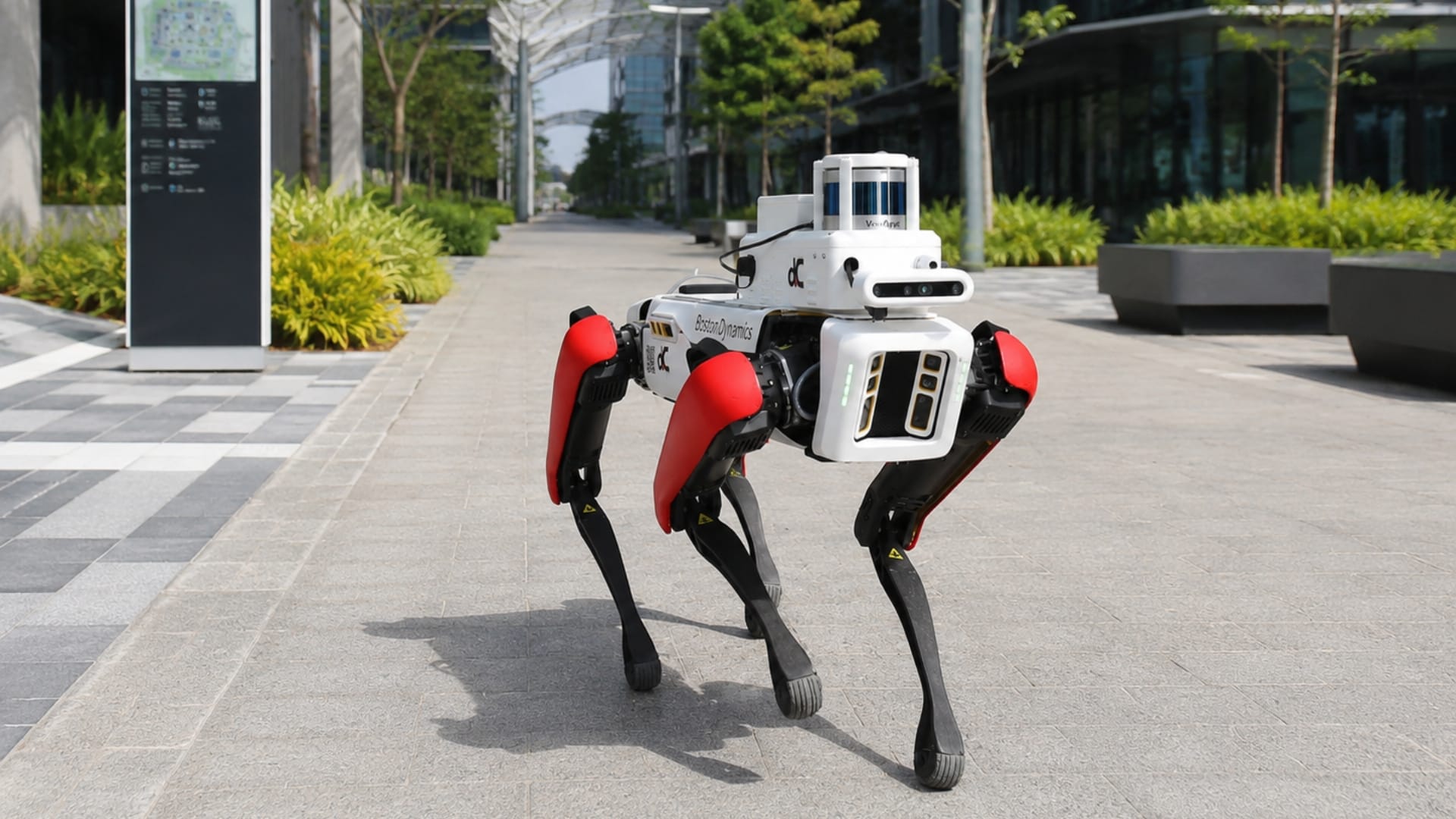
Physical AI changes the deployment problem because the system operates in shared space. A robot moving through a district has to read people, routes, doors, lifts, weather, obstacles and service rules. It may need to stop for pedestrians, reroute around congestion, access restricted areas, return to a charging point, escalate an incident or coordinate with a human operator.
Part of the interest in Physical AI comes from services that are difficult to scale through labour alone. Delivery, cleaning, facilities management, security and healthcare support all involve repetitive movement, routine monitoring and service coverage across physical spaces. Robots may help absorb some of that workload, but adoption will depend on whether they can improve reliability without creating new costs, safety risks or labour tensions.
That is why the Punggol Digital District (PDD) testbed, announced during ATxSummit 2026, expanded through new government-industry collaborations announced at ATxSummit 2026, should be viewed as more than another robotics trial. It places Singapore’s AI agenda in a physical operating environment, where urban governance, infrastructure readiness, and multi-operator coordination must be tested around people, buildings, and everyday services. The question is whether those conditions can turn public-space robotics into repeatable urban operations, rather than isolated pilots.
Physical AI brings AI into shared space
Physical AI must be assessed as a deployment system, not just as an AI model or robotics capability. A robot that completes a route in a controlled test has only answered part of the question, because wider deployment depends on how it functions within public paths, building access systems, human movement, service priorities, maintenance requirements and emergency procedures.
That makes Physical AI a useful test of national AI strategy. It brings together applied research, hardware, infrastructure, governance, data, workforce design, and public acceptance, which are often treated as separate priorities but must operate together when machines move through shared spaces. For Singapore, the significance lies in that convergence. The country is evaluating whether robots can perform defined tasks, and whether the surrounding rules and systems can make those tasks safe, repeatable and commercially useful.
Punggol Digital District makes the test operational
PDD gives Singapore a useful setting for that evaluation. The 50-hectare district is expected to support 28,000 jobs and 12,000 students, creating a mixed-use environment where robots can be assessed around office workers, students, service teams and visitors.
The project involves IMDA, JTC and the Singapore Institute of Technology, alongside companies such as Certis, DHL, Grab and QuikBot. The expected use cases include food and parcel delivery, cleaning, and security patrols, which make the trial relevant to practical, labour-intensive services rather than abstract research demonstrations.
PDD is evaluating the operating conditions around robots, too, not the robot itself. Public-space robotics depends on how different operators share paths, how machines access buildings, how safety requirements are enforced, how incidents are handled and how automated services fit into existing human teams.
The precinct-level exemption framework under the Active Mobility Act provides the trial with a regulated setting, but the more important work lies in operations. A controlled route can demonstrate that a robot can move from one point to another, while a live, mixed-use precinct assesses whether multiple robots can operate around people without causing confusion, congestion, or unclear accountability.
PDD is therefore better understood as a controlled stress test than a district showcase. The trial’s value will lie in whether it exposes the practical issues that determine wider deployment, including route reliability, service interruptions, incident response, worker adaptation, public acceptance and coordination across multiple operators.
Other markets are taking different routes
Singapore is not alone in trying to understand how Physical AI moves from controlled environments into everyday operations. Other markets are approaching the same problem through different strengths, which makes PDD useful as a local test of a wider global question.
China’s advantage lies in manufacturing scale and robotics supply chains, giving it a pathway built around hardware production, cost reduction and deployment volume. Japan’s route is shaped by labour shortages, ageing-related needs and service continuity, especially where automation can support healthcare, retail, logistics and facilities work. South Korea’s approach has leaned heavily on outdoor delivery, patrol applications, regulatory sandboxes and smart-city-style demonstrations, while Europe’s focus is grounded in safety, standards, human-robot collaboration and regulated industrial adoption.
Singapore’s route into Physical AI is more specific because it is unlikely to match China’s manufacturing volume or the deployment scale of larger economies. Its potential advantage lies instead in testing whether regulated urban environments, dense infrastructure and public-sector coordination can make public-space robotics practical beyond a purpose-built district.
That value will depend on whether PDD produces lessons that can travel. If the trial leads to workable rules for route priority, lift access, incident response, safety assurance, service integration and liability handling, it could become relevant to other districts, campuses, airports, hospitals and commercial developments. If those lessons only apply within a carefully designed precinct, PDD will remain a useful but limited testbed rather than a broader model for Physical AI deployment.
Coordination will decide whether robotics scales
Physical AI depends on more than robot capability. Better sensors, navigation models and hardware will help, but public-space robotics also needs infrastructure, connectivity, mapping, fleet management, incident response, maintenance, liability rules and human oversight.
Pilots become more difficult to scale when these layers are weak. Older lifts may not support API integration, while some buildings may require smart gantries, access-control upgrades or manual intervention. Robots need charging, storage and maintenance areas, and delivery or cleaning fleets need loading zones, clear route access and escalation procedures. Hospitals, airports, malls, campuses and older estates may also require retrofitting before robots can operate reliably.
PDD may not expose all this friction because it is a coordinated, purpose-built district. That does not weaken the evaluation either, but it should shape how the results are interpreted. A robot that works well in a planned district may still struggle in an older estate, a fragmented business park or a private building with legacy access systems.
Interoperability adds another layer of difficulty. Multi-operator deployment is challenging because fleets from different vendors may use different route-planning systems, sensors, mapping layers, fleet-management tools and data structures. A delivery robot, cleaning robot and security robot can each work well on their own, yet still create inefficiency when they compete for the same lift, corridor or loading point.
The testbed will therefore need to examine whether shared operating rules can be created for route priority, lift access, incident response and public safety without forcing vendors to expose proprietary data. Without those rules, public-space robotics can become fragmented even when individual machines perform as designed.
Commercial viability cannot be assumed
Even if coordination improves, the operating model still has to make economic sense beyond the trial environment. PDD is a public-sector-led initiative in which agencies help define the operating and regulatory conditions, making it different from purely market-led deployment.
The commercial test will come when these services have to operate under repeatable rules, clear liability structures and ordinary cost pressures beyond PDD’s controlled conditions. Robotics may reduce some repetitive movements, but it can also introduce new costs for supervision, maintenance, integration, training, downtime, insurance, incident handling and human exception management.
For enterprises considering similar deployments, the business case will depend on more than the purchase or lease cost of a robot. The organisation also has to account for procurement, vendor management, facilities integration, cybersecurity review, insurance coverage and service-level accountability. If supporting costs are underestimated, expected productivity gains can narrow quickly.
Public-space services such as food delivery, parcel delivery, cleaning and security already operate under tight cost and manpower constraints. Robots may improve consistency in some areas, but their economics will depend on utilisation, maintenance cycles, route density, intervention rates and whether human teams still need to remain close enough to handle exceptions.
The PDD trial can help clarify these economics, but it should not be treated as proof that the model is ready for wider adoption. Commercial viability will be determined when operators must sustain the service without the same level of precinct coordination, regulatory support, and infrastructure alignment.
Workers will shape public acceptance
The labour question should not be reduced to whether robots replace workers, because near-term deployments are more likely to reshape tasks than to fully replace workers.
Delivery, cleaning and security involve judgement, service recovery, customer interaction, safety checks, equipment handling and coordination with other teams. Robots may take on routine routes or repetitive patrols, but humans will still be needed for remote fleet monitoring, route supervision, robot maintenance, customer escalation, exception handling and coordination with existing service teams.
The critical labour question is who moves into these roles. If existing delivery, cleaning and security workers can be trained to manage, supervise and maintain robotic systems, Physical AI may support better job design. If new technical layers are created above them while frontline workers remain exposed to disruption, the benefits will be less evenly distributed.
Pay progression, training, responsibility and safety accountability will shape how workers experience the change. A cleaner tasked with managing a robot fleet needs a different skill set from someone assigned to manual cleaning routes. A security officer supervising autonomous patrols needs clear escalation rules and authority, while a delivery operator working with robots needs to know who handles failed handovers, damaged goods or blocked routes.
Public acceptance will partly depend on this labour design. Robots are more likely to be accepted if they visibly improve services and support workers. They will face more resistance if they appear to be adding machines to public spaces without sufficient consideration for the people affected.
Punggol Digital District is a proving ground rather than the endpoint
Taken together, the operational, commercial and labour questions point to the same conclusion: PDD should be treated as a proving ground rather than the destination. Its value lies in what it reveals about deployment friction, from operator coordination and liability handling to access systems, service economics and workforce adaptation.
The risk is that a purpose-built smart district can make adoption look easier than it will be elsewhere. A coordinated precinct can align agencies, infrastructure owners, technology partners and service operators more easily than an older town, a private commercial district or a hospital campus with legacy systems and multiple decision-makers. Some friction that would otherwise hinder broader adoption may already have been reduced by design.
That makes PDD useful but incomplete. The evaluation becomes more meaningful when lessons are applied to messier environments with older lifts, fragmented access systems, tighter service margins, crowded public paths, private landlords and less integrated infrastructure.
Singapore’s opportunity is to identify the rules, interfaces, responsibilities and cost structures that make public-space robotics practical beyond a controlled environment. And in this case, PDD can show whether Physical AI is ready to move from controlled pilots into settings where cities, industries, workers and citizens share the same space.