


Singapore has updated its National AI Strategy with 10 refreshed priorities, setting out how the country plans to move AI adoption beyond small-scale pilots and into deeper sector-wide use.
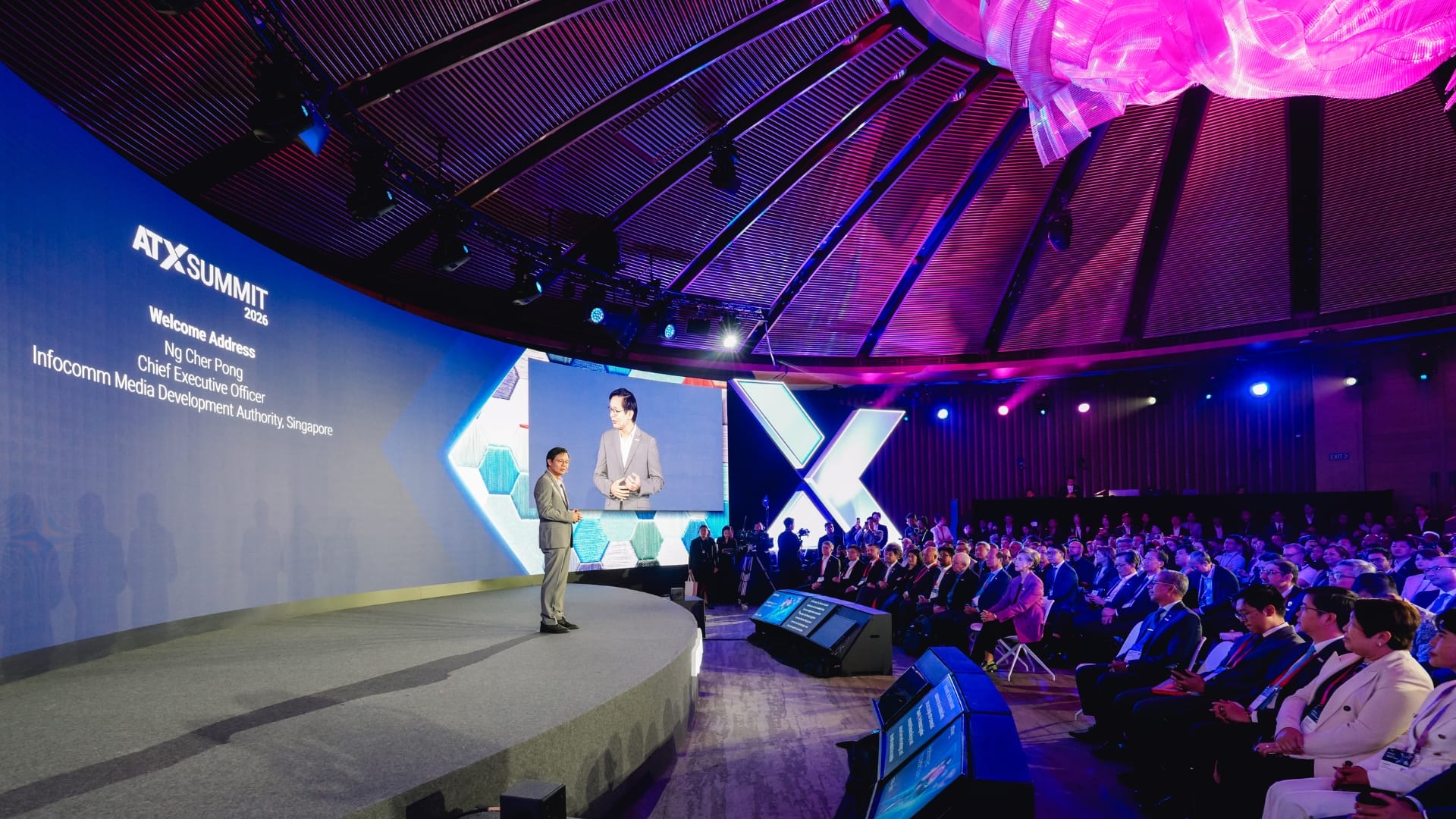
Minister for Digital Development and Information Mrs Josephine Teo announced the update during her opening keynote at ATxSummit 2026 on 20 May. The refresh builds on NAIS 2.0, which was launched by Prime Minister Lawrence Wong in December 2023, and keeps Singapore’s stated focus on harnessing AI for the Public Good.
The update comes after the establishment of the National AI Council in February 2026, chaired by Prime Minister Wong, to provide strategic direction for Singapore’s AI agenda. The refreshed priorities are organised around the existing NAIS enablers and support three broad areas: deepening sectoral and public sector transformation, mainstreaming AI adoption and workforce readiness, and building Singapore as an AI hub.
National AI Missions target four major sectors
A central part of the update is Singapore’s plan to pursue National AI Missions in Advanced Manufacturing, Financial Services, Connectivity, and Healthcare. These sectors collectively account for more than 40% of Singapore’s GDP and are seen as areas where data access, regulatory sandboxes, and other government enablers can support AI deployment.
The missions are intended to move AI adoption beyond narrower productivity projects. In her keynote, Mrs Teo said the refresh is a “double-click” rather than a system reboot, with the strategy intended to build on Singapore’s experience implementing NAIS 2.0.
The Government will also continue efforts to broaden AI adoption across enterprises. The National AI Impact Programme aims to help 10,000 SMEs use AI meaningfully, while the Champions of AI programme will provide targeted support for companies ready to pursue larger enterprise-wide impact.
Connectivity was highlighted through aviation and maritime examples. Singapore’s Changi Airport is preparing for the Terminal 5 expansion, which will double passenger handling capacity from 70 million passengers a year to 140 million. Mrs Teo pointed to AI-related opportunities in areas such as gate-to-gate passenger movement, baggage handling across terminals, and aircraft sequencing on runways.
Tuas Port was also cited as an example of a large-scale operational environment with rich datasets that can support new AI solutions. The port is described as the world’s largest automated container terminal and sits along one of the world’s busiest waterways.
AI adoption will need talent, compute, and data access
The updated priorities also cover the supporting systems needed for wider AI adoption. Singapore plans to build capabilities across AI research, nurture AI bilingual talent, and deepen AI literacy across the workforce.
The strategy places particular emphasis on AI bilingual talent, meaning people who combine domain expertise with AI capability. This is intended to help organisations apply AI more meaningfully within specific sectors and job functions, rather than treating AI expertise as a separate technical layer.
Compute access is another priority. Singapore plans to secure more compute while improving the efficiency of AI models and systems. The factsheet cites the second Data Centre Call-for-Application, the Strategic Digital Infrastructure Scheme, the National Supercomputing Centre Singapore’s ASPIRE 2B supercomputer, and research under the updated National AI R&D Plan as part of this effort.
Data governance also remains central to the strategy. The update states that the challenge is not simply making more datasets available, but enabling trusted access to the right datasets for specific use cases while preserving privacy, security, and legitimate commercial interests.
Punggol and NVIDIA lab support testbed ambitions
Singapore is also developing Punggol Digital District as a testbed for AI and robotics deployment. The district will include an integrated data platform, real-world test scenarios, and special testing permits for robot deployment.
The keynote also referenced NVIDIA’s new Research Lab in Singapore, which will focus on embodied AI and efficient AI. The lab will work with universities, industry partners, and government agencies, adding to NVIDIA’s existing presence in the country.
Mrs Teo said Singapore’s role as a testbed is tied to its network and track record in trusted technology adoption. In her remarks, she said: “What makes us compelling is the global network we are connected to and our track record for trusted technology adoption.”
Governance remains central to AI deployment
The refreshed strategy keeps trust and governance as key conditions for wider AI adoption. Singapore plans to strengthen layered AI governance, deepen sector-specific risk management, and build AI testing, assurance, and safety capabilities.
The Government is updating the Model Governance Framework for Agentic AI with case studies of real-world agentic deployments by companies including PwC and Workday. It has also released a case study on OpenClaw, highlighting best practices for users.
Singapore is also working with the global AI safety community. Mrs Teo said an eminent group including Professors Yoshua Bengio, Stuart Russell, Dawn Song, Zhang Ya-Qin, and Max Tegmark had updated the Singapore consensus on AI Safety Research Priorities.
The refreshed NAIS priorities point to a more deployment-led phase of Singapore’s AI strategy, where sector missions, workforce capability, governance, compute, and data access are treated as connected requirements for adoption.