


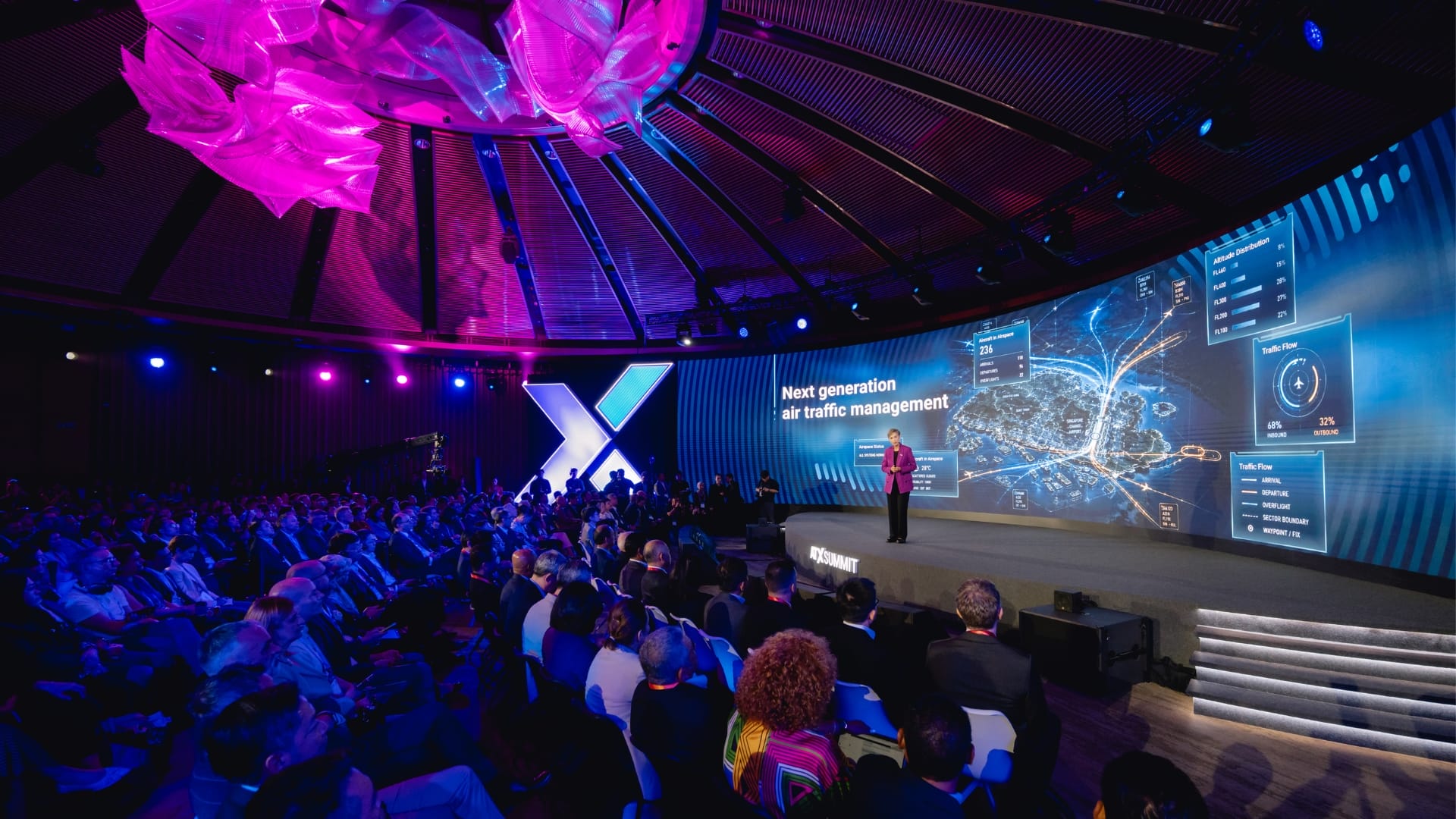
Singapore has announced a series of AI partnerships and testbeds aimed at moving AI systems from experimentation into real-world deployment across robotics, manufacturing, enterprise systems, public services and governance.
The announcements were made at ATxSummit 2026 by Minister for Digital Development and Information Mrs Josephine Teo, and include collaborations involving OpenAI, NVIDIA, Google, Temus, AI Singapore and several robotics companies. The initiatives point to a more deployment-led phase of Singapore’s AI strategy, where the focus is on applied systems, operational testing and governance frameworks that can support wider adoption.
They also build on Singapore’s stated aim to become a trusted hub for developing, testing and deploying AI solutions that address real-world problems at scale.
Punggol Digital District becomes a testbed for physical AI
The clearest example of that approach is a new physical AI testbed at Punggol Digital District, developed by the Infocomm Media Development Authority, JTC and the Singapore Institute of Technology.
The testbed, scheduled to launch later in 2026, will support the research, testing and deployment of physical AI in a mixed-use public area. Singapore describes it as its first testbed for multi-use-case and multi-operator deployments at scale, giving companies a shared environment to assess how robots and AI systems perform outside controlled settings.
Certis, DHL, Grab and QuikBot will be among the first companies to co-design, deploy, test and validate commercially viable robotics services in public spaces. The initial use cases include food and parcel delivery, cleaning and security patrolling, with robots expected to complement existing human operations rather than replace them outright.
The testbed is supported by a precinct-level exemption framework under the Active Mobility Act, facilitated in collaboration with the Land Transport Authority. That regulatory layer is significant because physical AI deployment depends on more than robot performance. It also requires rules for safety, movement, public interaction and shared use of urban infrastructure.
IMDA and the National Robotics Programme will also work with knowledge partners such as FieldAI and Thoughtworks, as well as companies including Slamtec, Unitree and QuikBot, to develop embodied AI use cases through SIT’s Centre for Intelligent Robotics at Punggol Digital District.
The site will be used to refine robots and AI systems across safety, use cases, regulatory challenges and infrastructure development. This gives Singapore a physical environment to test embodied AI under operational conditions, rather than limiting development to labs or isolated pilots.
Research and industry partnerships target applied AI
Singapore is also expanding the research and platform partnerships that sit behind applied AI deployment.
NVIDIA is launching an AI research lab in Singapore focused on embodied AI and efficient AI, working with university researchers, industry partners and government agencies. The lab will serve as NVIDIA’s Singapore hub and its second research presence in Asia Pacific.
The lab will focus on two areas with potential applications in manufacturing. Embodied AI enables intelligent systems to perceive, reason and act in the physical world, while efficient AI computing focuses on optimising models and infrastructure to reduce compute costs, improve energy efficiency and support scalable deployment.
The Ministry of Digital Development and Information (MDDI) and Google have also announced a National AI Partnership, expanding Google’s collaboration with the Singapore Government. The partnership will look at using AI to address societal challenges, developing an AI-ready workforce and supporting a secure and trusted AI ecosystem.
MDDI and OpenAI separately signed a Memorandum of Understanding for the OpenAI for Singapore initiative. The collaboration covers three areas, advancing applied AI innovation, building AI talent and making AI accessible to citizens, enterprises and the public sector. OpenAI is committing more than S$300 million to strengthen Singapore’s AI ecosystem.
Temus will launch an AI Foundry to help enterprises deploy AI solutions at scale and develop talent pipelines. Supported by Digital Industry Singapore, the Foundry will hire 50 professionals across roles such as AI architects, data scientists, AI and machine learning engineers, product owners, full-stack engineers, DevOps engineers and UX engineers.
These professionals will be deployed on live enterprise projects in sectors including financial services and precision health. Temus will also sign a Memorandum of Understanding with AI Singapore to explore joint prototypes, reusable delivery frameworks and enterprise deployments that bring nationally developed AI capabilities into operating environments.
A*STAR Institute for Infocomm Research is also updating MERaLiON, its Multimodal Empathetic Reasoning and Learning in One Network AI model. The updated MERaLiON AudioLLM v3 will deliver paralinguistic intelligence across Southeast Asian languages, including speech and non-speech understanding.
The model will be available through cloud hosting, API access and edge computing environments, including devices with Apple silicon such as Mac and iPad. The intended use cases include healthcare, field operations and emergency response, where tone, intent and context can influence decision-making.
Governance work follows AI agents into real-world use
Singapore is pairing these deployment efforts with updates to AI governance and assurance tools, particularly as organisations begin to test more autonomous AI systems.
The Model AI Governance Framework for Agentic AI, first launched at the World Economic Forum in January 2026, has been updated with real-world case studies and new best practices. The update drew feedback and contributions from more than 50 organisations, including AWS, DBS, Google and Salesforce.
It also includes more than 10 new case studies from contributors such as Ant International, CDL, CyberSierra, Dayos, GovTech Singapore, Google, Knovel, OCBC, PwC, Stability Protocol, Tencent, Terminal 3 and Workday. The case studies are intended to show how the framework’s recommendations can be applied to agentic AI deployments across different sectors and operating contexts.
Google has also worked with the Cyber Security Agency of Singapore, GovTech Singapore and IMDA on a whitepaper about AI agents. The work follows a joint AI Agents Sandbox launched in August 2025, where the partners tested how computer-use agents behave in practice and turned those findings into a shared whitepaper.
The whitepaper provides a roadmap for governments looking to use AI agents for public good, based on findings from the sandbox. Together with the updated governance framework, it gives Singapore a policy and assurance layer to accompany the technical and enterprise deployments announced at ATxSummit.
Mrs Teo also attended an ASEAN-US AI Ministerial Roundtable on the sidelines of ATxSummit. The discussion brought together Digital Ministers from ASEAN Member States, the ASEAN Secretariat, the US government and industry leaders from Amazon and Google. Topics included inclusive AI adoption, support for small businesses, capacity building, skills development, technology partnerships and regional assurance mechanisms for AI.