

Singapore’s AI ambitions are moving into a more operational phase, where the harder task is applying advanced systems across public services, research, classrooms and enterprise workflows without losing control over safety and trust.
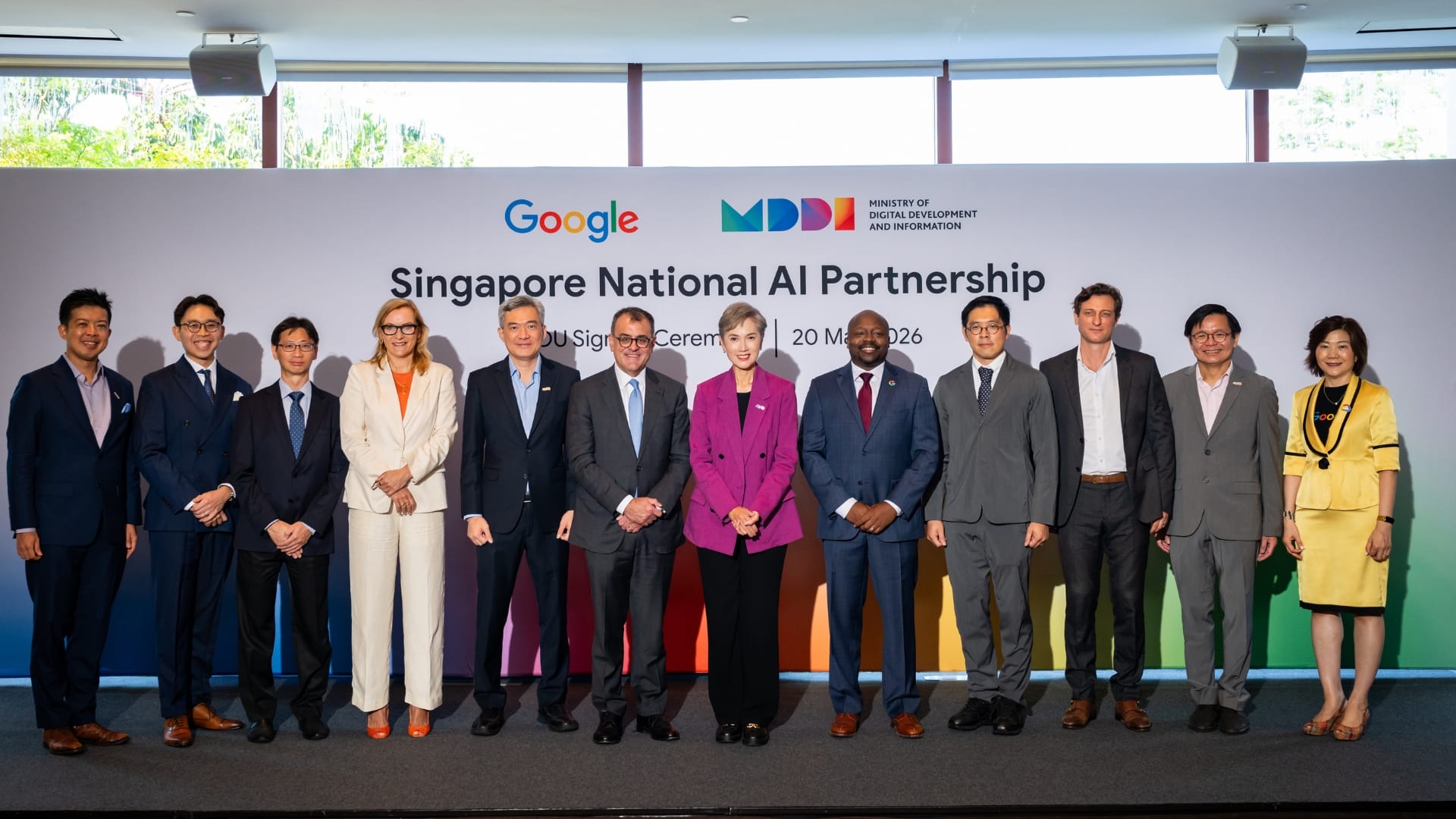
Google and the Ministry of Digital Development and Information have expanded their collaboration with the Singapore Government through a new National AI Partnership. The MOU is led by MDDI and builds on a 2022 agreement with the Smart Nation and Digital Government Group, which the release describes as Singapore’s first public-private AI partnership to enhance AI innovation.
The new partnership will cover health and life sciences, education, workforce training, enterprise adoption and AI governance. It is also intended to support Singapore’s National AI Strategy by deploying AI at scale for economic growth and public good.
Healthcare and science lead the deployment agenda
The most substantive parts of the partnership sit in healthcare and research, where Google DeepMind’s work in Singapore will be linked to public agencies and local researchers.
Google DeepMind is exploring a collaboration with public health clusters as part of its global AI co-clinician research initiative. The effort examines how AI could support doctors with information drawn from clinical guidelines and scientific literature, while keeping clinical authority with physicians. The release describes this model as “triadic care”, where AI agents support patients through their care journeys under medical supervision.
The research track extends beyond clinical support. Google DeepMind is partnering with the National Research Foundation to train local researchers on agentic AI tools for science, including Co-Scientist, which the release says has shown promise across biomedical applications. Workshops will also be held to help the local scientific community use these tools.
Google and the Agency for Science, Technology and Research will collaborate on translating lab discoveries into higher-value work across materials and life sciences. A*STAR plans to equip researchers and staff with secure, AI-enabled tools on Google Cloud, including hypothesis generation capabilities, so they can analyse scientific datasets within a governed environment while safeguarding intellectual property.
The partnership also includes an accessibility project. Google DeepMind is developing a Gemma-powered running assistant for blind and low vision athletes, using spatial reasoning to provide real-time environmental understanding. SG Enable will work with Google DeepMind to test and refine the tool for vision-impaired runners.
Schools and enterprises get wider AI support
Education is another major channel for the partnership. Google has enabled advanced AI features within Google Workspace for Education for educators from primary schools to junior colleges, covering tasks such as lesson planning and tailoring course material.
The Ministry of Education and Google are expanding their work to strengthen MOE’s AI capabilities across teaching and learning, including educator training and upskilling programmes. The effort forms part of MOE’s evaluation of how enterprise solutions can be applied and scaled to support education outcomes.
Google will also continue programmes under its Majulah AI initiative. These include Skills Ignition SG with the Infocomm Media Development Authority for jobseekers, Google for Startups Accelerator: AI First and AI Cloud Takeoff for startups, entrepreneurs and developers, and Gemini Academy for Singaporeans, including seniors.
Skills Ignition SG has trained 28,000 Singaporeans to date. Its AI Challenge has onboarded 600 trainees and 27 organisations to integrate AI into daily workflows.
For enterprises, Google Cloud’s expanded team of Forward Deployed Engineers will work with Singapore-based companies on agentic enterprise transformation, following the launch of its Singapore Engineering Center. The partnership also builds on Google Cloud’s work with AI Singapore, the Centre for Strategic Infocomm Technologies, GovTech Singapore, the Home Team Science and Technology Agency, and the National University of Singapore.
Agentic AI puts governance under pressure
The governance component is central to how far these deployments can go. As AI agents move from experimentation into task execution, Singapore is testing “computer use” agents in real-world settings to understand their behaviour, value and risks.
A joint whitepaper by Google, the Cyber Security Agency of Singapore, GovTech Singapore and IMDA discusses findings and recommendations from their AI Agents Sandbox. The recommendations cover practices for agents performing tasks such as software testing and social assistance applications.
Google DeepMind is also working with IMDA and MLCommons on multimodal and multilingual safety benchmarks. The collaboration will examine how AI systems can account for local languages and cultures as they are deployed in more varied settings.
“This partnership builds on years of close collaboration with Google, and we are pleased to take it to the next level. Bringing frontier AI into our public services and enterprises is central to Singapore’s AI ambitions. This partnership, spanning across multiple agencies, allows us to deploy it at scale,” said Mr Chng Kai Fong, Permanent Secretary (Digital Development and Information).
“As Singapore advances its National AI Strategy the focus now shifts to deploying frontier AI to accelerate real-world impact for the country. Through this expanded partnership with the Singapore Government, we are putting AI into action by combining the best of our technology, R&D expertise, and local talent to accelerate AI for the public good. This also creates a scalable blueprint for responsible AI innovation, built in Singapore for the world,” added Mr Ben King, Country Managing Director, Google Singapore.