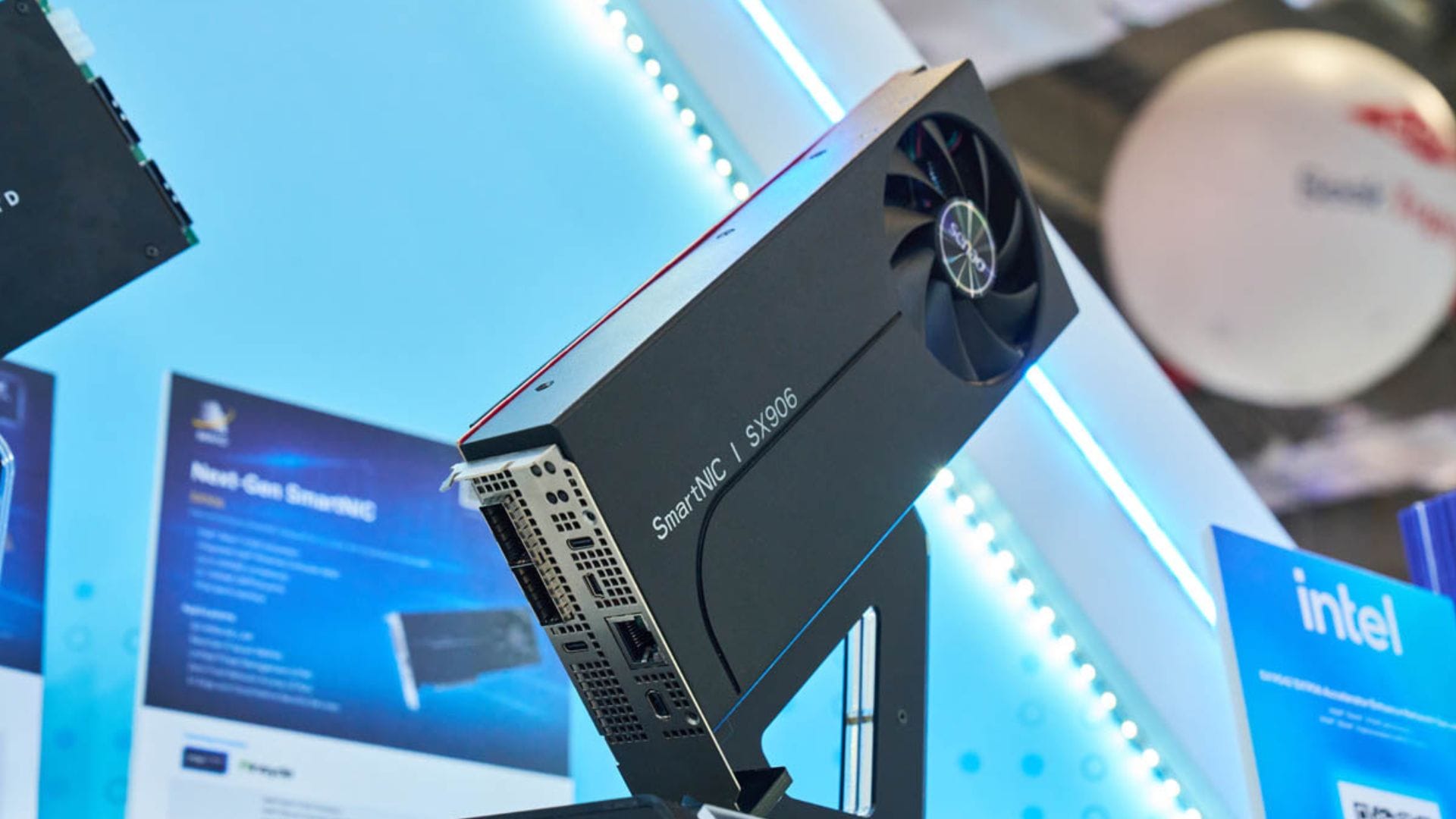
A new PCIe card unveiled at Computex 2026 is blurring the line between a network adapter and a standalone server. The Senao SmartNIC SX906 combines Intel Xeon processing power, high-speed networking, storage, memory, and management features into a dual-slot PCIe card designed for demanding enterprise workloads.
Unlike traditional network interface cards, the SX906 integrates a complete server platform within a form factor that fits into a PCIe expansion slot. Built around Intel’s Xeon 6 system-on-chip processor based on the Granite Rapids-D architecture, the card delivers up to 200Gbps of networking throughput while housing components typically found in a dedicated server.
The device measures 266 x 98.4 x 40.6mm, weighs approximately 1kg, and receives power through both a PCIe edge connector and a 16-pin 12VHPWR power connector. The latter is commonly associated with high-performance graphics cards and reflects the significant power requirements of the hardware packed onto the board.
Three Xeon configurations target different workloads
Senao is offering the SX906 in three processor configurations. The entry-level model uses Intel’s Xeon 6523P-B processor, featuring 24 cores operating at 2.5GHz with a power rating of 295W. A mid-range version incorporates the Xeon 6553P-B, increasing the core count to 36 and operating at 2.6GHz while drawing 355W.
At the top of the range is the Xeon 6563P-B model, which provides 38 cores running at 2.4GHz and also carries a 355W power envelope. These configurations are designed to address varying requirements for networking, security, and edge computing deployments.
All versions of the card support up to 64GB of four-channel DDR5-4600 ECC memory. Storage options include two M.2 2280 NVMe SSD slots and up to 128GB of onboard eMMC storage. The higher-end 36-core and 38-core models also feature a dedicated media transcode accelerator, expanding their capabilities beyond standard networking tasks and making them more suitable for media processing and specialised edge workloads.
Networking performance varies between models. The 24-core version supports up to 100GbE throughput, while the 36-core and 38-core variants unlock the full 200GbE capability through dual 100G QSFP28 ports. This level of bandwidth positions the card for demanding enterprise applications that require high-speed data processing and network traffic management.
Enterprise features extend beyond networking
The SX906 includes a range of enterprise-grade management and security technologies typically found in rack-mounted servers. An ASPEED AST2600 baseboard management controller provides out-of-band management capabilities through OpenBMC, enabling administrators to monitor and manage the device independently of the host system.
Security features are reinforced by the inclusion of an AST1060 controller that supports Intel Platform Firmware Resilience. This technology is designed to help protect firmware against corruption and malicious tampering, adding an extra layer of security for critical infrastructure deployments.
The card’s connectivity options further distinguish it from conventional SmartNIC products. In addition to the dual high-speed networking ports, the SX906 includes a Mini DisplayPort output, a dedicated RJ45 1GbE management port, and a USB 3.0 Type-C connector. The Type-C port can power external devices, allowing users to charge a smartphone while the card continues to handle workloads.
Additional expansion is available through a second Type-C console port and two PCIe Gen5 x8 MCIO connectors. Together, these connectors expose 24 PCIe Gen5 lanes, enabling engineers and system builders to integrate additional hardware and extend the platform’s functionality.
The SX906 supports Ubuntu 22.04 and 24.04 natively and includes TPM 2.0 and Secure Boot. These features complete a security and management package that rivals many standalone enterprise servers.
While the commercial market for such a product remains uncertain, the card appears well-suited to AI edge deployments, network security applications, and other specialised environments that require significant computing power within a compact footprint. By combining server-class processing, storage, networking, and management technologies on a single PCIe card, Senao has introduced a product that challenges traditional definitions of both servers and network adapters.