


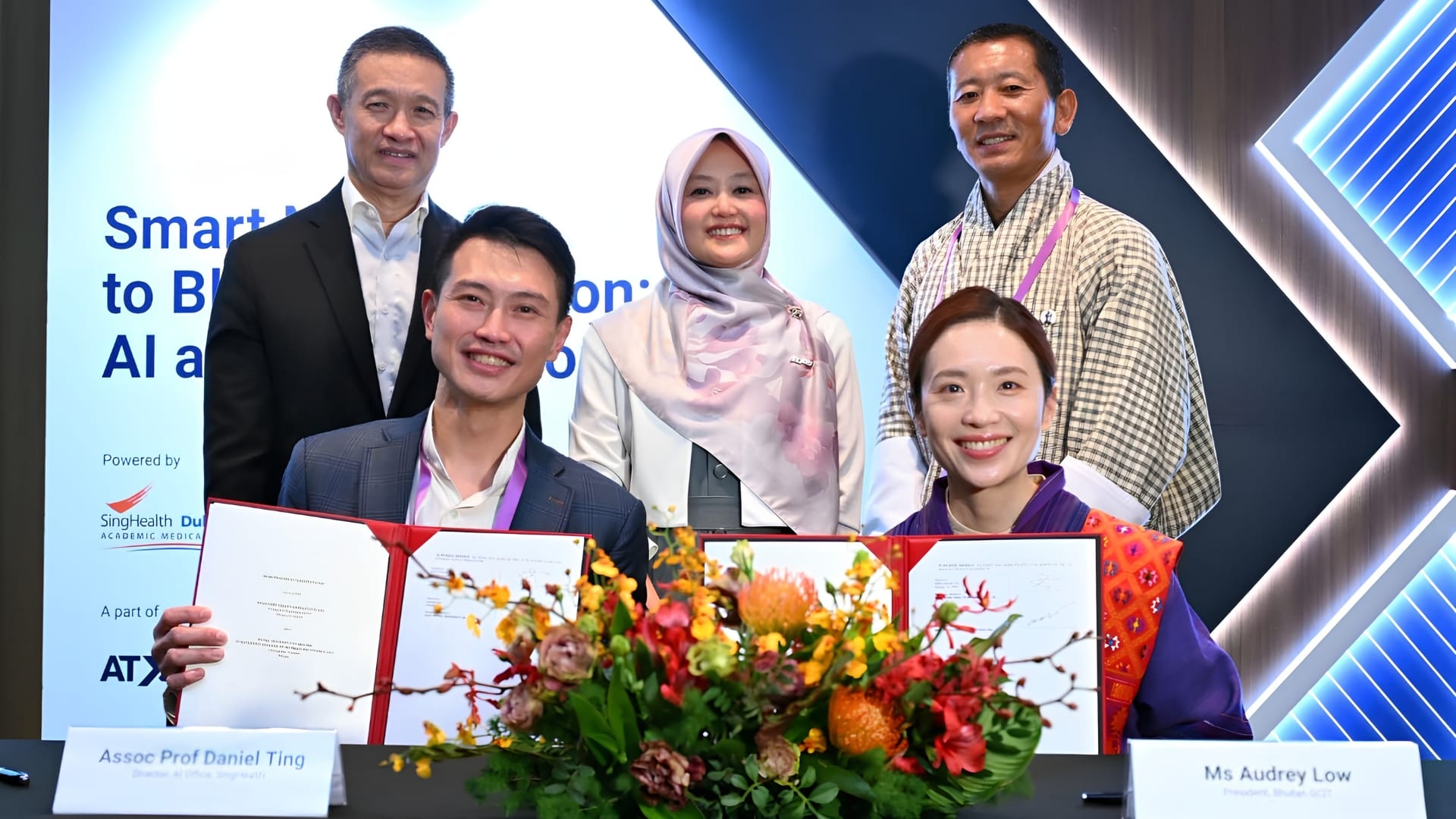
Healthcare AI projects face two practical tests before they can move beyond research settings: whether they can work within local clinical environments, and whether hospital-developed tools can be prepared for adoption at scale.
SingHealth’s two MOUs at ATx 2026 address both areas. One agreement focuses on adapting an AI-assisted chest radiograph model for Bhutan’s healthcare system. The other brings Singapore General Hospital and the Diagnostics Development Hub together to move AI-enabled and multimodal diagnostics closer to clinical and commercial use.
AI model to support rural diagnosis in Bhutan
SingHealth has signed a two-year MOU with Gyalpozhing College of Information Technology, Royal University of Bhutan, to develop healthcare AI initiatives centred on responsible use.
The main project under the agreement is an AI-assisted Chest Radiograph model trained on Bhutanese data. It is designed to support the diagnosis of lung diseases, including infections and cancer, in a healthcare setting where rural hospitals face geographical barriers and shortages of radiological expertise.
The model will be developed by GCIT and Bhutan’s Digital Health and Innovation Unit, with clinical expertise from SingHealth. It is expected to roll out in 2027 across Bhutan’s GMC Healthcare Hospitals.
The model draws on MerMED-FM, a multimodal, multi-specialty medical imaging foundation model developed by SingHealth Duke-NUS Academic Medicine Centre and A*STAR Institute of High Performance Computing. MerMED-FM has been published in The Lancet Digital Health and has demonstrated performance in detecting pneumonia, tuberculosis, hepatic masses, and colorectal cancer.
While Bhutan’s first use case focuses on chest radiographs, the broader value of the work lies in adapting medical imaging AI to a specific healthcare environment rather than treating one model as universally deployable. The source states that the collaboration will also provide SingHealth with insights into Bhutan’s healthcare environment and a more diverse dataset covering Asian and Himalayan populations.
Responsible AI work extends beyond the model
The SingHealth and GCIT agreement also covers publications, guidelines, and educational programmes on AI ethics and responsible healthcare AI use.
Both institutions will work on AI applications that are safe, effective, ethically sound, and adapted to Bhutan’s regulatory frameworks and healthcare environment. That makes governance part of the collaboration rather than a separate consideration after deployment.
The partnership is also linked to the strengthening of GCIT’s Research Centre of Excellence in global healthcare innovation.
SGH and DxD Hub target market-ready diagnostics
The second MOU connects Singapore General Hospital with the Diagnostics Development Hub, a national platform hosted by A*STAR, to accelerate the translation of AI-enabled and multimodal precision diagnostics into clinically relevant, scalable, and investable assets.
The agreement focuses on diagnostics that can be adopted in SGH and Singapore’s public sector healthcare systems. It also aims to create licensable diagnostic technologies that can support spin-offs or licensing to local and foreign MedTech companies.
One identified spin-off is the In-vitro Antibiotic Combination Test, or iACT. Developed in-house, iACT is an algorithm-based antibiotics combination testing tool designed to expand treatment options for complex patients, including oncology and transplant patients, facing antimicrobial-resistant infections worldwide.
Under the arrangement, SGH will serve as the clinical champion and first adopter. It will provide clinical expertise, samples, and validation support. DxD Hub will support product development and commercialisation, including workflow optimisation, standardisation, assay plate formulation and manufacturing, automation, software co-development for high-throughput deployment, and venture-building support.
Pipeline includes memory screening and diabetic kidney disease tools
SGH and DxD Hub have also identified other projects under the MOU.
These include the productisation of PENSIEVE-AI, a digital drawing application developed by SGH and GovTech to identify early memory problems in seniors. Another project covers the clinical integration and implementation of HealthVector from Mesh Bio, described in the source as the world’s first foundational digital twin model of human biology for detecting and managing diabetic kidney disease, approved by HSA as a medical device.
Taken together, the two MOUs place SingHealth’s healthcare AI work across two execution tracks: localised deployment in a different healthcare system, and commercial development for diagnostics that begin inside Singapore’s clinical environment.