

Enterprise AI deployment is becoming less about access to models and more about where those models run, how they reach internal data, and whether companies can govern them inside existing infrastructure.
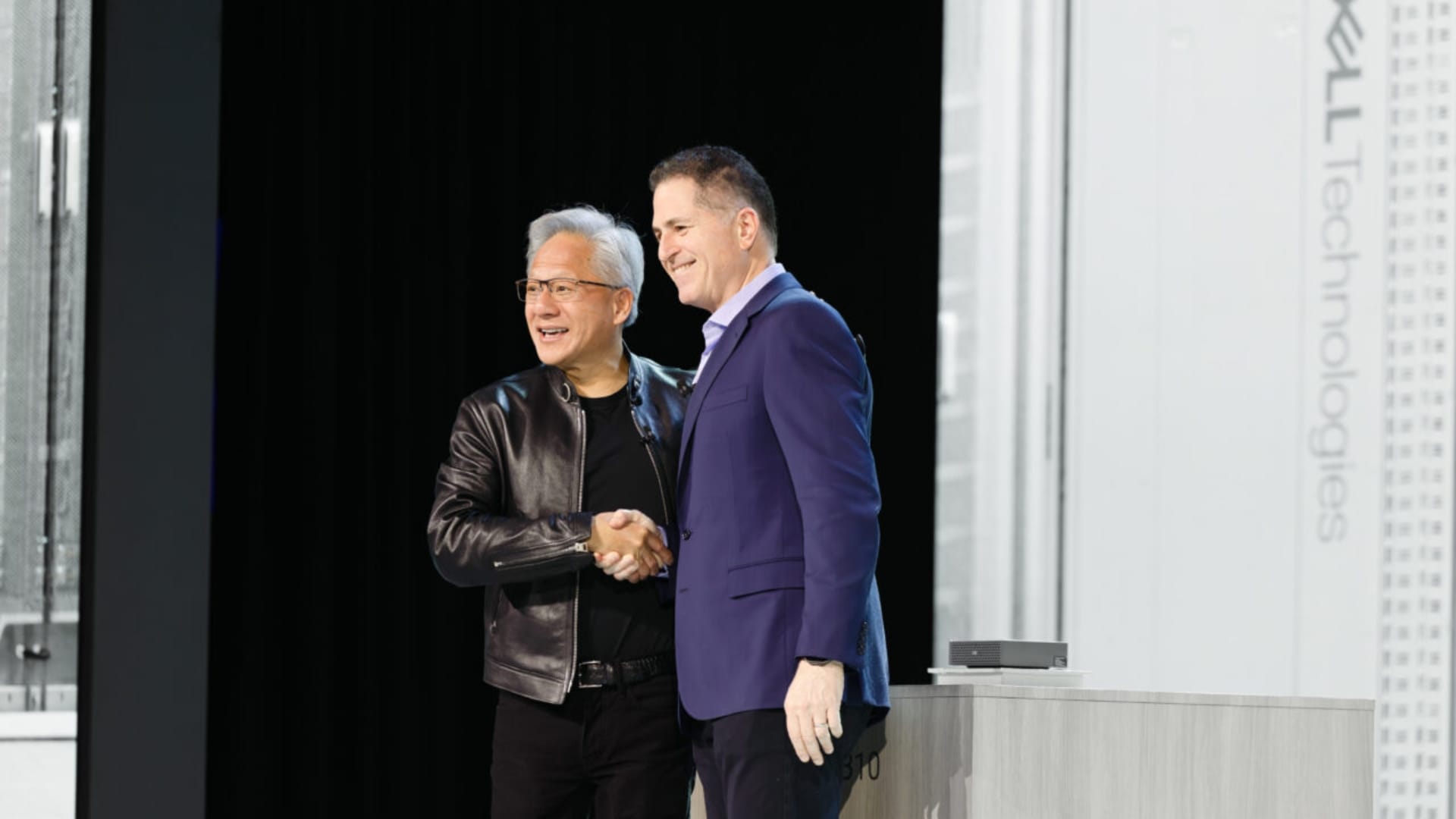
Dell and NVIDIA are addressing that operational gap with updates to the Dell AI Factory with NVIDIA, extending the platform across servers, racks, data engines, workstations, confidential computing and enterprise software integrations. The announcement centres on agentic AI workloads, where autonomous agents need to query data, run code, use tools and operate within corporate security controls.
The companies are also making a clearer case for on-premises AI. Dell cited survey findings that 67% of AI workloads now run outside the cloud, across on-premises systems, devices, the edge or colocation, while 88% of respondents are running at least one AI workload on premises.
Infrastructure moves closer to agentic workloads
The core hardware update is the Dell PowerEdge XE9812, built on NVIDIA Vera Rubin NVL72. NVIDIA said the system delivers up to 10x lower cost per token than NVIDIA Blackwell for massive-scale agentic AI inference.
Dell is also adding PowerEdge XE9880L, XE9885L and XE9882L servers, described as the first Dell systems built on NVIDIA HGX Rubin NVL8. These support up to 144 GPUs per rack, direct liquid-cooled compute nodes and up to 5.5x the performance of HGX B200.
The rack-level update extends beyond compute. Dell PowerRack brings compute, networking and storage into an integrated system, with thermal design, power management and software optimisation designed to work together. Dell is also adding PowerSwitch systems with NVIDIA Quantum-X800 InfiniBand, co-packaged optics and NVIDIA Spectrum-6 Ethernet.
For enterprises, the practical challenge is the full stack around agents, not GPUs alone. Agentic workloads often depend on serial steps, from retrieving data to executing code and calling tools. Dell PowerEdge M9822 and R9822 servers bring NVIDIA Vera CPUs into that environment, with NVIDIA claiming 50% faster agentic workloads than x86 processors and 1.2 TB/s memory bandwidth.
Starburst, a new data engine in the Dell AI Data Platform with NVIDIA, delivers 3x faster query throughput on NVIDIA Vera CPU for large-scale SQL analytics. Dell’s AI Data Platform update also adds accelerated data engines built on NVIDIA CUDA-X libraries, including cuDF for structured data and cuVS for unstructured data.
Frontier models move behind enterprise controls
The announcement also addresses a central barrier for enterprises that want advanced models but need to keep sensitive data and systems within controlled environments.
Google Distributed Cloud with Gemini 3.0 is now available in preview on Dell PowerEdge XE9780 servers, accelerated by NVIDIA Blackwell and secured by NVIDIA Confidential Computing. SpaceXAI will also bring its latest models on premises to the Dell AI Factory, with NVIDIA Confidential Computing used to protect model weights and enterprise data.
The open model layer is also being expanded. NVIDIA Nemotron models run on Dell AI Factory infrastructure for enterprises that want open weight models tuned to their own domains and data. Reflection’s open source frontier AI models are also coming on premises, with a stated focus on regulated industries, governments and sovereign entities.
Additional models, including MiniMax-M2.7, DeepSeek Pro, DeepSeek-V4, GLM 5.1 and Kimi K2.6 with NVIDIA NVFP4 optimisation, are available on the Dell Enterprise Hub on Hugging Face. They join Gemma 4, NVIDIA Nemotron Super 3, Mistral Small 4 and Arcee Trinity-Large-Thinking.
Agent development extends from deskside to data centre
Dell is also bringing agentic AI development closer to enterprise teams through deskside systems. Dell Deskside Agentic AI runs on Dell Pro Max systems with GB10 and GB300, powered by the NVIDIA Grace Blackwell architecture. It also supports Dell Pro Precision systems using NVIDIA RTX PRO Blackwell workstation platforms.
These systems use the NVIDIA NemoClaw stack, NVIDIA OpenShell runtime and NVIDIA Nemotron open models. NVIDIA OpenShell, an open source runtime for the development and deployment of autonomous agents with security and privacy controls, is now supported across the Dell AI Factory with NVIDIA.
That gives developers a common layer to build, deploy and govern agents across workstations and servers. Dell also highlighted support for the NVIDIA AI-Q Blueprint, which provides a reference example for deploying multi-agent workflows for deep research.
Software partners fill out enterprise use cases
Dell is adding software integrations for use cases that include agentic AI, code assistants, computer vision, workflow automation and security.
Palantir’s sovereign AI OS reference architecture with NVIDIA now runs on Dell infrastructure, supporting on-premises deployment of Palantir Ontology and AIP with the NVIDIA Sovereign AI OS Reference Architecture. ServiceNow customers will be able to use the Dell AI Factory with enterprise workflow automation to discover, govern and operationalise AI.
OpenAI Codex will connect with the Dell AI Data Platform, bringing it closer to codebases, documentation, business systems, operational knowledge and team workflows. Dell and OpenAI will also explore how Codex can connect with the Dell AI Factory.
Other named partners include Fogsphere, Ipsotek, Mistral AI, Poolside, Uneeq, CrowdStrike and Fortanix.
Dell said 5,000 enterprises, including Lilly, Samsung and Honeywell, are running AI workloads on Dell AI Factories with NVIDIA. The examples span life sciences, chip design and manufacturing, industrial AI, digital twins, automation and AI-driven research.