


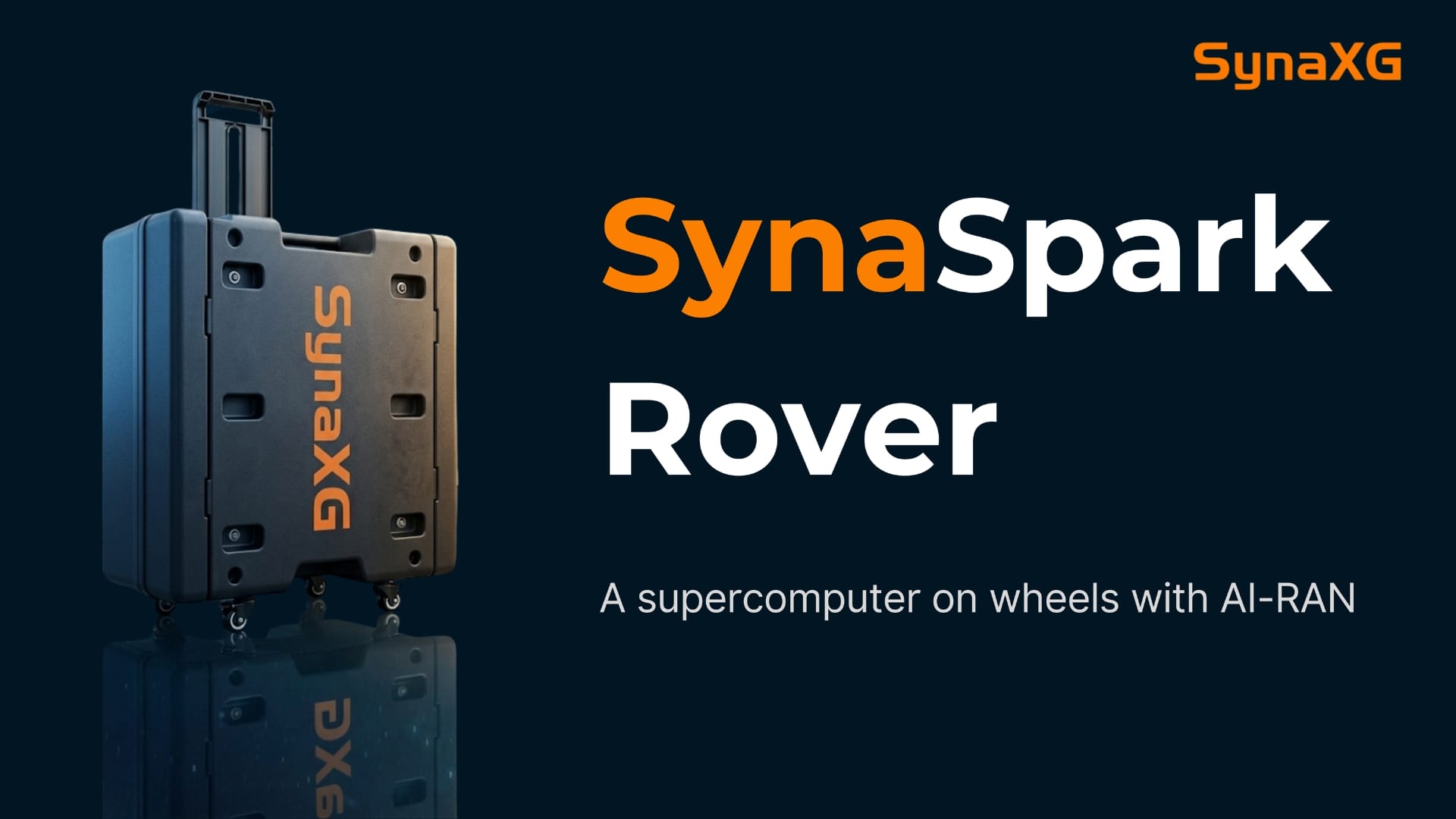
SynaXG has launched SynaSpark Rover, a portable AI-RAN and distributed AI compute platform designed to deploy private AI-native 5G networks and edge AI processing within minutes.
Powered by NVIDIA DGX Spark and the NVIDIA AI Aerial platform, SynaSpark Rover combines SynaXG’s AI-RAN with GPU-accelerated AI compute in a network-in-a-box architecture. The ruggedised platform is aimed at enterprises, operators, and industrial customers that need carrier-grade 5G connectivity and AI processing closer to where operations take place.
The platform is built for environments that require low latency, high throughput, and localised AI processing. Target use cases include smart factories, ports, logistics hubs, events, critical operations, warehouses, utility sites, ships, first responder operations, stadiums, trade shows, conferences, and concerts.
A portable deployment stack for private 5G
SynaSpark Rover integrates 5G Core, fronthaul, high-performance radios, and power supply into a single deployable system. The platform supports both Sub-6GHz and millimetre wave spectrum bands, giving customers a portable way to deploy private 5G infrastructure where fixed network deployments may be too slow or complex.
Each NVIDIA DGX Spark system supports up to three sectors, 1,000 active users, and 3,000 connected users. The system is also designed to support 5G camera deployments, Vision AI processing, and deterministic low-latency connectivity for Physical AI applications such as robots, drones, and autonomous systems.
For heavier AI workloads, SynaSpark Rover can support up to four DGX Spark systems in a single deployment. That configuration delivers up to 4 PFLOPS of AI compute performance for model training, fine-tuning, inference, Vision AI, digital twins, and edge AI applications.
Edge AI is the main deployment case
SynaXG is positioning the platform around the Physical AI era, where AI systems need to process data from machines, cameras, sensors, and autonomous systems in real time. The practical value lies in bringing AI inference and private 5G connectivity closer to operational sites, rather than relying only on centralised infrastructure.
This could make the platform relevant to sites where connectivity, compute, and physical operations need to be managed together. SynaSpark Rover is designed to handle AI inference directly at the edge, supporting applications such as robotics, drones, and Vision AI in locations where latency and availability are critical.
Xin Huang, CEO of SynaXG, said the platform was developed to address the limits of conventional telecom infrastructure for AI-driven physical environments.
“Traditional telecom infrastructure was never designed for the Physical AI era,” emphasised Xin Huang, CEO of SynaXG. “The Physical AI era demands infrastructure that is intelligent, portable, and deployable on demand. Our conviction has always been that AI compute, and wireless connectivity should not be constrained by location. SynaSpark Rover is our answer to that challenge, combining AI-RAN and distributed AI compute into a ruggedised platform built for the most demanding real-world environments.”
NH Institute signs on as launch customer
NH Institute in Japan will serve as the launch customer for SynaSpark Rover. The company is working with SynaXG to provide AI-RAN connectivity and localised distributed AI compute infrastructure to property owners across shopping malls, stadiums, and high-rise office buildings.
The deployment model is also tied to AI-as-a-Service opportunities for tenants that require on-premises AI inference at the edge. For property owners, this turns network and compute infrastructure into a potential service layer for commercial buildings and venues.
“We work with property owners with buildings and venues full of potential that have yet to be monetised,” stated Jun Yamada, CEO of NHI. “SynaSpark Rover changes that, enabling us to bring private 5G connectivity, AI-powered operations, and distributed AI compute directly into these properties, with AI inference running at the edge and turning every building into a distributed network. This unlocks new revenue streams for the property owners.”