


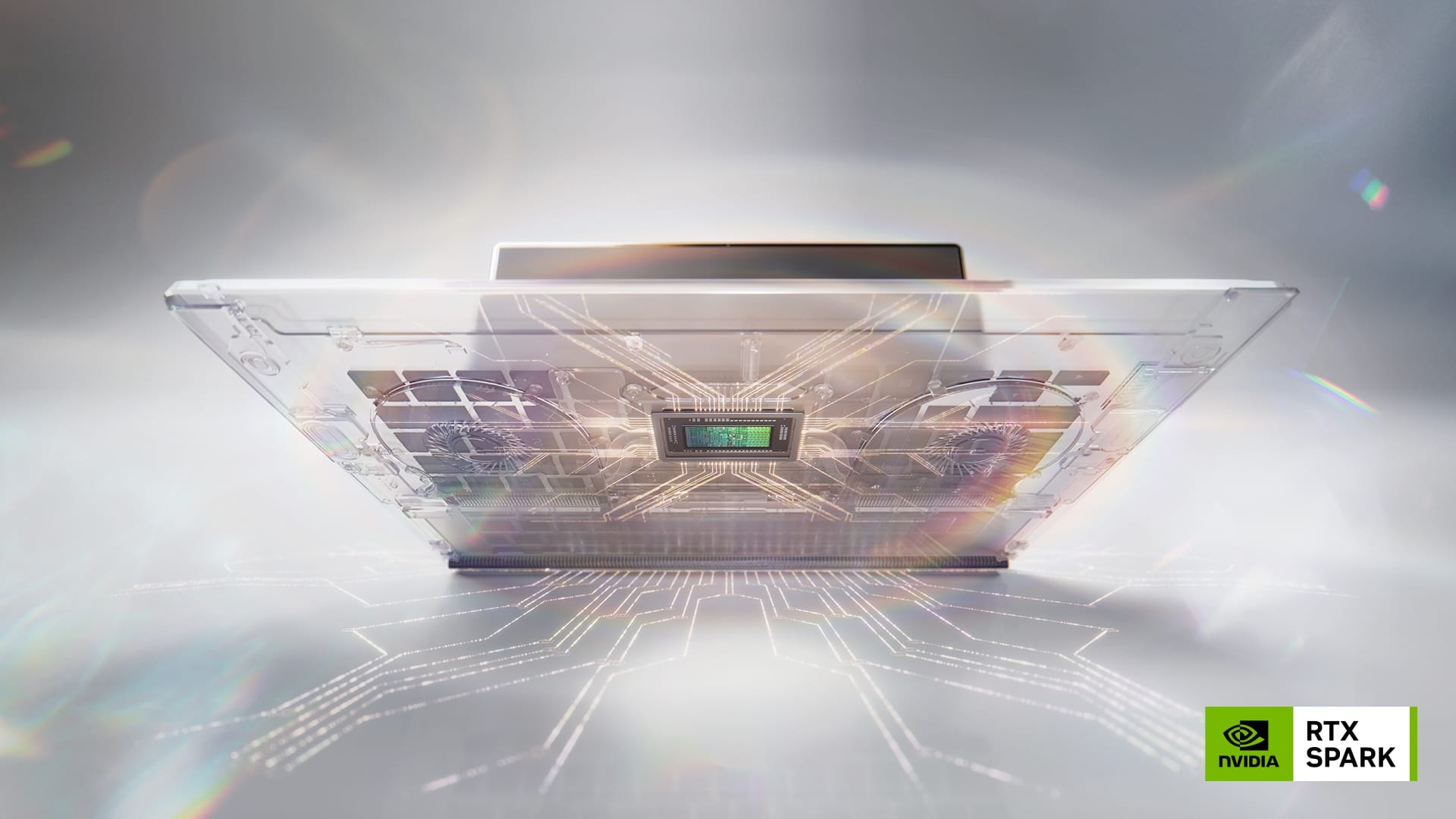
NVIDIA has unveiled RTX Spark, a new superchip for Windows PCs designed to run personal AI agents locally, combining up to 1 petaflop of AI performance, 128GB of unified memory, and NVIDIA’s full AI and graphics software stack.
Announced at NVIDIA GTC Taipei at COMPUTEX, RTX Spark is aimed at creators, AI developers and gamers who need higher local performance for agentic workflows, creative applications and graphics-heavy workloads. The platform will appear in slim Windows laptops with all-day battery life and compact desktop PCs, with systems expected this fall from ASUS, Dell, HP, Lenovo, Microsoft Surface and MSI. Models from Acer and GIGABYTE will follow.
“The PC is being reinvented,” said Jensen Huang, founder and CEO of NVIDIA. “For forty years, you launched apps. Click. Type. With RTX Spark and Microsoft Windows, you ask — and the PC does the work. RTX Spark brings everything NVIDIA has built — CUDA, RTX, our AI platform — into a single superchip. Local agents. Frontier models. Creative workflows. RTX games. All on a laptop. This is the new PC. The personal AI computer.”
Microsoft and NVIDIA build a Windows layer for local agents
The NVIDIA and Microsoft collaboration centres on making AI agents usable on primary Windows devices while keeping user control, security and privacy in place. The companies are combining new Windows security primitives with NVIDIA OpenShell, a runtime designed to help agents run safely on-device.
The Windows primitives cover identity, containment, policy and end-to-end security for native agents. NVIDIA OpenShell adds policy controls that allow users to define what agents can and cannot do. It can also route queries to local models based on privacy policies and disguise personal information when queries are sent to cloud models.
Agent developers including Hermes Agent and OpenClaw are adopting this security and privacy layer for new Windows apps. These apps are intended to let agents execute tasks in Windows applications, handle cross-app workflows, generate images and video, code plug-ins and apps, and search local files semantically.
The hardware behind RTX Spark pairs an NVIDIA Blackwell RTX GPU with 6,144 CUDA cores and fifth-generation Tensor Cores with FP4 precision. It is connected through NVIDIA NVLink-C2C to a 20-core NVIDIA Grace CPU. MediaTek collaborated with NVIDIA on the custom CPU design.
NVIDIA said the platform can run 120-billion-parameter large language models with up to 1 million tokens of context locally. Its claimed performance also covers ultralarge 90GB 3D scenes, 12K 4:2:2 video editing, 4K AI video generation, and AAA gaming at 1440p above 100 frames per second.
Adobe rebuilds key creative apps for RTX Spark
Adobe is rearchitecting Photoshop and Premiere for RTX Spark, with the companies claiming up to 2x faster AI, editing, colouring and effects performance across creative workflows.
Premiere will use RTX Spark’s unified memory, Blackwell GPU and TensorRT software through a new video pipeline. The aim is real-time performance for editing and colour correction, GPU-accelerated AI, and more efficient rendering of complex timelines. Adobe Substance 3D Painter and Stager will also run natively on RTX Spark for 3D texturing and scene creation workflows.
Photoshop’s next-generation engine will be optimised for GPU-accelerated compositing, including live filters, high dynamic range and modern natural brushing. Adobe also plans to extend Premiere and Photoshop so users can create, edit and design with Windows agents.
Updates to Premiere, Photoshop and Substance are expected to start rolling out alongside RTX Spark availability.
RTX Spark extends NVIDIA’s gaming and creator ecosystem
RTX Spark also brings NVIDIA’s wider technology stack into the platform, including CUDA, RTX, DLSS, FP4, TensorRT, OptiX, Reflex and G-SYNC. NVIDIA said more than 100 Windows software providers and game developers are embracing the platform, including Adobe, Blackmagic Design, Blender, CapCut, ComfyUI, OTOY, KRAFTON, NetEase, Remedy Entertainment, Riot Games and XBOX.
NVIDIA also announced DLSS 4.5 Ray Reconstruction, which uses a second-generation transformer model to improve image quality in ray-traced and path-traced content. The update is coming to all GeForce RTX GPUs in August and will also arrive in Blender 5.3 as a new denoiser.
For PC makers, RTX Spark will support laptops as thin as 14mm and as light as three pounds, in 14-inch to 16-inch designs. These systems will include aluminium chassis and tandem OLED displays with NVIDIA G-SYNC technology.
The platform will also extend beyond personal systems. NVIDIA said its collaboration with Microsoft includes NVIDIA DGX Station for Windows, a deskside AI supercomputer for enterprise developers running agents on Blackwell architecture.