

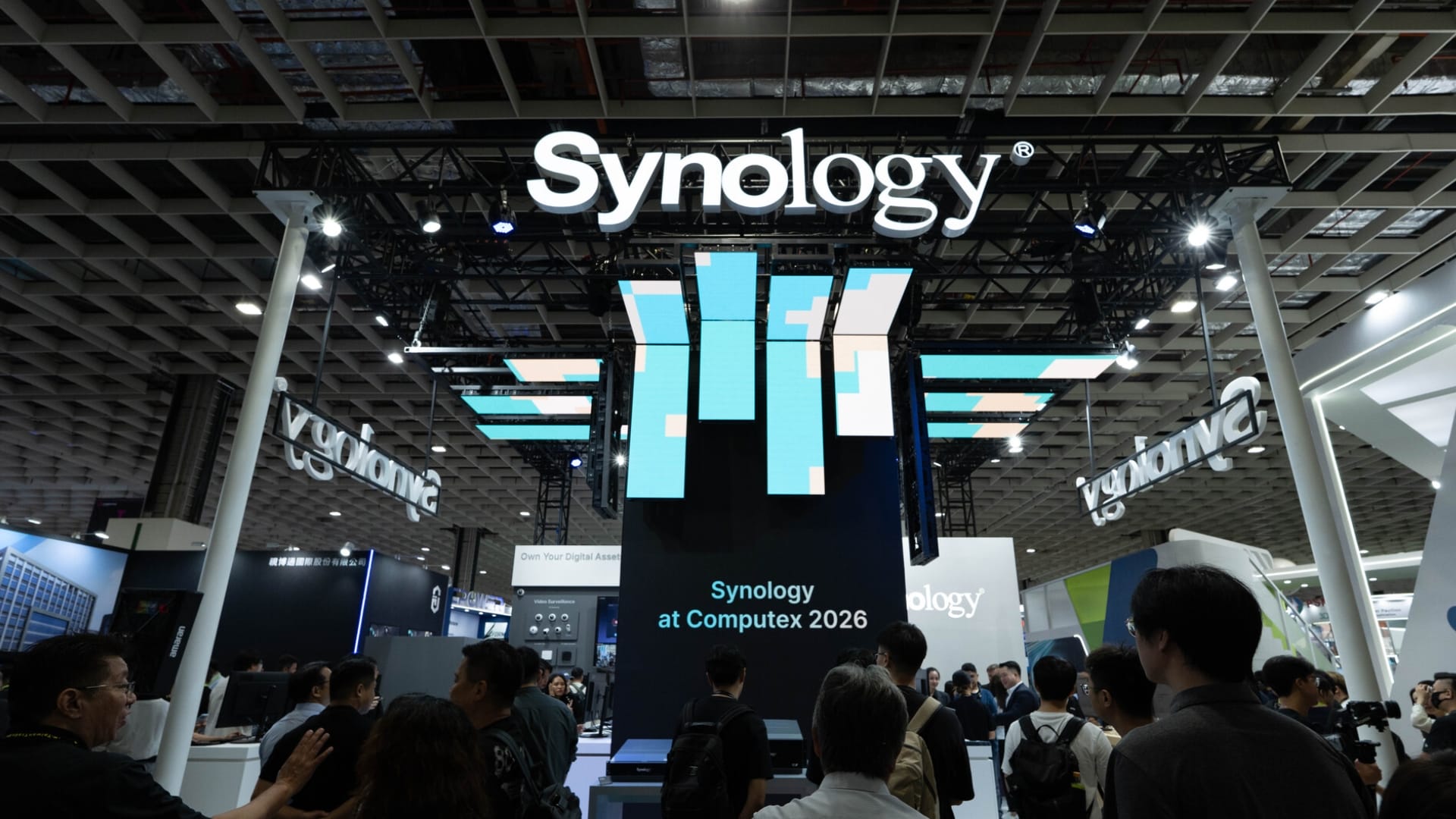
Synology has announced the roadmap for the next generation of DiskStation Manager, expanding DSM from a storage operating system into an intelligent data platform for governed, on-premises AI workflows.
The update moves DSM deeper into private enterprise AI, where business data, system logs, and metrics can be used by AI agents while remaining within an organisation’s own environment. It also extends DSM’s role in enterprise management, with new tools for distributed deployment, fleet operations, security, and audit.
Synology is linking the roadmap to its longer operating system history, citing 20 years of DSM development, 14 million systems shipped, and more than 400 EB of data managed. The company said the next generation of DSM is being built for both human users and AI agents, as enterprises deal with rising data volumes, cybersecurity demands, digital sovereignty concerns, and wider AI adoption.
“Enterprise AI adoption is no longer the challenge, data control is,” said Philip Wong, Chairman and CEO of Synology. “The next generation of DSM leverages over two decades of expertise to create an AI-ready platform that keeps organisations firmly in control of their data.”
Private AI starts with data residency and local inference
Synology’s AI roadmap for DSM begins with productivity but extends into data processing and automation. Synology Office Suite’s AI Assistant is designed as a private generative AI workspace for team collaboration, with capabilities such as content generation and refinement, email summaries and replies, natural language formula search, live translation, and meeting summaries.
The broader aim is to turn existing enterprise data into a private knowledge base that AI agents can use. DSM will support processing across text, audio, images, and scanned documents through functions such as speech-to-text, image captioning, OCR, and embedding. This gives organisations a way to make more of their unstructured data usable without relying entirely on external cloud services.
Model deployment is also being designed with flexibility in mind. Synology said DSM will support OpenAI API-compatible LLMs, allowing organisations to use self-hosted models or cloud-based AI services. Built-in local LLMs are also planned for deployments that require minimal setup.
The infrastructure layer will include Synology GPU rack servers and dedicated AI appliances for local inference. RackStation 26-series systems with GPU support are intended for private cloud AI agent use cases, while AI Station with GPUs is aimed at large-scale model inference and cross-device management through multi-GPU clusters.
DSM Agent brings AI into system operations
DSM Agent is the centre of Synology’s move from AI tools to agentic workflows. It is a built-in AI agent for DSM with pre-integration across the Synology ecosystem, starting as an on-demand AI consultant for troubleshooting and system management before moving towards autonomous agents that can execute more complex tasks across DSM.
The intended use cases sit close to daily IT operations. DSM Agent can support periodic health checks, service monitoring, and proactive alerts. It can also assist with backup validation, gap detection, and restoration guidance. For security and compliance work, Synology said the agent can help investigate suspicious logins, anomalous file activity, and log indicators.
Governance sits across that agentic layer. Synology said AI workflows will be controlled through guardrails, data loss prevention, user and group permissions, capability-level controls, skills and tools permissions, DSM permissions, package permissions, and file permissions. The roadmap also includes input rails, action rails, and output rails, giving IT teams more visibility into how AI workflows access and use organisational data.
Bie-i Chu, Executive Vice President of the Synology NAS Group, said the updated system is “built for both AI and enterprise demands, enabling private AI workflows with full governance, fleet-scale management, and the security controls IT teams need for regulation and compliance requirements.”
DSM will also support AI agent access through MCP and CLI integration. MCP is intended to provide plug-and-play connectivity for AI agents, including DSM Agent, Claude, and enterprise AI tools, while CLI access supports deeper system control. Synology said this access will be secured by DSM permissions.
Fleet management becomes a larger part of DSM
The enterprise management side of the roadmap focuses on making Synology systems easier to operate across larger and more distributed environments. Cluster Manager will allow multiple storage resources to be managed as a single system, with Synology aiming to improve resource utilisation, performance consistency, and deployment flexibility.
This is supported by a storage container infrastructure that can isolate workloads such as File Server, Drive, and MailPlus. By containerising storage services and applications, DSM can support smoother workload management, workload migration, storage QoS and load balancing, and broader backup and protection policies.
Active Insight will add another layer for organisations deploying Synology systems across multiple locations. Its Mass Deployment feature will allow administrators to batch-deploy multiple NAS devices and apply configuration settings at once, reducing the time needed to bring new systems online in distributed environments.
Synology is also extending DSM’s role in higher-performance storage environments. The roadmap includes the PAS Series for mission-critical workloads, with an active-active dual controller design, more than 2 million 4K read IOPS, capacity of 1.6 PB, or 8 PBe effective capacity, and connectivity options that include 4x100GbE combined with either 8x25GbE or 32G FC. Drive deduplication and compression are also planned to improve storage efficiency.
Security and audit controls are expanded for regulated environments
Security and compliance form the third major pillar of the DSM roadmap. Synology said DSM will expand identity and access management with more granular Role-Based Access Control, giving IT teams more precise control over user privileges.
A revamped Log Center will bring operational and application logs into a single view for monitoring and audit. Synology also plans cross-system log management, including a centralised log server for systems and services, integration with external analysis and investigation tools, and compliance-ready reporting. Native export to industry-standard observability platforms is also planned.
The wider security framework includes Secure Sign-In 2FA and MFA, network isolation, self-encrypting drives, WORM folders, Hyper Backup, Snapshot Replication, immutable snapshots, encryption at rest, and backup and recovery tools. Synology is also adding a built-in secure element, while FIPS 140-3 certification is in progress.
Synology said the features in the next-generation DSM roadmap will be introduced progressively across upcoming DSM releases.