


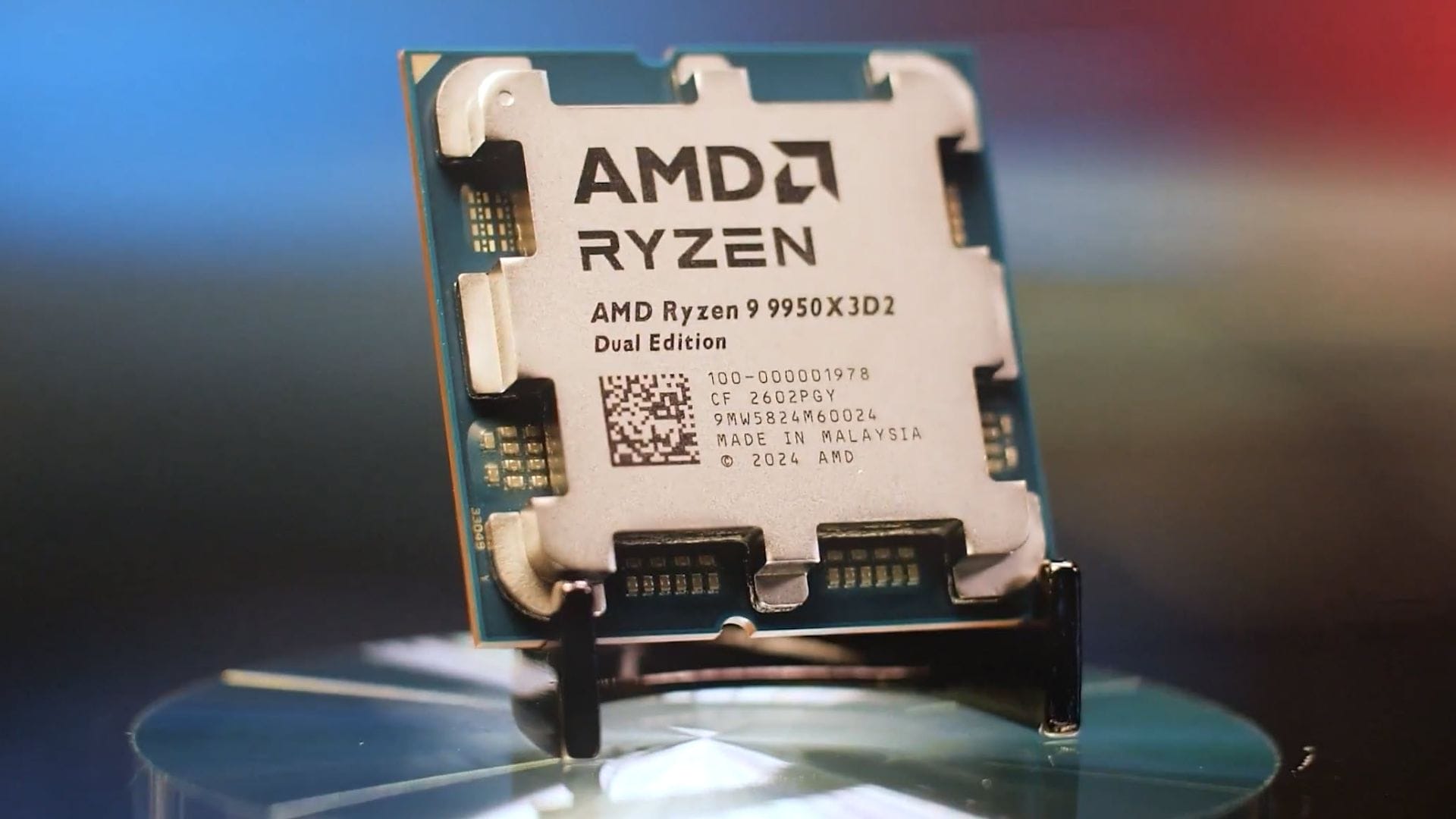
AMD has introduced a new flagship processor aimed at high-end users, revealing the Ryzen 9 9950X3D2 Dual Edition in a brief video announcement. The latest addition to the company’s X3D lineup signals that AMD is continuing to refine its performance-focused desktop chips, particularly for developers, creators and demanding workloads.
The new processor builds on the existing Ryzen 9 9950X3D but introduces a notable architectural change. Unlike earlier X3D models, which typically feature a single chiplet with 3D V-Cache, the Ryzen 9 9950X3D2 adopts a dual-chiplet design in which both chiplets carry the additional cache. This marks the first time AMD has implemented such a configuration in its consumer Ryzen range.
The dual V-Cache design aims to improve consistency
The introduction of two chiplets with 3D V-Cache addresses a long-standing limitation in previous X3D processors. Earlier designs combined two cached chiplets without additional cache, which could lead to inconsistent performance when workloads shifted between the two. This behaviour sometimes required careful scheduling optimisation to ensure the best results.
By equipping both chiplets with V-Cache, AMD aims to deliver more consistent performance across a wider range of applications. The company suggests that this design reduces latency and improves data access, particularly in scenarios where workloads frequently move between cores. This could be especially beneficial for developers working on complex projects and creators handling large datasets.
In terms of specifications, the Ryzen 9 9950X3D2 retains 16 Zen 5 cores but significantly increases total cache capacity to 208MB. According to AMD, this is the highest cache ever offered on a Ryzen processor. The additional cache is expected to enhance performance in both gaming and professional applications by allowing faster access to frequently used data.
Performance gains focus on real-world workloads
While independent benchmarks are not yet available, AMD has shared early performance estimates for the new processor. The company claims a modest improvement of 5-10% over the current Ryzen 9 9950X3D in applications such as DaVinci Resolve, Blender, and large-scale code compilation, including projects like Unreal Engine and Chromium.
Although these gains may appear incremental, AMD is positioning the chip’s consistency as its primary advantage. Rather than delivering dramatic performance increases, the Ryzen 9 9950X3D2 is designed to deliver more predictable results across different workloads. This could appeal to professionals who rely on stable performance rather than peak figures alone.
The processor’s enhanced cache and improved architecture may also benefit complex multitasking scenarios. Developers compiling large codebases or creators rendering high-resolution content often encounter fluctuating performance due to shifting workloads. A more uniform cache distribution could help mitigate these fluctuations, resulting in smoother overall operation.
Implications for gaming and market positioning
The new design also raises questions about how the Ryzen 9 9950X3D2 will perform in gaming. Previous X3D processors have demonstrated strong results in titles that benefit from large cache sizes, but their asymmetric chiplet design sometimes required software-level adjustments to achieve optimal performance.
With both chiplets now featuring V-Cache, the Ryzen 9 9950X3D2 could simplify this process. Games may be able to take advantage of the additional cache more consistently without relying on complex scheduling tweaks. However, real-world gaming performance will need to be validated through independent testing once the processor becomes available.
AMD has confirmed that the Ryzen 9 9950X3D2 will launch globally on 22 April. Pricing details have not yet been disclosed, though expectations are that the processor will sit at the premium end of the market, in line with its flagship status.
As AMD continues to push the boundaries of its X3D technology, the Ryzen 9 9950X3D2 represents an incremental but potentially meaningful step forward. Its success will likely depend less on headline performance gains and more on whether it can deliver the consistent, reliable experience that developers and creators increasingly demand.