


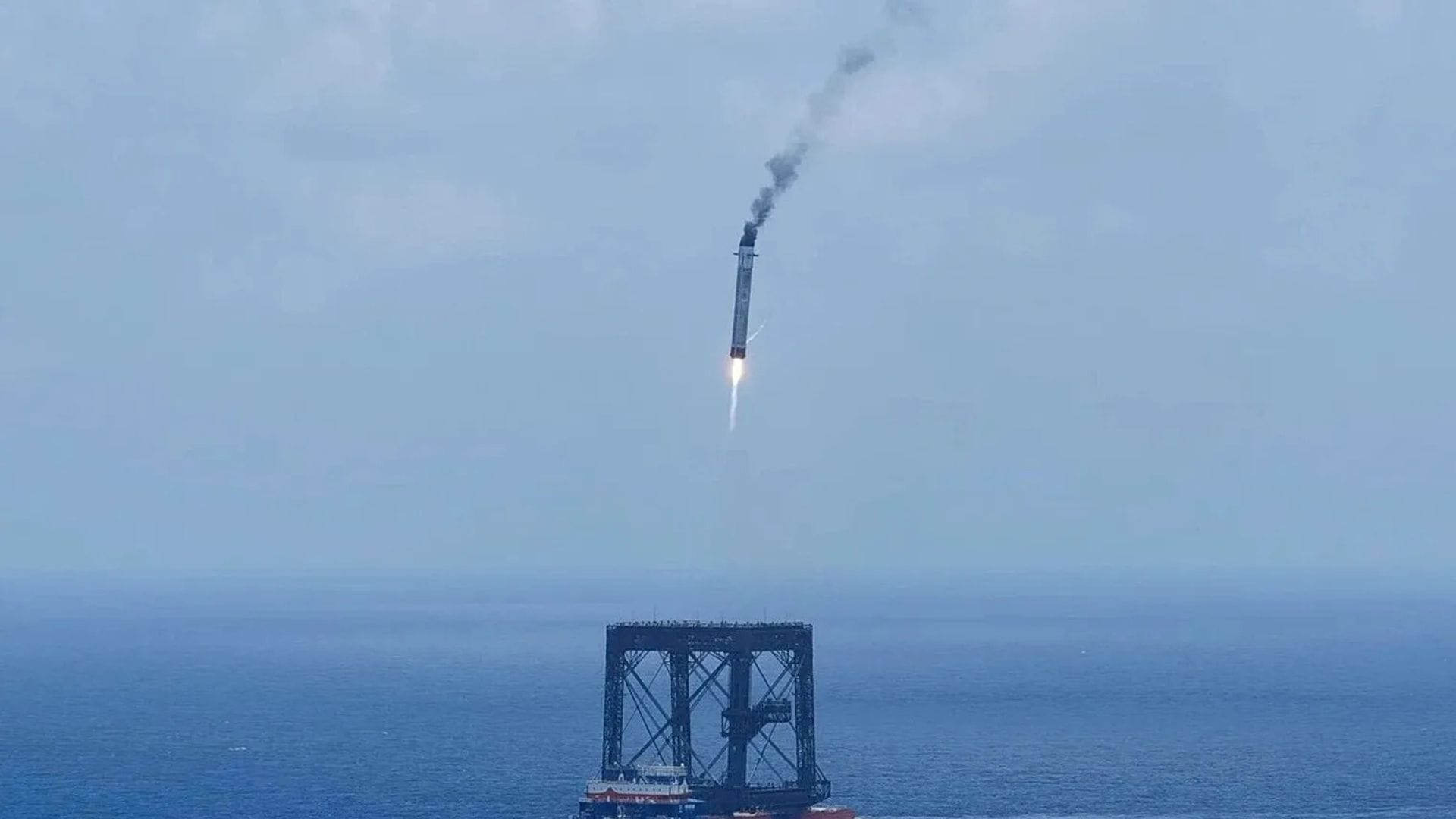
China has become the second country to recover a reusable rocket booster after completing a successful capture during the maiden flight of the Long March 10B. The achievement marks an important step in the country’s efforts to develop reusable launch technology and expand its access to space.
Footage broadcast by Chinese state television CCTV showed the booster descending under its own power before being captured by a net-based recovery system. The operation was described as the first successful use of this type of rocket-catching method.
The Long March 10B was developed by the state-owned China Academy of Launch Vehicle Technology (CALT). The organisation said the mission represented a major advance for China’s reusable rocket programme and could support the development of more efficient launch services.
“[The mission] marks a historic breakthrough for China in the field of reusable rocket technology and will lay a solid foundation for accelerating the enhancement of the country’s space access capabilities,” CALT said in a translated statement.
New recovery system uses hooks and a net
The Long March 10B recovery system differs from the methods used by US space company SpaceX. Falcon 9 boosters return to Earth using retractable landing legs, allowing them to land vertically on ground-based landing zones or autonomous drone ships at sea.
SpaceX has also developed a separate recovery method for its larger Starship launch system. The Super Heavy booster is designed to return to the launch site, where large mechanical arms attached to the launch tower attempt to catch it during descent.
CALT instead used a system involving hooks and a net to capture the Long March 10B booster. The organisation described the approach as a world first. The rocket was reportedly recovered intact, although the footage did not provide a clear view of the grappling and capture mechanism.
Video from the mission showed the booster descending slowly while using its engines to control its speed and position. The engines appeared to shut down shortly before the vehicle was caught. Cheers could be heard after the recovery, apparently from CALT employees and other mission personnel.
The successful capture could allow the booster to return to service within a relatively short period. CALT expects to reuse the recovered vehicle on another flight before the end of 2026. A successful second launch would provide further evidence that the rocket can withstand recovery and be prepared safely for another mission.
Reusable rockets can reduce the need to manufacture a new booster for every launch. However, the technology also requires detailed inspections, maintenance and testing between flights. The cost and speed of refurbishment will therefore be important factors in determining the Long March 10B system’s long-term value.
Recovery follows earlier tests and setbacks
The successful mission followed previous attempts by Chinese organisations to develop reusable rocket technology. In February 2026, CALT conducted a simulation of a reusable booster’s recovery. That test ended with the vehicle landing in the water about 200 metres from the recovery platform.
Although the booster did not reach its intended target, the earlier test provided information that could be used to improve guidance, navigation and landing systems. The latest mission suggests that CALT has made progress in controlling the vehicle during its final descent and positioning it for recovery.
Other Chinese rocket developers are also working on reusable launch systems. Beijing-based private company LandSpace has been developing the ZhuQue-3 rocket, which uses mechanical landing legs similar to those fitted to SpaceX’s Falcon 9 boosters.
LandSpace’s recovery attempt came close to achieving a successful landing but ended in an explosion. The company did not release footage showing the outcome. Despite the setback, the test highlighted the growing number of Chinese organisations pursuing technologies to recover and reuse major rocket components.
Reusable rocket development remains technically difficult because boosters must survive the stresses of launch before returning through the atmosphere. They must then slow down, navigate towards a recovery site and complete a controlled landing or capture while carrying limited fuel.
China’s net-based approach could offer an alternative to landing legs by reducing the equipment carried on the booster. However, further missions will be needed to determine how reliably the system can operate and whether it can support frequent launches.
Reusable rockets support China’s space ambitions
China aims to become a leading space power by 2030, and reusable launch vehicles are expected to play an important role in that strategy. Recovering rocket boosters could lower launch costs, shorten the time between missions and support more regular access to orbit.
The country has expanded its space activities in recent years through crewed missions, satellite launches and lunar exploration programmes. Developing reusable rockets could strengthen those efforts by making launch operations more efficient and reducing dependence on single-use vehicles.
China continues to trail the United States in the number of orbital launches. The US completed 193 orbital launches in 2025, including 165 conducted by SpaceX. China recorded 92 launch attempts during the same period.
SpaceX’s high launch rate has been supported by the repeated use of Falcon 9 boosters. Some vehicles have completed numerous missions, allowing the company to operate more frequently without building an entirely new first-stage booster for every flight.
China’s successful recovery of the Long March 10B represents an important technical milestone, but regular reuse will be the next major test. CALT will need to inspect the recovered booster, assess its condition and prepare it for another launch before the technology can demonstrate its wider operational value.
If the planned second flight takes place before the end of 2026, it could provide further evidence of China’s ability to develop a reusable launch system. The mission may also encourage additional investment and competition among the country’s state-owned and private space companies.