


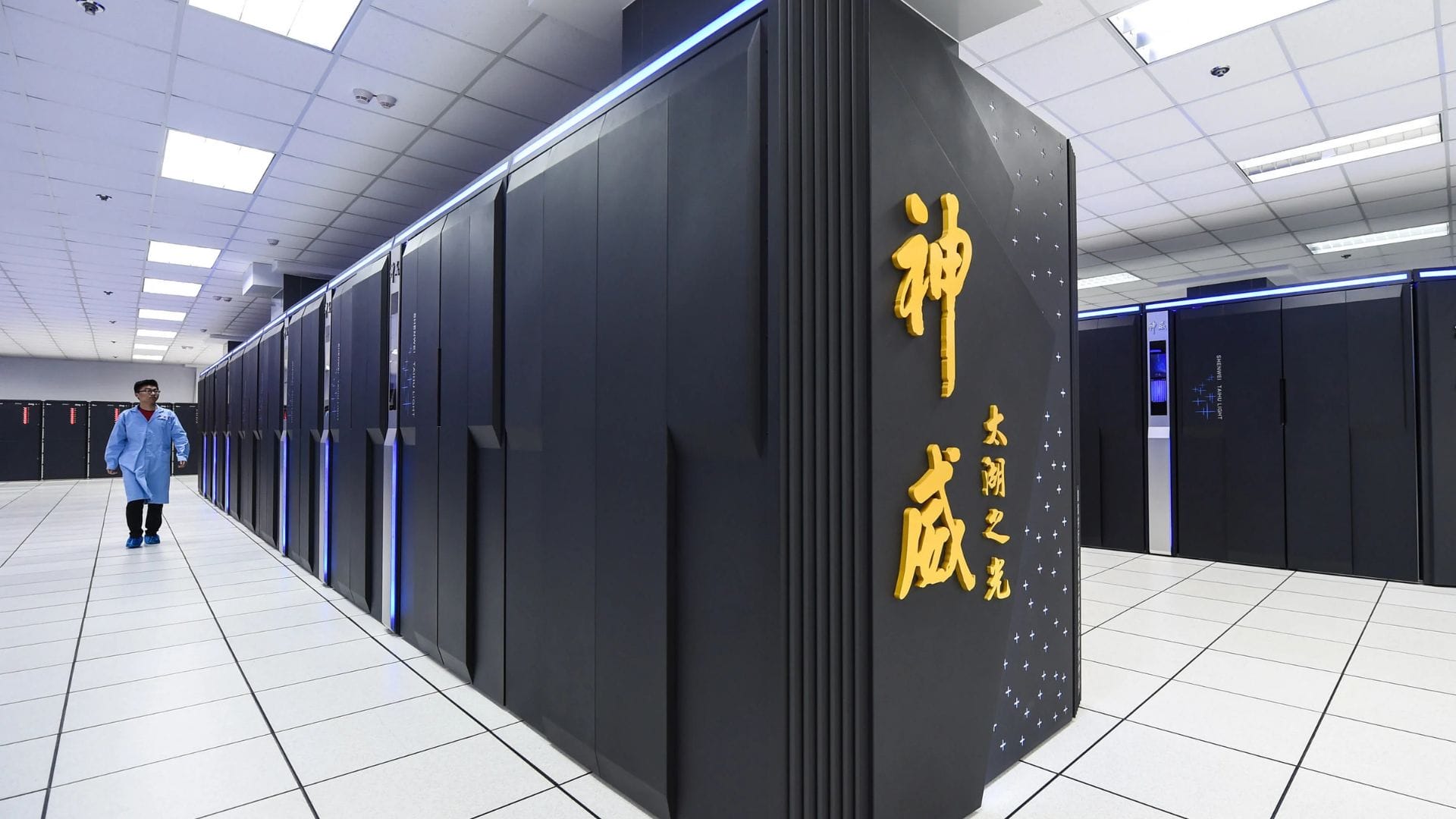
China has revealed plans for a new supercomputer that aims to reach two exaFLOPS of computing power using only central processing units, marking a significant shift from current industry approaches. The system, known as Lingsheng, was introduced at a conference in Shenzhen in April 2026 and is being developed by the National Supercomputing Centre in Shenzhen.
According to Lu Yutong, the centre’s director and the project’s chief designer, the system’s hardware and software stack is “fully independently controllable”. This emphasis reflects China’s broader push to reduce reliance on foreign technology while advancing its domestic high-performance computing capabilities.
The proposed machine would integrate around 47,000 processors across 92 compute cabinets. If realised, it would represent one of the most ambitious CPU-based supercomputing efforts to date, challenging the prevailing reliance on hybrid architectures that combine CPUs with graphics processing units or other accelerators.
A shift away from GPU-dominated designs
Most of the world’s leading supercomputers currently depend on GPUs or specialised accelerators to deliver exascale performance. Systems such as the United States’ El Capitan rely on tightly integrated CPU and GPU components to achieve high efficiency and speed.
The Lingsheng system takes a different route by focusing entirely on CPUs. It uses domestically produced high-performance processors, combined with on-chip high-bandwidth memory and high-speed interconnects. The design also incorporates technologies such as 3D floating-orthogonal computing and liquid cooling to handle the substantial heat generated by such high-density processing power.
Developers claim the platform achieves advances across six key areas: system architecture, computational performance, energy efficiency, programming flexibility, scalability, and reliability. The infrastructure is designed to support not only exascale computing but also exascale storage and petascale communication capabilities.
Liquid cooling plays a central role in the system’s design. Officials describe it as the largest centralised liquid cooling deployment of its kind, intended to maintain stable operation under heavy workloads. The system also includes a large-scale interconnect network supported by 36 dedicated cabinets, enabling communication across up to a million ports.
A pilot phase of the project has already been conducted using 100 servers based on Arm-derived Taishan cores, delivering a total of 12,800 cores. In its projected full-scale configuration, the system would expand to 1,580 blade servers using x86 processors, reaching more than 100,000 cores and a theoretical peak performance exceeding 10 petaflops at that stage alone.
Storage is another major component of the design. Plans include 650 petabytes of storage distributed across hundreds of nodes, with liquid-cooled storage cabinets capable of delivering up to 10 terabytes per second of bandwidth.
Performance claims and global competition
If the Lingsheng system achieves sustained performance of 2 exaFLOPS, it could rival or even surpass existing supercomputers in measured performance. The current leading system, El Capitan, has recorded a Linpack benchmark score of 1.809 exaFLOPS.
However, comparisons are complex. While Lingsheng’s two exaFLOPS figure is presented as a target for sustained performance, it remains theoretical at this stage. El Capitan, by contrast, has already demonstrated real-world results and has a higher theoretical peak of 2.79 exaFLOPS.
This distinction highlights the uncertainty surrounding Lingsheng’s ultimate capabilities. Without verified benchmark data, it is not yet possible to determine whether the system will meet or exceed the performance of existing global leaders in practice.
Questions also remain about the hardware supply chain. Although the project emphasises domestic sourcing, China’s options for x86 processors are limited, with companies such as Zhaoxin and Hygon yet to demonstrate performance on par with leading international chipmakers. The announcement did not specify which vendors would supply processors for the full production system.
In addition, no clear timeline has been provided for the completion or deployment of Lingsheng, leaving its future progress open to speculation.
Potential applications and unanswered questions
Despite these uncertainties, the developers have outlined a wide range of potential applications for the system. These include fields such as remote sensing, materials science, bioinformatics, meteorology, pharmaceuticals, oil exploration, artificial intelligence, life sciences, and electromagnetic simulation.
Early research efforts linked to the project have reported promising results. One team claimed to achieve 81 per cent parallel scalability in simulations involving 100 million atoms. At the same time, another suggested that combining artificial intelligence with reinforcement learning could improve large-scale compound screening efficiency by up to 1,000 times.
However, these claims remain unverified without access to a fully operational system. Experts note that real-world performance, energy consumption, and reliability can differ significantly from early projections, particularly at exascale scale.
The lack of benchmark data and detailed technical disclosures means that Lingsheng’s true capabilities will only become clear once the system is built and tested under standard conditions. Until then, it remains an ambitious proposal that reflects China’s determination to compete at the highest levels of global supercomputing.
The project also underscores a broader shift in strategy, as nations explore alternative architectures and seek greater control over critical technologies amid geopolitical and supply chain challenges.