


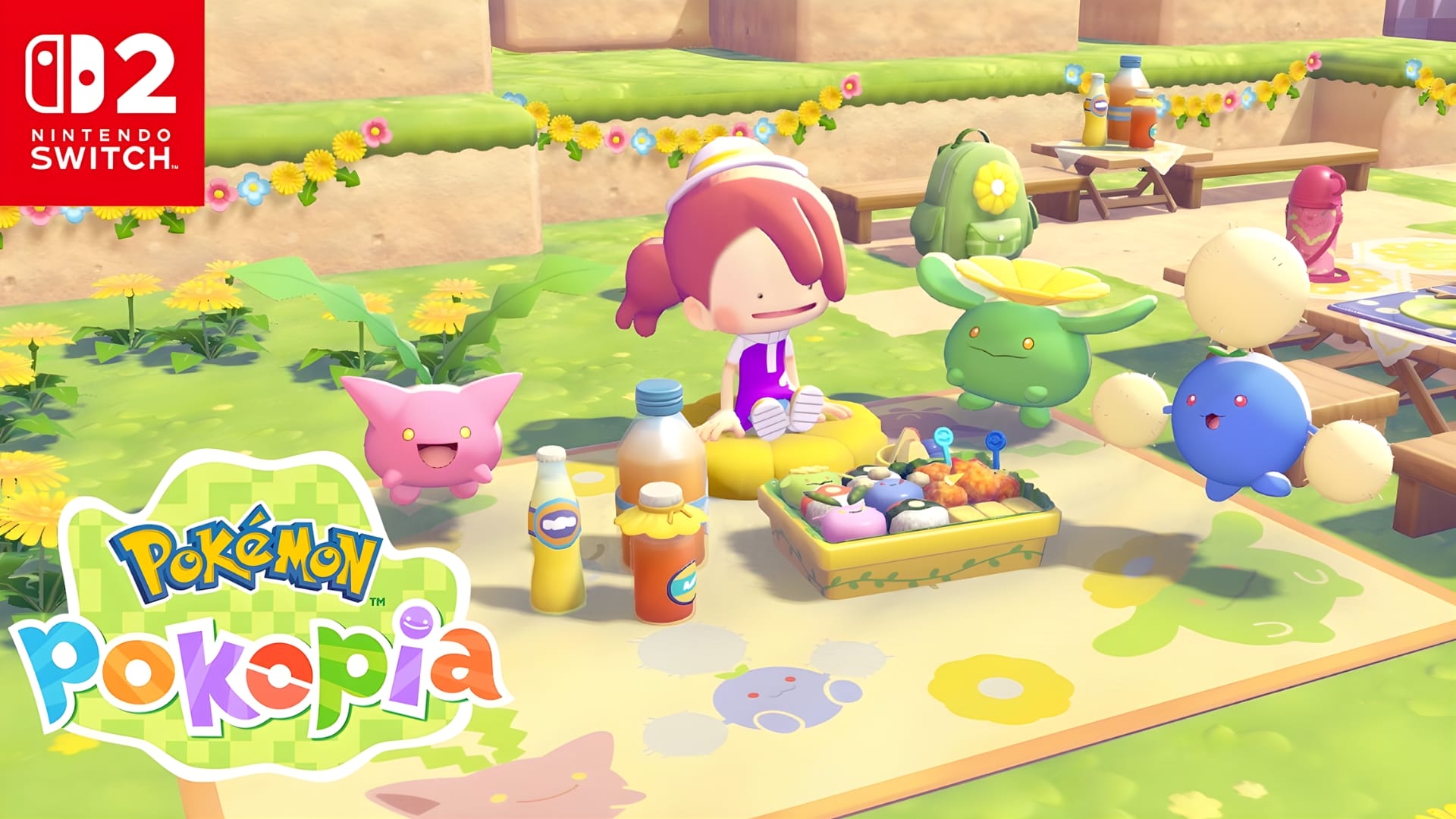
While Pokémon Pokopia appears to be a low-intensity life simulation, its release marks a high-stakes pivot for Nintendo. Beneath its habitat restoration mechanics lies a structural blueprint for a persistent service ecosystem designed to support long-term engagement in the volatile economics of the Switch 2 era.
Instead of building the experience around battles and linear progression, Pokémon Pokopia centres on inhabiting and maintaining a shared environment. The player’s role becomes more akin to a caretaker of ecosystems than to a trainer advancing through challenges.
That design direction points to a deeper transformation increasingly described by observers as “Pokémon as a Service”. The phrase is not an official Nintendo term, yet it has surfaced in several corners of the ecosystem, appearing simultaneously as a developer experiment, a cloud-driven business model and a spatial data platform built from player activity.
Habitat replaces battle as the organising system
For decades, Pokémon has been defined by a loop of collecting and competing. Players capture creatures, assemble teams and progress through structured encounters that culminate in battles.
Pokémon Pokopia replaces that familiar loop with habitat restoration and environmental design. Pokémon appear when players construct environments suited to their behaviour, turning the world itself into the primary system that drives interaction.
This approach changes the player’s relationship with Pokémon. Rather than overcoming a sequence of competitive tests, the experience revolves around nurturing ecosystems and revisiting spaces that change over time.
A platform strategy hidden inside cosy gameplay
Nintendo’s broader platform strategy helps explain why this shift matters. With the Switch 2 install base already at 17.37 million units globally by early 2026, sustaining long-term engagement has become as important as selling hardware.
Life simulation games are particularly effective at expanding a console’s audience. Their routine-driven structure appeals to families, casual players and lifestyle gamers who engage with software through repetition, comfort and shared play rather than mastery alone.
Selling 2.2 million copies within four days, including 1.0 million in Japan, signals more than strong launch demand. In Japan, that figure amounts to a remarkable early attachment rate for a non-mainline spin-off, giving Nintendo meaningful software leverage at a time when rising memory costs are squeezing hardware economics.
Competition also shapes this strategy. Titles such as Palworld showed in 2024 that creature-based sandbox experiences could attract mass attention outside Pokémon’s traditional battle structure, pushing The Pokémon Company to test formats that lean into world-building and social routine.
This commercial traction gives Nintendo something equally important beyond revenue. It provides the scale needed to test the more ambitious technical systems that underpin the game’s longer-term service potential.
Persistence through shared worlds
Beyond gameplay, Pokémon Pokopia functions as a live environment for testing the Switch 2’s simulation infrastructure. The title runs on the Katana Engine, KOEI TECMO GAMES’ proprietary technology, whose modular building systems matter because they allow environments, objects and player actions to be updated and managed without rebuilding the entire world structure each time.
That matters for persistence. A game built around habitat creation and evolving routines needs an architecture that can support many small state changes, social interactions and environmental updates over time.
Real-world time synchronisation links in-game weather and day-night cycles with the player’s local environment. On the Switch 2, stronger connectivity features make that sort of synchronised play more practical, turning the game into something closer to a living schedule than a fixed session.
Island Tours extends that logic into shared spaces where players can explore each other’s habitats. These interactions make environmental design visible to others, shifting world-building from a private activity into a social layer of the experience.
Pokémon already operates partly as a service
The idea of Pokémon as a service predates Pokémon Pokopia. Over the past decade, the franchise has steadily moved key parts of its ecosystem into cloud-based infrastructure.
Services such as Pokémon HOME and the earlier Pokémon Bank shifted Pokémon collections away from cartridges and into persistent online storage. A creature captured years earlier can still move across multiple generations of games because it exists within a centralised digital platform.
This architecture changes both the economics and the behaviour of the franchise. Subscription storage generates recurring revenue, but it also keeps users invested in the wider ecosystem because their long-term collections remain available for future releases.
Developers are already testing cloud-native Pokémon worlds
Independent developers have also begun exploring what a cloud-native Pokémon ecosystem might look like. One notable example is an open-source project called “Pokémon as a Service” created by developer Nick Felker.
The project runs on Firebase and Google Cloud, using serverless architecture to host persistent Pokémon worlds. Gameplay mechanics such as catching, trading and battling are executed as cloud functions that automatically scale based on user activity.
Instead of operating traditional game servers, the system treats the Pokémon world as a software service. Updates can be pushed continuously, and communities can host shared environments without maintaining their own heavy infrastructure.
From persistent worlds to spatial infrastructure
The logic of Pokémon as a service does not stop at virtual spaces. Once player activity becomes continuous and location-aware, it can also generate infrastructure with value outside the game itself.
That is what happened with Pokémon GO. Over several years, players scanned landmarks and submitted environmental data through in-game activities, creating a large repository of spatial information tied to real places.
Niantic has turned that activity into a Visual Positioning System as part of the Niantic Spatial initiative. Rather than relying solely on GPS, the system uses detailed three-dimensional mapping to help machines understand their location with much greater precision.
Companies like Coco Robotics have integrated this geospatial AI into their Coco 2 fleet, using the game-generated Visual Positioning System to navigate dense urban corridors where traditional GPS signals struggle. What began as player exploration inside a consumer game has become commercial spatial infrastructure.
A layered Pokémon ecosystem is emerging
Taken together, these developments show how Pokémon increasingly operates as a layered digital ecosystem rather than a sequence of discrete products. Cloud storage platforms manage long-term collections, mobile games generate spatial datasets, and console titles experiment with synchronised, evolving worlds.
Pokémon Pokopia sits directly within that trajectory. Habitat building, shared play, and routine-led engagement create behavioural patterns that resemble service platforms, where value is measured by return visits and retained identity.
Even distribution reflects this shift. Pokémon Pokopia uses Nintendo’s Game-Key Card model in physical retail, where the cartridge serves as a licence key for a required download, underscoring how cost pressures on NAND flash are pushing packaged games toward hybrid digital distribution.
The cosy economy and Asia’s platform influence
Asia may be one of the clearest markets where this model can mature. Across Japan, South Korea and Southeast Asia, lifestyle-oriented games have become central to how players use portable hardware and mobile-connected devices.
These games succeed because they fit into daily routines. Short play sessions, commuting windows and social check-ins create a pattern of engagement that favours synchronised worlds over long, uninterrupted sessions built around competition.
Connectivity also matters here. As handheld and home devices become better at maintaining stable, always-connected experiences, features such as live weather, shared visits and time-based world states become easier to sustain at scale.
Pokémon Pokopia fits neatly into that regional pattern. Its structure rewards habitual return rather than marathon play, making it well-suited to markets where gaming already overlaps with routine, mobility, and social presence.
A prototype for a persistent Pokémon future
Pokémon Pokopia does not openly present itself as a service platform. Yet its mechanics, infrastructure and surrounding ecosystem reveal a broader transformation within the franchise.
Habitat creation, shared environments and time-based engagement mirror the structural patterns of persistent digital platforms. When combined with cloud storage systems, hybrid distribution and spatial data networks, Pokémon increasingly behaves like an interconnected ecosystem.
If that trajectory continues, Pokémon Pokopia may eventually be remembered as the moment the franchise began testing how a persistent Pokémon world could function.