

SensorFlow, a Singapore-based, smart energy management startup, has announced that it has secured US$2.7 million Series A funding led by private investor Pierre Lorinet, followed by Playfair Capital, Cocoon Capital, Entrepreneur First, 2be.lu Investments, Aurum Land and Insitu Asia Holdings.
The startup said in a press release that it would use the funding to boost its regional growth and to achieve its mission to make Asian hotels smart and energy efficient. This strategy will further expand SensorFlow’s rapid operational growth, allowing it to meet the demands of its growing clientele across major hotel chains in Singapore, Indonesia, and Hong Kong. It will also help SensorFlow to enter into new markets which include Malaysia, Thailand, Vietnam, Cambodia, and the Philippines, bringing the startup closer to its goal of 800,000 smart hotel rooms by 2022.
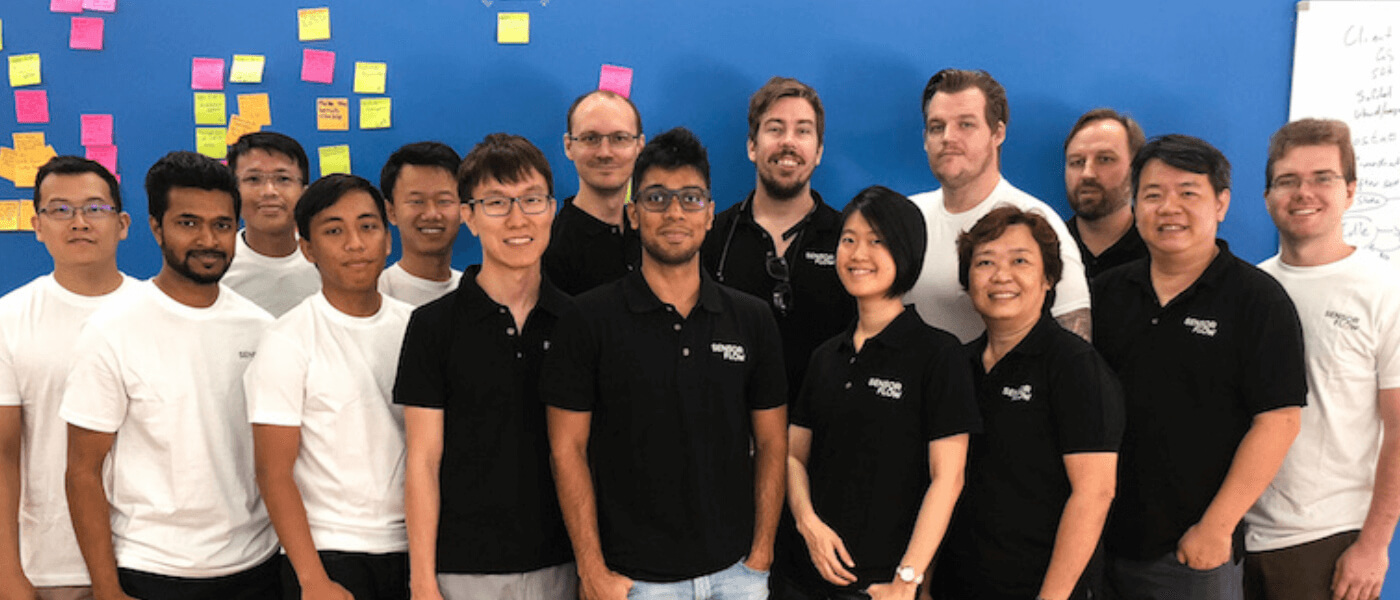
Team SensorFlow with Co-founder and CEO Saikrishnan Ranganathan (centre)
Founded in 2016 by Saikrishnan Ranganathan and Max Pagel, the cleantech startup combines the use of smart wireless Internet of Things (IoT) solutions and Artificial Intelligence (AI) to monitor, analyze and automate energy consumption of buildings, to drive better productivity, sustainability, and energy efficiency. The startup uses sensors to collect real-time data and AI to automate decision making. It said that its solutions have delivered up to 30 percent in energy savings and close to a 40 percent reduction in maintenance costs.
With energy consumption accounting for more than 60 percent of utility costs, the company is providing a solution for hoteliers that face a challenge on setting up an energy management system, which invariably carries high upfront cost and has integration issues.
The startup is in the midst of securing contracts with hotels and property developers in Singapore, Malaysia, Indonesia, and Thailand, and it is hoping to expand into Sri Lanka, India, the United Arab Emirates, and Saudi Arabia within the next two years.
This round of funding brings the total funds raised to date to US$3.5 million. Cocoon Capital led the previous round of funding in 2018 and followed by SG Innovate and SparkLabs under the Entrepreneur First accelerator programme.