

Micromobility startup, Beam, has recently secured US$26 million in Series A funding, bringing their total raised capital to US$32.4 million. The latest financing round was led by Sequoia India and Hana Ventures, with other investors from the APAC region in participation.
Coined by Horace Dedi, an analyst at Apple, the term “micromobility” is defined as travel with a distance of less than 8km. Beam’s electric-powered scooters have the potential for success given the region’s congestion and pollution challenges that are exacerbated by the use of gasoline-powered vehicles. This positions Beam’s nimble e-scooters as a more wallet- and environmentally-friendly alternative mode of transport.
To add, Beam is the only e-scooter operator in APAC that is officially Climate Neutral Certified. Having worked with Climate Neutral (a non-profit organisation) to have its 2019 carbon emissions measured, Beam went on to offset their emissions entirely by investing in projects involving renewable energy as well as planting trees. Drastically reducing carbon emissions is a commitment that Beam looks to extend in 2020 and in the future.
With the fresh capital obtained, Beam looks forward to expanding its electronic scooter operations and engineering potential beyond their current markets in Australia, Korea, Malaysia, New Zealand, and Taiwan. In addition, Beam is also planning to expedite the launch of its third-generation model – the Beam Saturn – which features an enhanced build and changeable batteries to more markets.
Although the funding came at a time of a pandemic and lockdowns enforced worldwide, the Singapore-based startup has taken the initiative to ease user’s concerns by putting into effect strict sanitizing practices to ensure their operations limit the spread of virus transmission.
Apart from having to comply with operation restrictions amidst the global health crisis, Beam is also faced with safety concerns on the pedestrian front. Despite e-scooters being a popular alternative in Singapore for use in regular commute and by food delivery dispatchers, a spate of unfortunate events involving e-scooter riders and pedestrians has led the government to ban e-scooters from footpaths in November 2019 to assuage the general public.
In response, Beam has shared in a statement that they will gradually be introducing measures that will ensure their e-scooters are safe for pedestrians when used in the streets. Plans are also underway to solve the issue of irresponsible users who absent-mindedly discard the e-scooters in unauthorized locations. Beam intends to do so via introducing an incentivized system for users to return the e-scooters and park them in authorized locations. Their “virtual docked” model claims to ensure that users will comply with the parking locations established by the Beam mobile app. To supplement their safety initiatives, the firm will also be improving its “Beam Safety Academy” and extend their online training solutions to the Asia Pacific region.
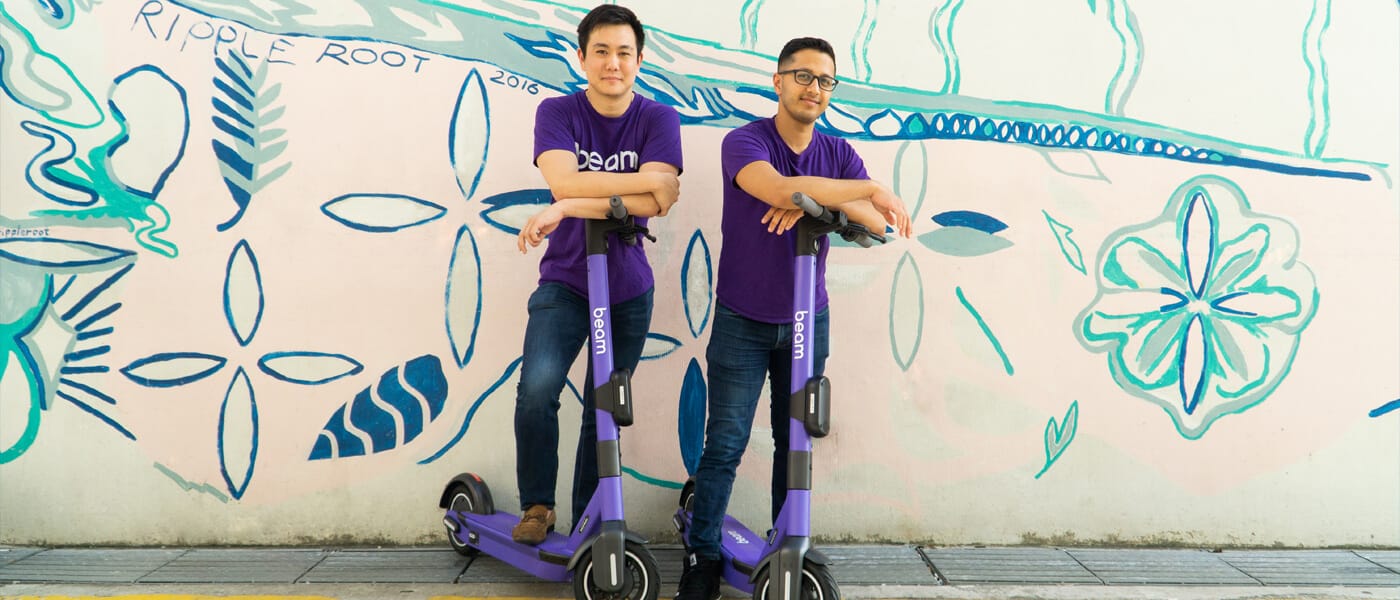
Co-Founder and Chief Executive, Alan Jiang expressed his sentiment that “I’m really excited about our new technology and its ability to reduce the problems associated with randomly scattered scooters around a city. This helps us to further improve our industry-leading vehicle retention rates, reduce operational costs, and most importantly, benefits communities by keeping city streets neater.”
Resonating with his business partner, co-founder and Chief Technical Officer, Deb Gangopadhyay shares that “The success of any new technology depends on mass acceptance, and the quicker and better we can ensure e-scooters are used and parked where they should be, the more welcoming city residents will be.”
In a show of support, Abheek Anand, Managing Director of Sequoia Capital, shares that Beam’s efforts in cooperating with regulators, and proactiveness in enhancing its technology, puts them in a more favourable position to lead the micromobility space in the APAC region. Back in 2018 when Beam was founded, Sequoia Capital was also the lead investor in the startup’s seed-stage where they raised a total of US$6.4 million in seed funding along with other investors.