


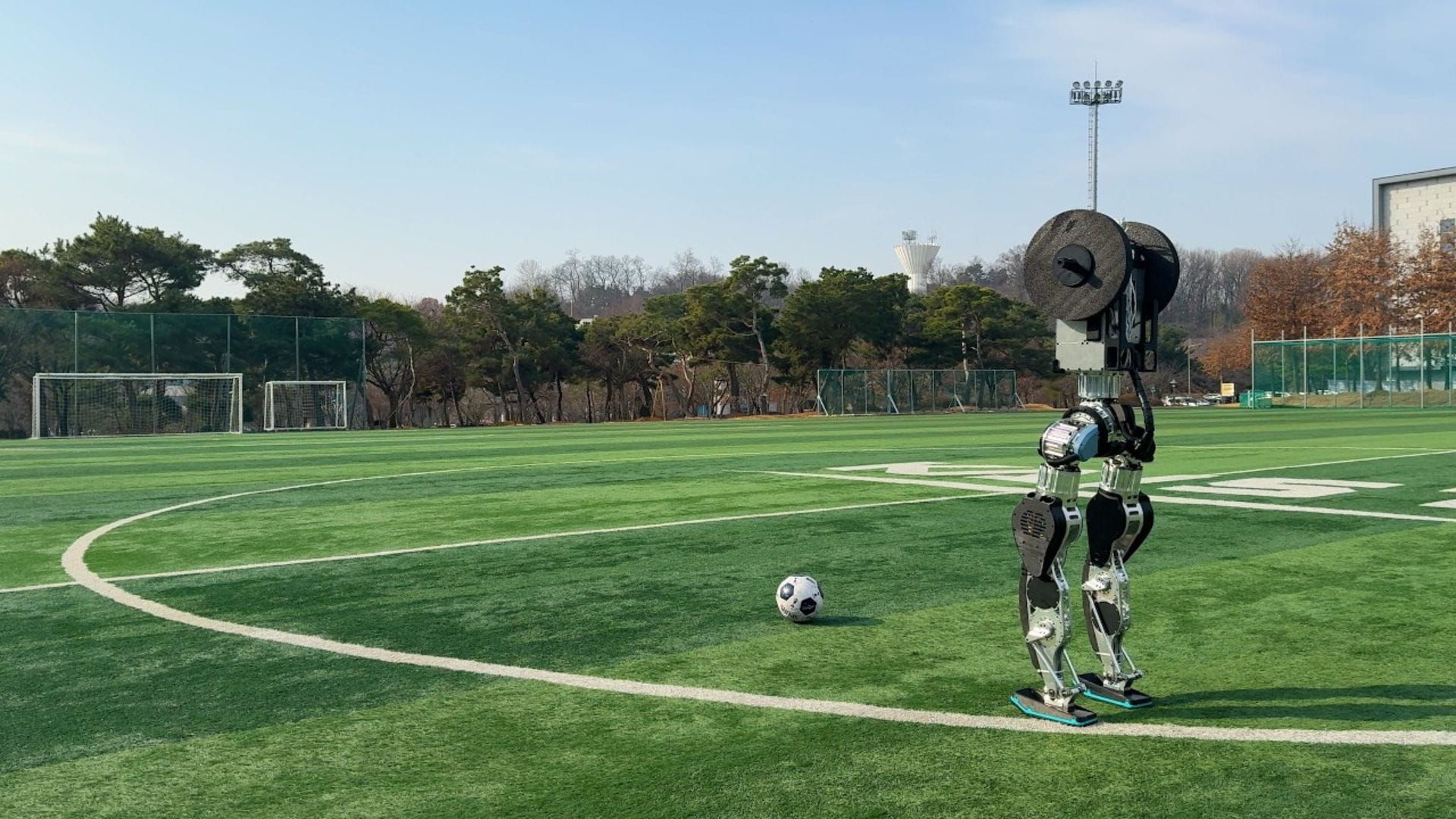
A newly released video from South Korea has drawn attention to a humanoid robot capable of remarkably lifelike movement, including a smooth moonwalk that has captured viewers’ interest online. The footage highlights the latest field tests of the KAIST Humanoid v0.7, developed by the Korea Advanced Institute of Science and Technology.
The robot, created at the university’s Dynamic Robot Control and Design Laboratory, demonstrates a range of physical abilities that closely resemble human motion. These include walking, jogging and jumping with notable balance and coordination. The machine also performs interactive tasks, such as kicking a football towards a goal, illustrating its potential for both mobility and responsiveness in real-world settings.
Online reactions have focused particularly on the robot’s dance-like movement. “Moonwalk was flawless,” one viewer commented, while another wrote, “Okay, all of this was impressive, but you convinced me with the moonwalk.” The responses reflect growing public fascination with humanoid robots that move in increasingly natural ways.
Advances in physical AI drive realistic motion
The development of the KAIST Humanoid v0.7 is closely tied to advances in what researchers describe as Physical AI. This approach enables machines to interpret and operate within the physical world, rather than relying solely on abstract data processing.
Unlike conventional artificial intelligence systems that primarily process language or static data, Physical AI equips machines with an understanding of space, timing and movement. This allows robots to respond dynamically to their surroundings, producing motions that appear more fluid and human-like.
The initiative forms part of a broader research programme at KAIST focused on collaborative intelligence. Led by Professor Young Jae Jang, the programme aims to develop systems that can learn continuously through simulation and real-time feedback. This method reduces reliance on large historical datasets and instead prioritises adaptability in changing environments.
By integrating software intelligence with hardware components such as sensors and motors, Physical AI enables robots to process and act on information simultaneously. This combination is essential for tasks that require coordination, balance and interaction, such as navigating uneven terrain or manipulating objects.
Future applications extend beyond demonstration
Engineers working on the KAIST Humanoid v0.7 are continuing to refine its capabilities, with a particular focus on improving mobility and dexterity. While the current version demonstrates strong dynamic movement, future iterations are expected to handle more complex physical tasks.
The research team aims to expand the robot’s functionality to include carrying items and operating machinery. Such developments could pave the way for practical applications across industries, from manufacturing to logistics, where adaptable robotic systems are increasingly in demand.
The integration of Physical AI into humanoid platforms also points towards broader use cases in environments that require close interaction between humans and machines. These could include service roles, hazardous work settings or collaborative industrial operations.
KAIST, widely regarded as one of South Korea’s leading scientific institutions, has played a significant role in advancing research across artificial intelligence, robotics and engineering. Established in the early 1970s, the university has been instrumental in supporting the country’s technological development and is often compared with leading global institutions in the field.
As research progresses, demonstrations such as the KAIST Humanoid v0.7 highlight both the technical achievements and the evolving ambitions of robotics. While challenges remain, particularly in scaling these systems for widespread use, the latest developments suggest that humanoid robots are moving closer to practical, everyday applications.