


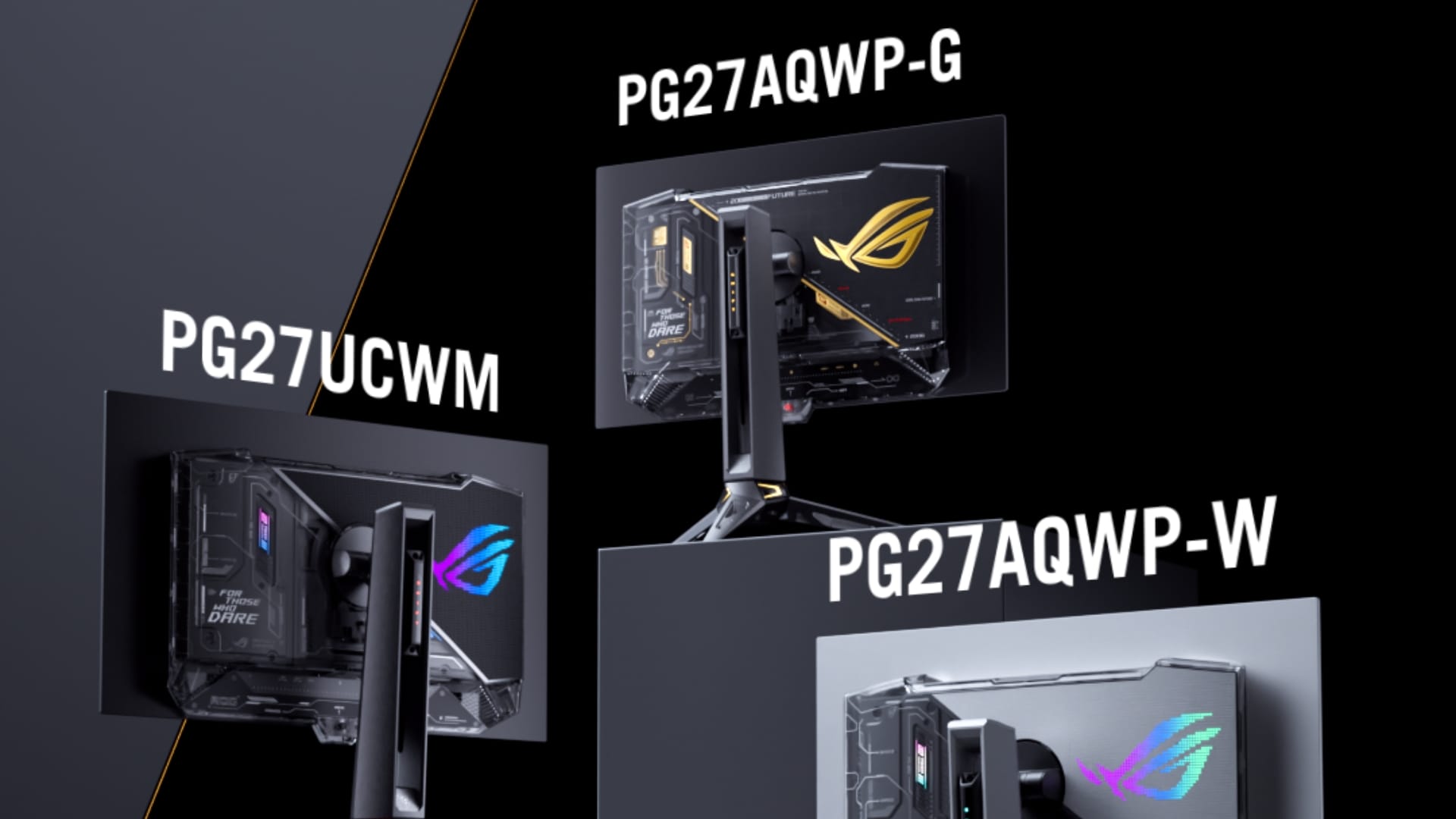
ASUS and Republic of Gamers have announced a broad display lineup at COMPUTEX 2026, covering high-refresh gaming monitors, creator-focused 4K QD-OLED displays, portable productivity screens, and video conferencing monitors for hybrid work.
The announcements are led by ROG’s OLED gaming monitors, including the ROG Swift OLED PG32UCWM and PG27UCWM with RGB Stripe Pixel OLED technology, and the ROG Strix OLED XG259QWPG Ace, which ASUS describes as the world’s first OLED esports monitor. ASUS also introduced new ProArt 4K QD-OLED displays for post-production workflows, new ZenScreen portable monitors, and business displays with built-in webcams, Microsoft Teams controls, and USB-C docking.
ROG expands OLED across gaming and esports
ROG’s OLED lineup is built around several display types rather than a single monitor category. The ROG Swift OLED PG32UCWM and PG27UCWM use Tandem RGB OLED panels, while the ROG Strix OLED XG259QWPG Ace targets esports players with a smaller, faster Tandem WOLED panel.
The ROG Swift OLED PG32UCWM is a 32-inch 4K Tandem RGB OLED monitor with a TrueBlack Glossy coating and Dual Mode visuals. Users can switch between 4K at 240Hz and FHD at 480Hz, while a 0.03ms response time is aimed at reducing ghosting and motion blur. ASUS said the monitor’s RGB Stripe Pixel OLED technology delivers 27% larger colour volume than previous WOLED panels by removing the white subpixel.
The PG32UCWM also supports Dolby Vision, VESA DisplayHDR 400 True Black, 99% DCI-P3, true 10-bit colour, and Delta E<2 colour accuracy. Connectivity includes DisplayPort 2.1a UHBR20 with full 80Gbps bandwidth, HDMI 2.1, and USB-C with 90-watt power delivery. The PG32UCWM and 27-inch PG27UCWM are expected to be available in early Q3 2026.
For esports, the ROG Strix OLED XG259QWPG Ace uses a 24.5-inch 1920 x 1080 TrueBlack Glossy Tandem WOLED panel with a 540Hz refresh rate and 0.02ms response time. ASUS said Tandem WOLED technology provides up to 15% higher peak brightness, 25% larger colour volume, and 60% longer OLED lifespan compared with previous-generation WOLED panels.
ASUS said ROG worked with BLAST and PGL to gather feedback from professional gamers for the XG259QWPG Ace. The monitor includes measurement markings on the stand and base, a Quick OSD menu, and three Esports Color modes for players moving from TN panels to OLED.
ROG also introduced the Strix OLED XG32UQWMS, a 31.5-inch 4K TrueBlack Glossy Tandem WOLED monitor with Dual Mode support for 4K at 240Hz or FHD at 480Hz. It includes VESA DisplayHDR 500 True Black, 99.5% DCI-P3, true 10-bit colour, Delta E<2 colour difference, DisplayPort 1.4 DSC, two HDMI 2.1 ports, and a USB hub.
The ROG Strix 5K XG27JCEG adds a higher-resolution option to the gaming range. It features a 5120 x 2880 panel with 218ppi pixel density and Frame Rate Boost technology, allowing users to switch from 5K at 80Hz to QHD at 320Hz. It also includes a KVM switch, DisplayPort 1.4 DSC, HDMI 2.1, USB-C with 15-watt power delivery, ASUS DisplayWidget Center, and ROG Gaming AI features including AI Visual, Dynamic Shadow Boost, and Dynamic Crosshair enhancements.
ASUS has also updated OLED Care Pro on selected ROG OLED monitors. The upgraded Neo Proximity sensor now has five adjustable motion sensitivity levels and a 1 to 15 minute Auto Away Timer. The ROG Swift OLED PG27UCWM, PG32UCWM, and Strix OLED XG259QWPG Ace also use GaNFET in their power supply design, which ASUS said reduces waste heat at the hottest point in the system by nearly 35% and lowers vent temperature by 10%.
ProArt QD-OLED displays target calibrated creator workflows
The ProArt Display OLED PA32USD is the lead model in ASUS’ new creator display lineup. It features a 31.5-inch 4K QD-OLED panel with up to 1000-nits peak brightness over a 3% area, 99% DCI-P3 coverage, and true 10-bit colour depth.
ASUS is positioning the PA32USD for video editing and post-production workflows. The monitor is factory calibrated to Delta E<1 colour accuracy and supports ASUS ProArt calibration software, Calman, and Light Illusion ColourSpace CMS professional hardware-calibration software.
The PA32USD also carries a broader set of professional connectivity options than the gaming models. It includes dual Thunderbolt 4 ports, with one supporting up to 96-watt Power Delivery and the other offering daisy-chain support. It also has HDMI 2.1, DisplayPort 2.1, a built-in USB 3.2 hub, and dual 12G-SDI inputs for uncompressed video signals at up to 4K at 60Hz. ASUS is also bundling two stands and a wraparound hood to reduce reflections in studio or location work.
ASUS also announced the ProArt Display OLED PA279CDV and PA329CDV. The 26.5-inch and 31.5-inch monitors use 4K QD-OLED panels with up to 1000-nits peak brightness over a 3% area, 99% DCI-P3, true 10-bit colour, and Delta E<1.5 factory calibration. Both include USB-C with 96-watt Power Delivery, HDMI 2.1, DisplayPort 1.4 DSC with daisy-chaining support, a built-in USB 3.2 hub, and Auto KVM for switching between two connected laptops or PCs.
ASUS adds portable, TUF Gaming and video conferencing displays
ASUS’ wider display lineup also includes new TUF Gaming, ZenScreen, and business monitors. The TUF Gaming Series 5 models are aimed at gamers who want high refresh rates and a more compact desk setup.
The TUF Gaming VG34WQML5F is a 34-inch WQHD 1500R curved Fast VA monitor with a 240Hz refresh rate and 0.5ms grey-to-grey response time. It supports Frame Rate Boost switching from WQHD at 240Hz to HD at 480Hz, alongside VESA DisplayHDR 400, 95% DCI-P3, ASUS Extreme Low Motion Blur, AMD FreeSync Premium, adaptive sync, and ASUS DisplayWidget Center.
The TUF Gaming VG27AQML5F uses a 27-inch QHD Fast IPS panel with a 320Hz refresh rate and 0.3ms grey-to-grey response time. It supports HDR10, VESA DisplayHDR 400, 95% DCI-P3, ASUS Extreme Low Motion Blur Sync, AMD FreeSync Premium, and G-SYNC compatibility. Both TUF models are compatible with the TUF Gaming Monitor Arm AAS02.
For portable work, the ASUS ZenScreen OLED MQ14FCKV is a 14-inch OLED monitor with a 16:10 1920 x 1200 panel, 90% DCI-P3 coverage, M Model P3 Color Temperature mode, and support for up to 65-watt USB-C power passthrough. It weighs less than 500 grams.
The ASUS ZenScreen Duo MB14FCD uses dual 14-inch 16:10 FHD IPS panels to create a 20-inch workspace. It includes a 360° hinge, integrated kickstand, tripod mount, dual USB-C with power pass-through, mini-HDMI, and ASUS DisplayWidget Center auto-rotation.
ASUS also introduced the ZenScreen Color ePaper MP13UC, a 13.3-inch display with a 300ppi, 3200 x 2400 panel that supports 4,069 colours. It has a 35Hz refresh rate, ASUS Ghosting-Free technology, touch support, and TÜV Rheinland certification for zero blue light and zero flicker. The display includes the foldable ZenScreen ATS01D stand, which supports height adjustment, tilt, and ±90° pivot. The stand can also be purchased separately.
For hybrid workspaces, the ASUS BE34WCGNK and BE27ACGNK Video Conferencing Monitors include built-in 5.0-megapixel webcams, dedicated Microsoft Teams controls, Windows Hello support, RJ45 connectivity, and ASUS Power Sync 96-watt power delivery. The BE34WCGNK uses a 34-inch WQHD 1500R curved VA panel, while the BE27ACGNK uses a 27-inch QHD IPS panel. Both monitors have a 120Hz refresh rate, 99% sRGB coverage, TÜV Rheinland-certified Low Blue Light and Flicker-free features, EPEAT 2.0 Gold certification, and EPEAT Climate+ certification.