


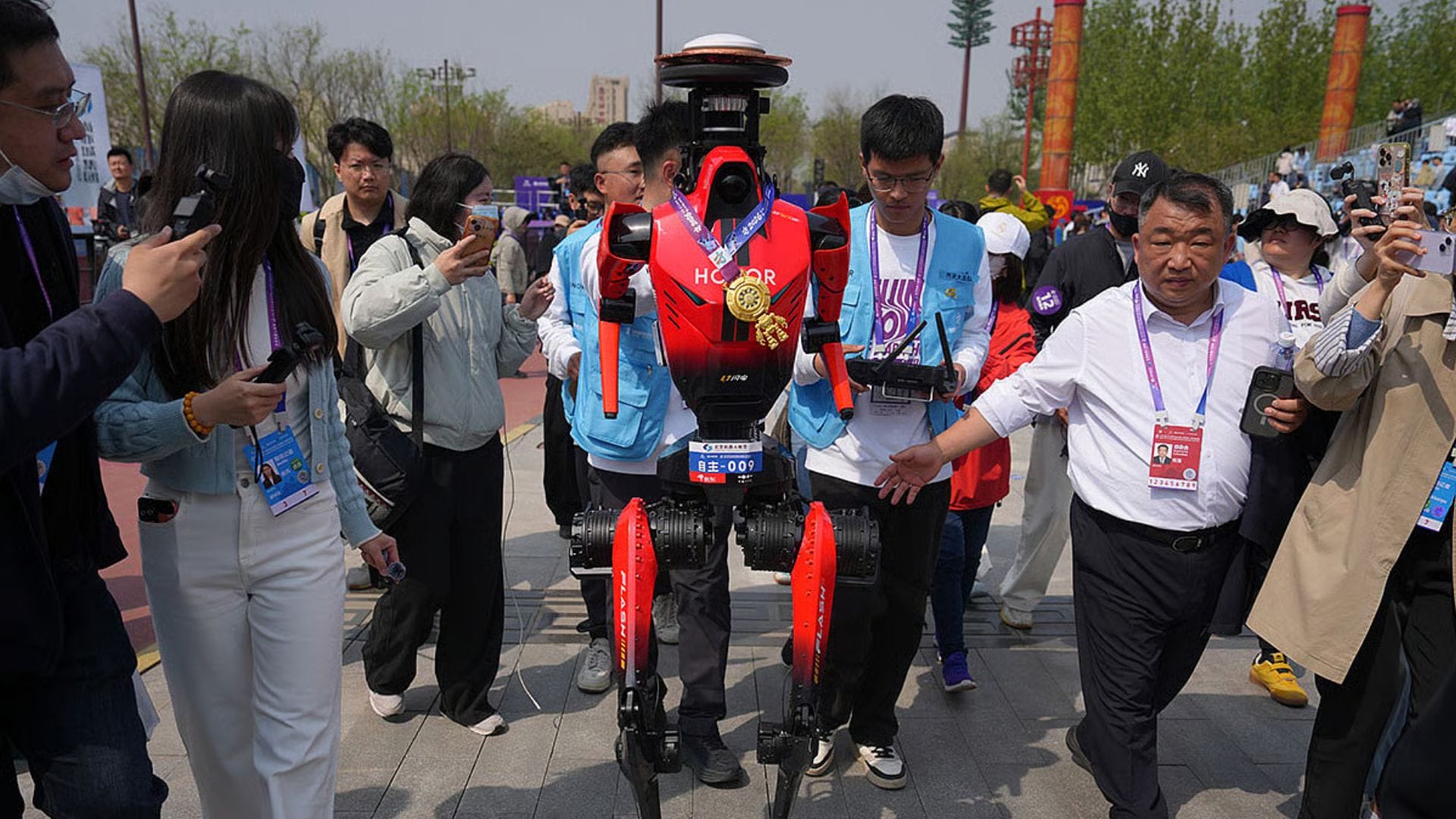
The humanoid robot half-marathon in Beijing returned for its second year with markedly improved results, signalling rapid progress in robotics performance and reliability. The unusual sporting event, which features humanoid machines racing over 13 miles, attracted attention after last year’s debut, which produced several technical failures and awkward moments.
Organisers positioned this year’s race as a demonstration of technological progress among Chinese robotics developers. More than 100 machines took part, representing a significant increase in participation compared with the inaugural edition. While the spectacle retained its novelty, the event also highlighted how quickly robotic mobility and autonomy are advancing.
The race is designed not only as a competitive showcase but also as a testing ground for endurance and navigation technologies. Humanoid robots must maintain balance, manage energy use and navigate a fixed route over long distances. These tasks present challenges similar to those faced by humans, making the race a public demonstration of engineering capability and innovation.
Improved performance marks a clear technological leap
This year’s race saw a dominant performance from the technology firm Honor, which is widely known for its smartphone business but is increasingly investing in robotics. Its red-coloured robot, named Lightning, claimed first place with a finishing time of 50 minutes and 26 seconds.
The winning time represented a dramatic improvement compared with last year’s competition. It also demonstrated how far humanoid robotics has progressed within a short period. Lightning’s performance stood out not only for speed but also for reliability, as the robot completed the route with minimal interruptions.
Honor secured the remaining podium positions as well, reinforcing its technological strength in the field. According to reports from state broadcaster China Central Television, all of the company’s podium-finishing robots navigated the course autonomously. This meant they relied on onboard sensors and algorithms rather than external human control.
Such autonomy represents a key milestone in robotics development. Machines capable of making real-time decisions while maintaining stability over long distances are considered essential for future industrial and service applications. The strong performance of these robots suggests that developers are moving closer to achieving reliable, fully independent movement.
Lessons learned from last year’s setbacks
The second edition of the race followed the widely discussed inaugural event, which produced several embarrassing moments. During the first competition, many robots struggled to remain upright, with some falling at the starting line or requiring human assistance to complete the course.
Last year’s fastest robot, known as Tiangong Ultra, recorded a finishing time of two hours and 40 minutes. That performance highlighted the technical limitations of early prototypes and underscored the gap between ambition and execution.
In contrast, this year’s faster completion times and smoother navigation suggested that developers had addressed many of those weaknesses. Improvements in balance control, motor efficiency and navigation systems were evident throughout the event.
However, not all machines performed flawlessly. Observers noted that technical failures persisted, reminding spectators that the technology is still in development. Even robots from leading teams experienced occasional crashes or stumbles along the route.
Despite these incidents, the overall reduction in mishaps marked an important step forward. Engineers appeared to have refined both hardware durability and software decision-making, enabling robots to recover more quickly from unexpected situations.
Mixed autonomy highlights ongoing development challenges
While many robots demonstrated strong independence, not all competitors operated entirely on their own. Reports from the BBC indicated that roughly 40% of participants ran autonomously, while the remainder were controlled remotely by human operators.
This mixture of autonomy levels reflects the current transitional stage of humanoid robotics. Some teams are confident enough to allow machines to run without direct input, while others continue to rely on manual guidance to ensure stability and safety.
The continued presence of remote-controlled robots shows that fully autonomous movement remains difficult to achieve across all systems. Navigation over extended distances introduces unpredictable factors, such as uneven terrain or mechanical strain, which can challenge even advanced designs.
Even leading performers were not immune to technical issues. Some of Honor’s machines reportedly experienced falls during the race, although they were able to resume operation afterwards. Such incidents illustrate that reliability, rather than speed alone, remains a central engineering priority.
Beyond its technical achievements, the event also drew comparisons with human athletics. The finishing time of Lightning was several minutes faster than a recently recorded human half-marathon time set by Ugandan runner Jacob Kiplimo last month. Although such comparisons are largely symbolic, they highlight the increasing pace of innovation in robotic design.
As the competition gains international attention, organisers are expected to continue refining the event format. Future editions may introduce stricter autonomy requirements or longer distances to challenge participants further. These developments could transform the race into a recognised benchmark for humanoid robotics worldwide.