

Gaming handhelds are giving the PC industry a new battleground at a time when gaming laptops are becoming harder to distinguish from one another. Omdia expects global PC gaming handheld sales to reach 2.3 million units in 2025 and 4.7 million units annually by 2029, leaving the market far below laptops, consoles and smartphones. The numbers are still modest, but the presence of Intel, AMD, ASUS, Acer, MSI, Microsoft and Valve shows that the industry sees greater strategic value than the sales volume alone suggests.
Gaming laptops now follow a familiar upgrade cycle built around faster processors, stronger graphics, brighter displays and improved cooling. Handhelds remain less settled, giving companies more freedom to decide what portable PC gaming should look like. Some devices aim to deliver a compact version of a gaming PC, while others lean towards a console-style experience or act as a companion to hardware already in the home.
The competition, therefore, extends beyond performance. Chipmakers want to prove that their processors can deliver useful gaming power without overwhelming a small battery or cooling system. PC brands are looking for a product class that offers more room for differentiation than the conventional laptop. Microsoft and Valve are competing to shape how players access and manage their games. The companies that bring those pieces together most convincingly will have a stronger case for asking buyers to add another costly gaming device to their existing setup.
Intel and AMD are making different bets
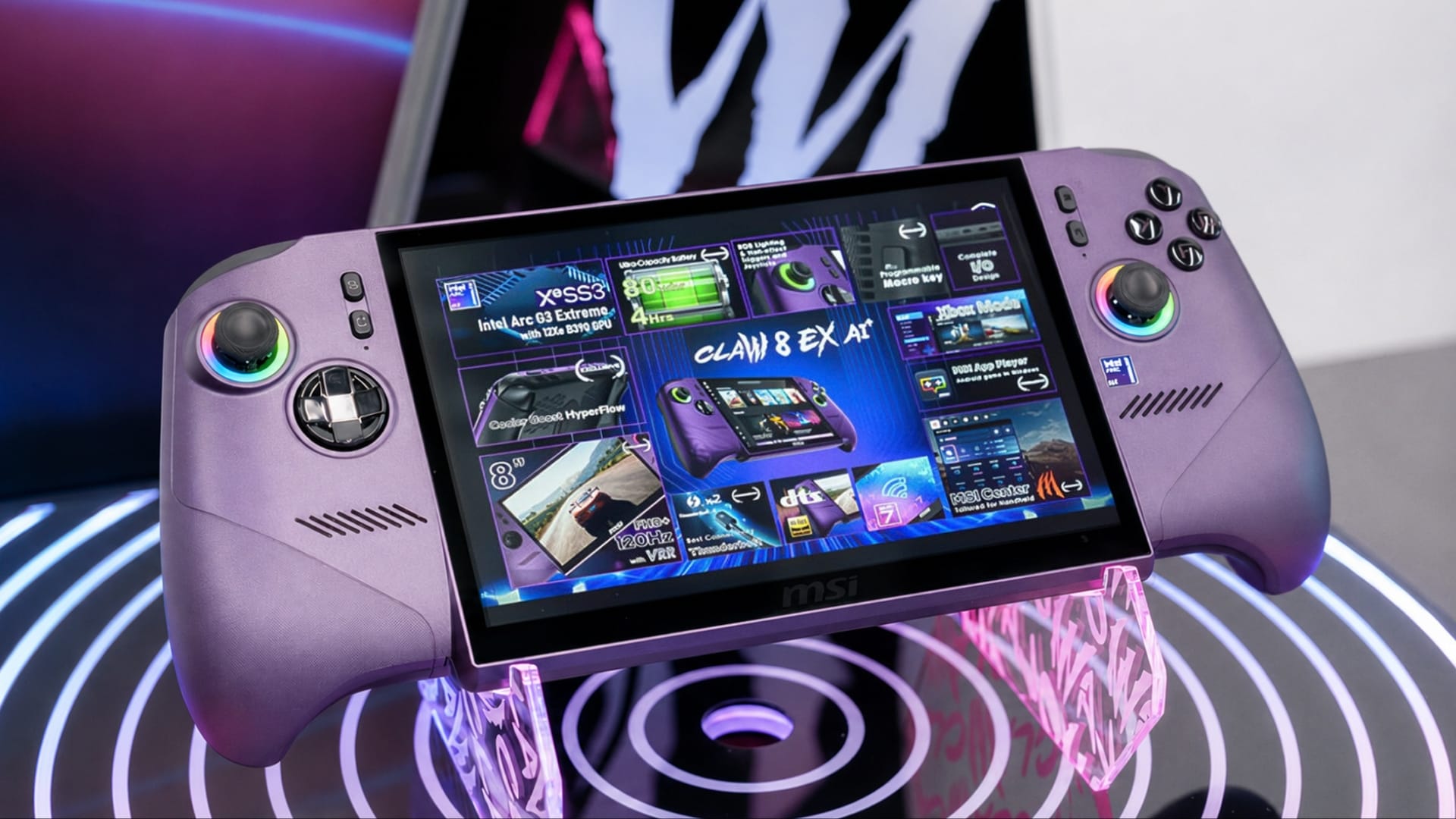
Intel is making a more serious push into gaming handhelds with Arc G-Series, and Acer, MSI and OneXPlayer are among the first manufacturers to use the new processors. Their devices will show whether Intel can compete with AMD in a form factor where power consumption, heat and battery life are much harder to manage than in a laptop.
The Predator Atlas 8 and Claw 8 EX AI+ are particularly important because they put Arc into products from established PC gaming brands. If Intel delivers stable performance without excessive heat, fan noise or battery drain, it will gain a credible foothold in the handheld market. Any weakness, however, will be immediately obvious to players because the device is being held and used directly throughout a gaming session.
ASUS is taking another route with the ROG XBOX Ally X20 Bundle, which keeps AMD at the centre through the Ryzen AI Z2 Extreme. Its OLED display, updated controls and bundled ROG XREAL gaming glasses show how ASUS is trying to distinguish the product through the wider experience rather than processor choice alone. The device also keeps AMD prominent in the premium handheld market while Intel works to establish Arc as a credible alternative.
Handhelds make these trade-offs much harder to hide. A gaming laptop has room for larger cooling systems and batteries, and many users will run it plugged in during demanding sessions. A handheld has to deliver acceptable performance without becoming too hot, noisy, heavy or uncomfortable to hold, so any weakness in the design quickly becomes obvious during play.
PC brands still need to explain the use case
Gaming laptops remain versatile machines that can serve work, study, content creation and entertainment alongside gaming. Their strengths and compromises are widely understood, even when individual models differ in size or performance. Gaming handhelds are more specialised, which means buyers need a clearer reason to add one besides a laptop, console or smartphone they already own.
The market has yet to settle on the handheld’s role. It can be a primary gaming device for someone who values portability, a travel companion for a desktop PC owner, or a secondary machine used around the home. It may also appeal to players who want access to PC games without opening a laptop, although that convenience has to outweigh the limitations of a smaller screen, reduced battery life and a less flexible design.
These distinctions make handhelds harder to compare than gaming laptops. Processor and display specifications provide only part of the answer. Buyers also need to know whether games resume reliably, whether Windows is comfortable to navigate without a keyboard, how easily different game stores work together, and whether the controls remain consistent across a varied library. Repair options, storage upgrades and docking support may also influence whether the device remains useful after the initial novelty fades.
The ROG XBOX Ally X20 illustrates the value problem facing premium models. Its display, controls and gaming glasses give ASUS a product that stands apart from conventional handhelds, but those additions also raise expectations around price and everyday usefulness. A richer bundle can appeal to enthusiasts who want a broader gaming setup, though it does not eliminate the familiar limitations of battery life, heat, weight, and software complexity.
PC brands, therefore, need to explain each device’s purpose more clearly. A buyer should be able to understand whether a handheld is intended to replace another gaming machine, extend an existing setup or provide a convenient way to play while travelling. Without that clarity, even technically capable products risk being seen as expensive accessories searching for a lasting role.
Streaming offers a lighter alternative
Acer’s Nitro Blaze Link takes a different approach by leaving the demanding processing work to another machine or service. Instead of running games locally, it acts as a screen and control interface for content streamed from a gaming PC, a cloud platform, or a home network.
Removing the need for powerful local hardware can make a streaming device lighter, simpler and potentially more affordable. It can also avoid some of the heat and battery demands faced by full Windows handhelds. The compromise is that the quality of the experience depends on the connection, the host machine and the service providing the game.
The distinction creates two clear buying cases. A native handheld suits players who want access to PC games without a stable network connection, including while travelling or in places where streaming is unreliable. A device such as Nitro Blaze Link is better suited to someone who already owns capable gaming hardware and wants to continue playing elsewhere in the home.
Acer’s decision to offer both approaches shows that the industry has not settled on a single answer. Some buyers may accept the additional weight and cost of local performance, while others may prefer a lighter companion device that extends the hardware they already own. The products may look similar at first glance, but their usefulness changes considerably when they are taken out of a reliable network or asked to work independently.
Clear positioning will be important because the difference between the two models is greater than their outward designs suggest. A buyer expecting a self-contained gaming PC could be disappointed by a streaming device, while someone seeking a light home companion may find a full Windows handheld unnecessarily expensive and complicated.
Software will decide whether handhelds feel complete
Windows handhelds give players access to Steam, the Epic Games Store, Battle.net, XBOX Game Pass and other services, which remains one of their strongest advantages. Players can carry an existing PC library across devices rather than be locked into a closed console ecosystem. The problem is that Windows still brings desktop habits into a product that needs to feel immediate and easy to control.
Background processes, pop-ups, small interface elements and inconsistent controller support can make a powerful handheld feel unfinished. A device may run games well once everything is configured, but reaching that point can require more navigation and manual adjustment than many buyers expect from portable gaming hardware.
Microsoft’s XBOX Mode is intended to reduce that friction by giving Windows handhelds a more controller-friendly interface. Its use on devices such as the MSI Claw 8 EX AI+ and ROG XBOX Ally X20 shows that software presentation has become part of the product itself rather than a secondary feature. Microsoft needs Windows handhelds to feel designed for gaming, not like desktop computers reduced to smaller screens.
Valve already has an advantage in this area through SteamOS, which gives the Steam Deck and other compatible devices a more focused route into games. Microsoft offers access to a wider range of stores and services, but that flexibility creates additional complexity. Valve can provide a more controlled experience, while Microsoft has to make several competing platforms feel coherent within Windows.
PC brands cannot solve that problem alone. Acer, MSI and ASUS can improve their controls, cooling, batteries and displays, but they still depend on Microsoft, chipmakers, game stores and developers to deliver reliable performance and consistent behaviour. Strong hardware will not compensate for slow wake times, confusing menus or games that require frequent manual tuning.
Once the launch excitement fades, buyers will judge these handhelds by how easily they fit into existing gaming habits. ASUS, Acer and MSI are building gaming handhelds that run games locally, while Nitro Blaze Link is designed as a lighter streaming companion to hardware elsewhere. Either approach is more likely to stay in regular use if the device wakes reliably, makes game libraries easy to reach and avoids constant troubleshooting, without asking buyers to accept too many compromises in battery life, price or connectivity.