


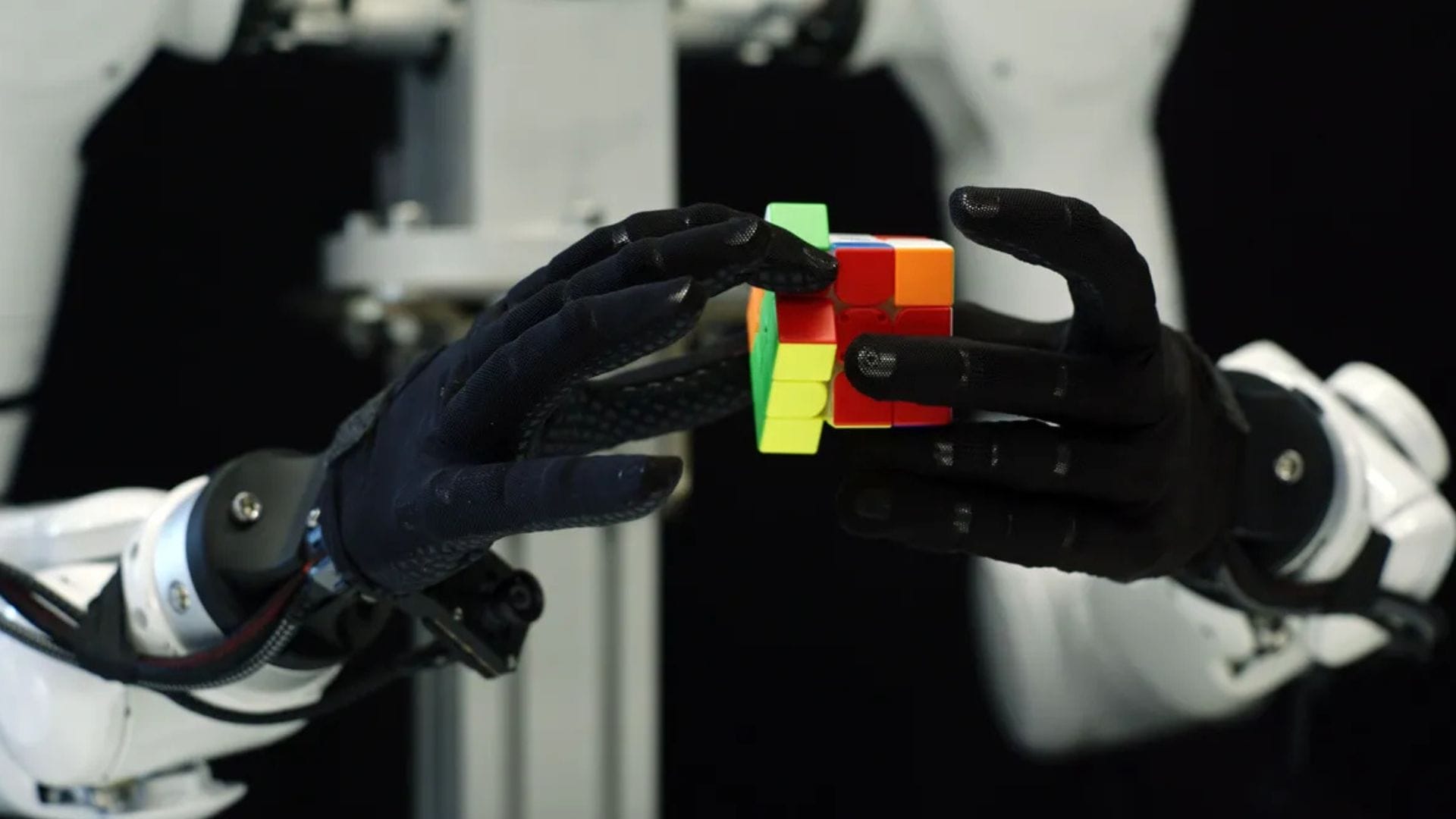
A new generation of robotic technology is beginning to tackle what experts describe as “frontier tasks” — complex, multi-step activities that humans perform almost instinctively but remain difficult for machines to replicate. These tasks include cooking, laboratory work, and solving puzzles, all of which require a high level of coordination, dexterity, and adaptability.
Recent demonstrations by Genesis AI highlight significant progress in this area. In one example, a pair of robotic hands prepared scrambled eggs, pausing briefly to wipe egg yolk from its fingers with a towel. The gesture, seemingly minor, stood out as remarkably human-like and underscored how far robotics has advanced in mimicking natural behaviour.
The same robotic system has also demonstrated its ability to solve a Rubik’s Cube, assist with laboratory procedures, and prepare a smoothie. These achievements suggest that machines may soon be capable of performing a wide range of manual tasks traditionally reserved for humans. According to Vivian Sun, Vice President of Commercial and Strategy at Genesis AI, the challenge lies in replicating the complexity of human hand movements. She noted, “80% of human labour is done with their hands,” highlighting the importance of dexterity in everyday work.
Training robots through human experience
To address this challenge, Genesis AI has developed an end-to-end system that focuses on capturing and replicating human actions. Central to this approach is a set of proprietary wireless gloves equipped with sensors and cameras. Trainers wear these gloves while performing repetitive tasks, enabling the system to record detailed motion data and hand interactions.
Sun described the method as “the most natural way to interact with the physical world”, emphasising its advantage over traditional training techniques. Trainers also use head-mounted cameras to capture their perspective, providing additional context for how tasks are performed. This combination of hand and visual data creates a comprehensive dataset that reflects real-world human behaviour.
The collected information is then combined with large volumes of online video content showing similar activities. This data is processed using the company’s Gene Foundation model, which interprets and translates human actions into robotic movements. The result is a system capable of transferring human skills directly into robotic form with high accuracy.
Genesis AI argues that this approach is more efficient and cost-effective than teleoperation, a commonly used method in robotics training. Teleoperation typically requires complex setups and controlled environments, which can be difficult to replicate for specialised tasks. Sun explained that recreating scenarios such as jet engine repair in a training facility is often impractical. By contrast, the glove-based system allows for flexible, real-world data collection at a significantly lower cost.
Towards a future of collaborative robotics
The design of the robotic hands themselves plays a crucial role in their effectiveness. Genesis AI has focused on creating hands that closely resemble human anatomy in both form and function. The hands are proportioned similarly to human hands and are capable of fluid, natural movements. When covered with gloves, they can be difficult to distinguish from real human hands at a glance.
This emphasis on realism helps bridge the “domain gap” between human and machine capabilities. By aligning the physical structure of robots with human expectations, the system can more easily replicate the subtle nuances of manual tasks. The result is a level of precision and adaptability that could make robots more useful in domestic and professional settings.
Looking ahead, Genesis AI plans to expand its technology beyond individual demonstrations. The company envisions mass-producing its training gloves and distributing them to businesses and households. This would allow users to contribute to the training process by performing everyday tasks, effectively crowdsourcing the development of robotic skills.
While the current focus remains on robotic hands, the company is also working on a complete humanoid robot. Details about this future system, including its name, have yet to be announced. However, Sun confirmed that development is ongoing and that further updates will be shared soon.
Reflecting on the progress made so far, Sun described her reaction to the demonstrations as one of surprise. “I was personally just stunned… seeing it in reality, performing this type of long-horizon, very complicated tasks, it was almost like a moment of reality check: here is the world we’re living in,” she said.
The advancements showcased by Genesis AI suggest that robots capable of performing intricate, human-like tasks may soon become part of everyday life, reshaping industries and redefining the relationship between humans and machines.