

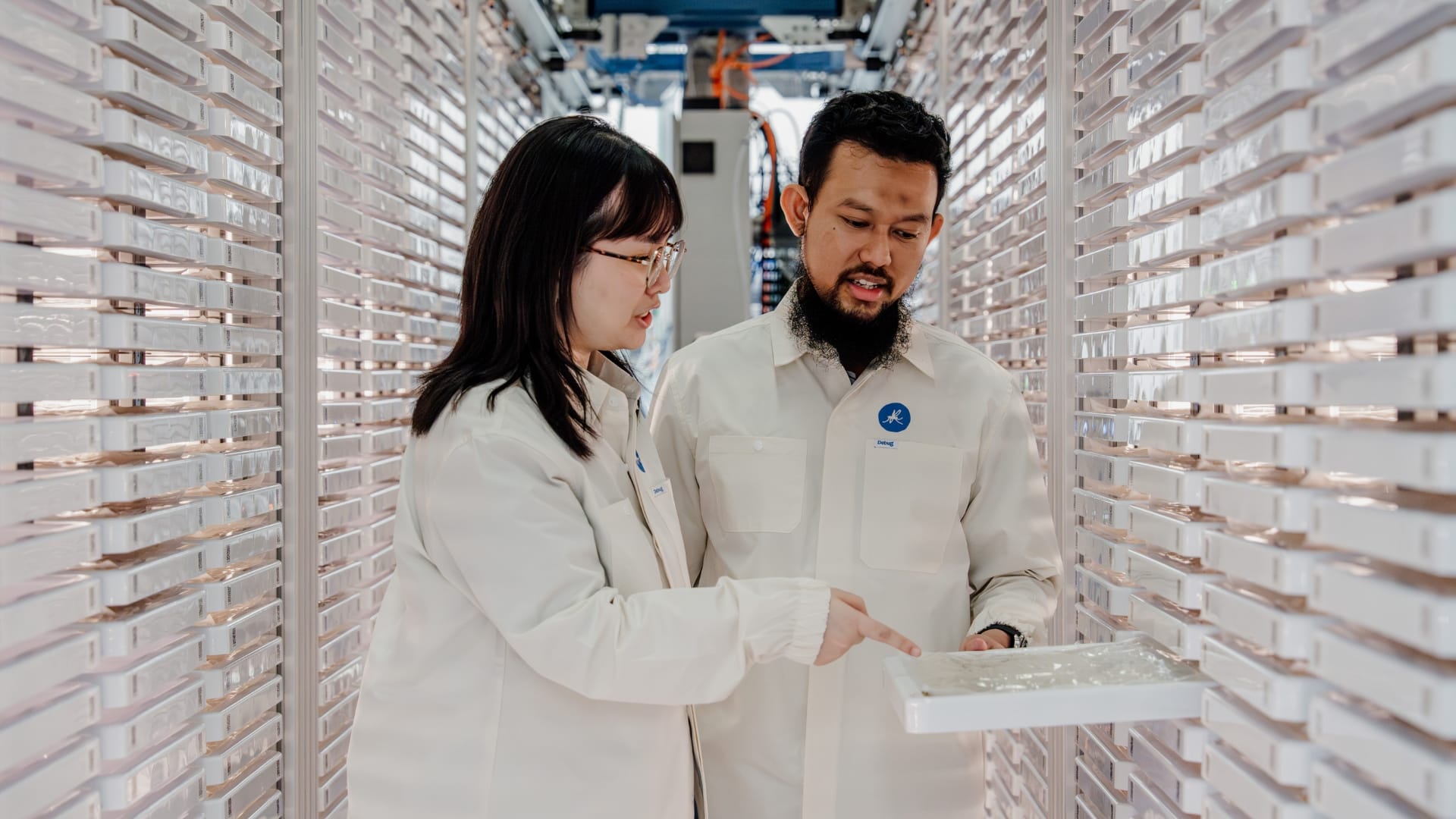
Controlling dengue in dense Asian cities increasingly depends on the ability to produce, sort, and release mosquitoes at industrial scale. Google’s Debug initiative is expanding its Singapore research and production site to support that operational challenge, making the country its first international R&D hub and largest facility for adult mosquito production.
The expanded site will bring together software engineers, hardware engineers, mosquito scientists, AI, robotics, and automated release systems. The goal is to increase production of Wolbachia-carrying male mosquitoes for use in Singapore, Southeast Asia, and other markets where mosquito-borne diseases remain a public health burden.
Scaling mosquito production in dense cities
Debug has supported Singapore’s National Environment Agency on Project Wolbachia since 2018 and opened its first end-to-end mosquito production facility in 2022. By 2024, it was releasing 6 million male Wolbachia mosquitoes a week. The weekly figure now exceeds 10 million.
The programme uses male Wolbachia-carrying mosquitoes to suppress the Aedes aegypti mosquito population, reducing the risk of dengue transmission among residents. Trials by NEA cited in the announcement showed 80% to 90% suppression of the Aedes aegypti population and more than 70% reduction in dengue incidents after 6 to 12 months of releases.
Singapore’s housing density makes the release process a major part of the deployment model. Treatment sites must be covered efficiently across high-rise residential areas, which places pressure on production consistency, route planning, and manpower allocation.
Debug said it has released more than 1 billion male mosquitoes globally since inception, across communities in Singapore, Italy, Australia, and the US. Its Singapore expansion builds on that deployment experience while giving the company a larger base to refine its technology for Asia Pacific markets.
AI and robotics move into biological deployment
The expanded facility will deepen automation across mosquito rearing, sorting, and release. At the production level, Debug uses Larval Rearing and Pupae Separation systems to automate the process from larvae growth to pupae separation. Male pupae are separated based on sexual size differences before entering the adult sex-sorting process.
This stage is central to the model because only male mosquitoes are released. Debug uses proprietary AI-powered computer vision to separate adult male and female mosquitoes, with the expanded R&D team working to improve sorting accuracy for non-biting males.
The release layer is also being automated. Debug’s software-enabled release vans have been locally tested in Singapore and are designed to improve coverage of treatment sites while using manpower more efficiently. In a programme that requires repeated releases across many residential areas, logistics can determine whether laboratory output translates into field coverage.
The expansion is therefore less about a single scientific breakthrough than the industrialisation of a biological intervention. Debug’s work combines custom software, hardware automation, AI, and mosquito science to make Wolbachia deployment more consistent at scale.
Singapore as a testbed for wider regional deployment
Debug’s current work in Singapore is centred mainly on mosquito population suppression. The expanded site will also support research into population replacement for other markets. That approach involves releasing mosquitoes that pass Wolbachia to the next generation, gradually replacing disease-carrying populations with mosquitoes less able to transmit dengue.
A new specialised larval rearing unit will support these replacement programmes for deployment in other countries. Debug said this could help tailor cost-per-person protected targets for Southeast Asian countries with larger populations.
Aedes aegypti remains the priority, but the facility and technology are designed to rear different mosquito species for other vector-borne diseases. That flexibility could be important for markets where disease vectors and urban conditions differ from Singapore’s.
“When we first launched Debug in Singapore, our goal was to advance mosquito production and releases through technology and bring Debug to more communities in Asia, where 70% of the global dengue burden occurs,” said Linus Upson, Head of Debug. “Our success in Singapore gives us the confidence to expand. Choosing Singapore as our first international R&D hub underscores our confidence in the nation’s deep-tech ecosystem, talents, and its leadership in deploying the Wolbachia method. This new chapter is about accelerating Asian-tailored solutions and scaling our experience to make Debug’s end-to-end technology accessible globally,”
Google said the expansion is part of its wider commitment to grow its Singapore R&D footprint, build local research capabilities for the region, and develop technologies across its products and platforms.