

At Mobile World Congress Barcelona 2026, Honor expanded its artificial intelligence roadmap with a series of hardware and ecosystem announcements spanning smartphones, robotics and computing devices. The company positioned the developments under its Augmented Human Intelligence vision and ALPHA PLAN framework, signalling a shift from feature-led upgrades to a broader platform strategy built around human-centric AI.
Presented on 2 March in Barcelona, the announcements were structured around three pillars, Alpha Phone, Alpha Store and Alpha Lab. Together, they are intended to define how Honor integrates hardware, software and materials innovation in the AI era. Alongside a conceptual “Robot Phone”, the company introduced its latest foldable flagship, the Magic V6, as well as new ecosystem products including the MagicPad 4 and MagicBook Pro 14.
James Li, Chief Executive Officer of Honor, said: “With Human-centric as our lighthouse, we navigate the growth of AI through the two beams of IQ and EQ, bringing three forms of intelligence together. We are exploring the new paradigm of AI devices with Alpha Phone; hosting the new paradigm of AI ecosystem with Alpha Store; and building the new paradigm of a silicon-carbon civilization with Alpha Lab. With three waves of the Alpha Plan, we now have all the components in place and we are driving this journey at full warp speed.”
Reimagining the smartphone through embodied intelligence
Central to the showcase was the Robot Phone, described by Honor as a new species of smartphone. The concept explores embodied AI interaction by combining motion, spatial awareness and imaging into a single handheld device.
Rather than relying solely on screen-based input or voice assistants, the Robot Phone integrates physical movement into its interaction model. Honor characterised this as giving devices “not only a brain, but also hands and feet”, blending artificial intelligence with mechanical motion and camera articulation. The approach is designed to allow the device to adjust perspective dynamically and respond to its environment in real time.
The system incorporates multimodal perception, enabling the device to identify sounds, track motion and maintain visual awareness simultaneously. By combining sensory input streams, the Robot Phone aims to deliver more intuitive and expressive interactions, moving beyond static interfaces towards what Honor describes as a more natural engagement model.
Embedding robotic capability within a smartphone form factor required significant engineering adjustments. According to the company, integrating motion components at such a small scale demanded a reassessment of space, strength and weight at a microscopic level. Honor drew on materials expertise and reliability engineering developed through its foldable devices to address these constraints.
A self-developed micro motor was engineered to achieve extreme compactness without sacrificing durability. By significantly reducing the size of the motor, Honor was able to integrate an ultra-compact four degrees of freedom gimbal system directly into the handset. This hardware foundation enables robot-grade embodied motion control within a conventional smartphone footprint.
Expanding into humanoid robotics
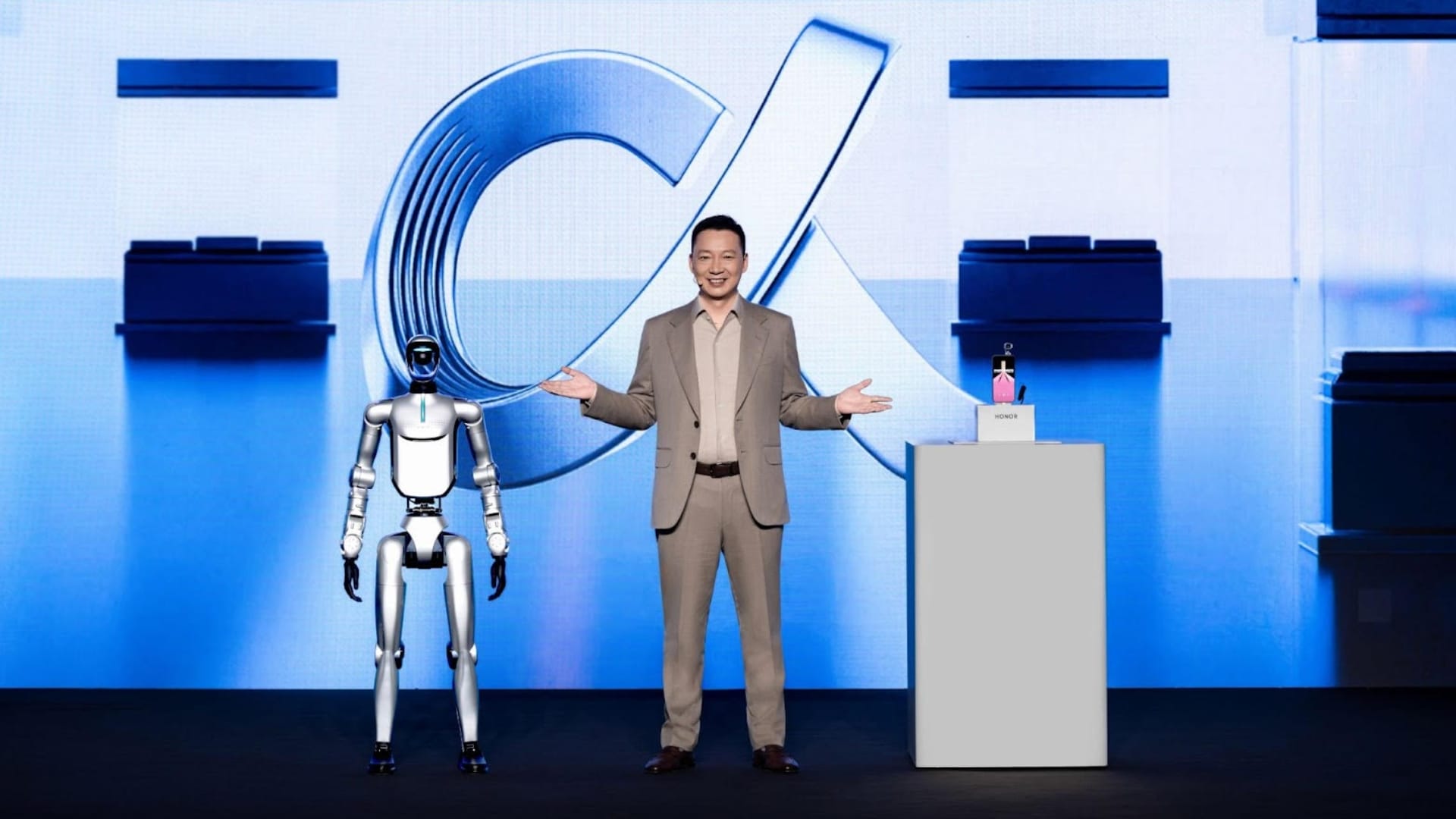
Beyond smartphones, Honor used the MWC platform to unveil its first humanoid robot, marking a broader move into consumer-grade robotics. The development reflects the company’s intention to extend its mobile technology expertise into physical AI systems.
Honor indicated that its robotics efforts will initially focus on three primary scenarios. These include shopping assistance, workplace inspections and supportive companionship. The emphasis suggests an orientation towards service and assistive roles rather than industrial automation.
The company argues that its experience in designing consumer electronics provides an advantage in understanding user behaviour and expectations. Unlike traditional robotics manufacturers, Honor claims continuity across its device ecosystem will allow embodied AI products to recognise users, interpret needs and deliver personalised assistance from the outset.
By linking smartphones, tablets, laptops and robots under a common AI framework, Honor is positioning itself to create an interconnected environment in which identity, preferences and behavioural data can be shared across form factors. This strategy aligns with its Alpha Store and Alpha Lab pillars, which aim to unify ecosystem services and materials innovation respectively.
Magic V6 and ecosystem integration
While robotics provided a glimpse of longer-term ambitions, Honor also reinforced its position in the premium smartphone segment with the launch of the Magic V6. The foldable device was presented as the most refined iteration of the company’s design to date.
The Magic V6 integrates silicon-carbon battery technology, advanced display engineering and AI-enhanced productivity tools. Silicon-carbon batteries are positioned as a breakthrough in energy density and efficiency, supporting thinner designs while maintaining endurance. Honor framed the technology as part of a broader push towards what it terms a “silicon-carbon civilisation”, reflecting its Alpha Lab research focus.
In addition to the foldable smartphone, Honor introduced the MagicPad 4 and MagicBook Pro 14. These devices extend the company’s AI-enabled ecosystem across tablets and laptops, reinforcing a multi-device strategy in which software intelligence and hardware design are developed in tandem.
Collectively, the announcements at MWC 2026 demonstrate Honor’s attempt to move beyond incremental hardware upgrades. By pairing flagship smartphones with embodied robotics and ecosystem expansion, the company is articulating a platform-level ambition centred on AI integration across everyday devices.
The emphasis on human-centric intelligence and embodied interaction reflects an industry-wide search for differentiation as AI capabilities become more widespread. For Honor, the challenge will lie in translating conceptual demonstrations such as the Robot Phone and humanoid robot into scalable, commercially viable products.