

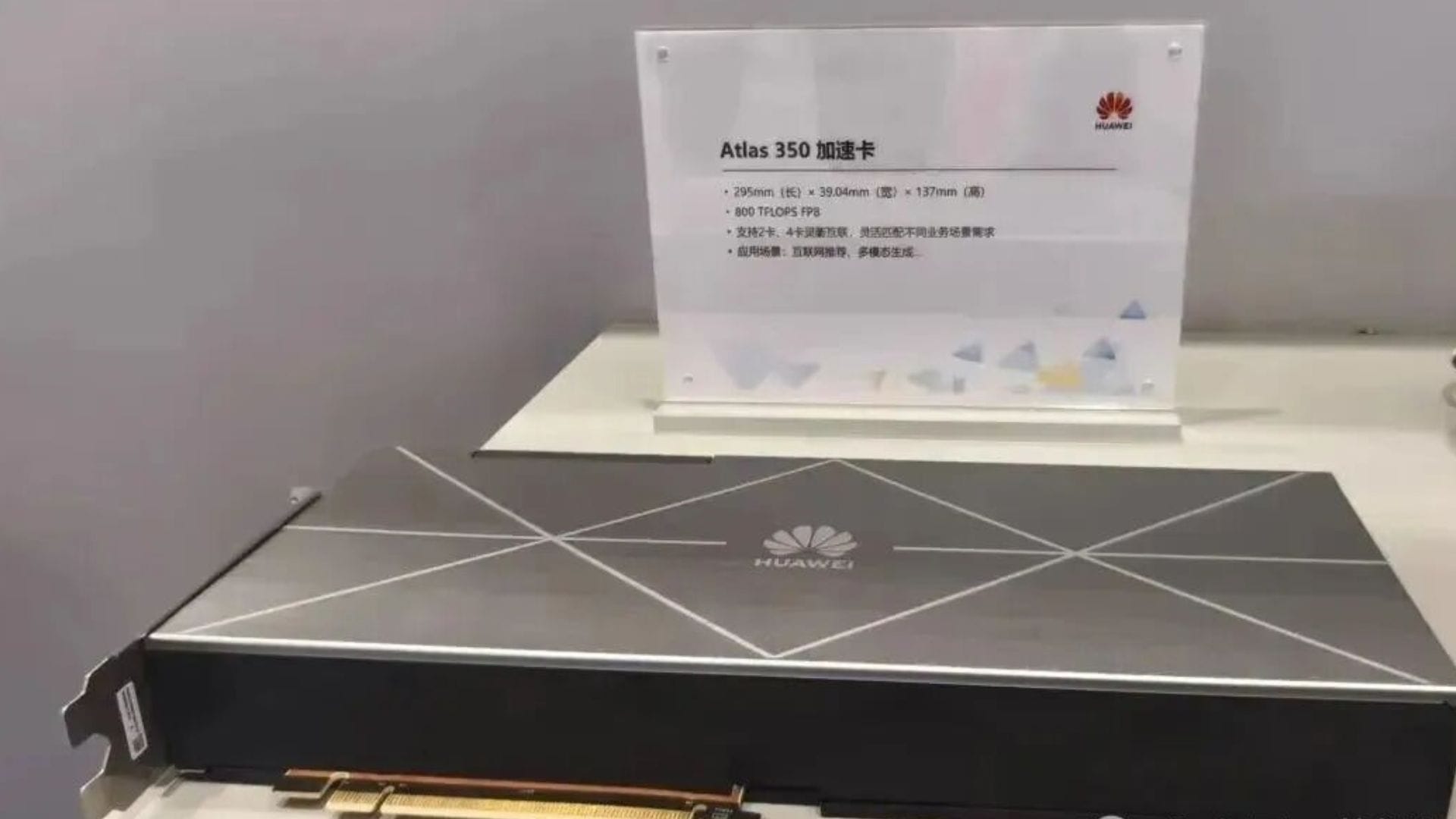
Huawei has introduced its latest artificial intelligence accelerator, the Atlas 350, at the Huawei China Partner Conference 2026 held in Shenzhen. The new hardware features the company’s Ascend 950PR processor and is positioned as a high-performance solution for enterprise AI workloads.
According to Huawei, the Atlas 350 delivers up to 1.56 petaflops of FP4 compute performance. The company claims this represents a significant improvement over competing products, including Nvidia’s H20 accelerator. However, direct comparisons remain difficult, as existing Hopper-generation GPUs do not natively support FP4 precision.
The launch marks a notable step for Huawei as it continues to expand its presence in the AI hardware market. The Atlas 350 is described as the first Chinese-developed accelerator specifically optimised for FP4 precision, a low-precision format designed to reduce memory requirements while maintaining performance for large-scale AI models.
Technical improvements and memory architecture
The Ascend 950PR processor at the core of the Atlas 350 introduces several upgrades over Huawei’s previous Ascend 910 series. These include enhancements to microarchitecture, faster memory access, and more flexible programming modes aimed at improving efficiency across a range of AI workloads.
Huawei has equipped the Atlas 350 with 112GB of its proprietary high-bandwidth memory, known as HiBL 1.0. Reports indicate that this memory system delivers bandwidth of up to 1.4TB per second, alongside a 128-byte memory access granularity. These specifications are intended to support demanding AI tasks, particularly those involving large datasets and complex model architectures.
The company states that the new configuration significantly improves performance in multimodal generation and inference scenarios. It also claims that memory access efficiency for smaller operations has increased by up to four times compared with the previous generation. This could allow developers to run more complex models without requiring additional hardware resources.
In addition to memory improvements, the Atlas 350 features an interconnect bandwidth of up to 2TB per second using Huawei’s LingQu protocol. This represents a reported 2.5-fold increase over the Ascend 910 series, enabling faster communication between components and improved scalability for distributed AI systems.
Enterprise applications and ecosystem support
Huawei is positioning the Atlas 350 as a versatile solution for enterprise use cases, including recommendation systems, large language model processing, and multimodal AI applications. These workloads are increasingly central to industries such as e-commerce, finance, and cloud computing.
The company highlighted collaboration with several partners that have already developed systems based on the new accelerator. These include Kunlun, Huakun Zhenyu, Shenzhou Kuntai, and Yangtze Computing, among others. Together, they have produced customised high-performance inference solutions tailored to enterprise requirements.
Huawei emphasised that the Atlas 350 is designed to integrate seamlessly with its broader AI ecosystem. This allows partners to optimise performance for specific workloads while maintaining compatibility with Huawei’s existing software stack. Such integration is expected to reduce development time and improve deployment efficiency for customers.
The growing ecosystem around Huawei’s AI hardware reflects a broader strategy to build a self-sustaining technology platform. By working closely with partners, the company aims to ensure its products support a wide range of real-world applications across sectors.
Market context and strategic significance
The launch of the Atlas 350 comes amid ongoing efforts by Chinese technology firms to strengthen domestic capabilities in advanced computing. Restrictions on access to certain foreign technologies have accelerated the push for self-reliance in areas such as semiconductor design and AI hardware.
Huawei has faced particular challenges due to limited access to manufacturing technologies such as TSMC’s CoWoS packaging. In response, the company has developed alternative approaches to advanced packaging, including its own solutions for high-bandwidth memory integration and stacking.
Despite these constraints, Huawei continues to advance its product roadmap. The Ascend 950PR processor, which powers the Atlas 350, was introduced in the first quarter of 2026 in line with earlier commitments. The accelerator itself has now been formally unveiled, although the company has not provided a detailed timeline for broader availability.
Pricing for the Atlas 350 is reported to be around 111,000 yuan, equivalent to approximately US$16,000. This places it within a similar range to competing accelerators such as Nvidia’s H20, which typically sells for between US$15,000 and US$25,000 depending on configuration.
The introduction of the Atlas 350 highlights Huawei’s ambition to compete more directly in the global AI hardware market. While performance claims will require independent validation, the product represents a significant development in the company’s ongoing efforts to expand its technological capabilities.