


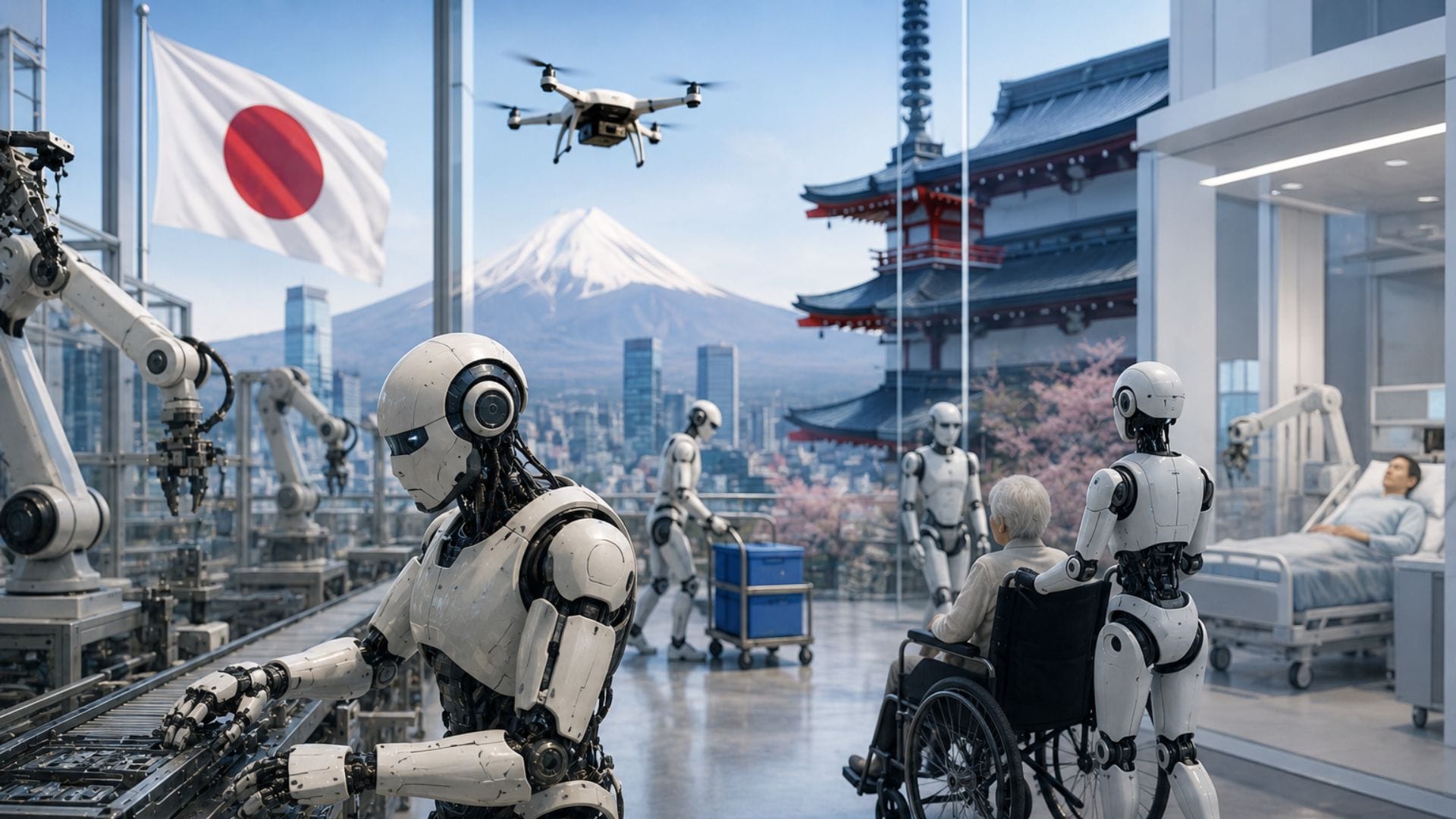
Japan has announced an updated national robotics strategy that aims to deploy around 10 million robots nationwide by 2040, as part of a wider effort to address labour shortages and strengthen its artificial intelligence capabilities.
The revised strategy, presented by Economy, Trade and Industry Minister Ryosei Akazawa, expands the government’s robotics priorities beyond previous plans to cover 18 sectors. Newly added areas include medical care and food and beverage manufacturing, reflecting growing demand for automation beyond traditional industrial settings.
The government also plans to establish a national AI robotics hub to support research, workforce training and the large-scale deployment of robotic technologies. Officials believe the initiative will help businesses adopt advanced robotics more quickly while supporting industries facing persistent worker shortages.
Government expands robotics into key service industries
Japan’s latest strategy marks a significant shift in how the country intends to use robotics over the next 15 years. While industrial robots have long been a strength of Japan’s manufacturing sector, the updated plan places greater emphasis on service industries, healthcare and food production.
Officials said the planned AI robotics hub will play a central role in helping businesses integrate robots into their daily operations. The facility will support research and development, provide training for workers and create an environment where companies can test and improve robotic systems before deploying them commercially.
A key part of the strategy is Noetra, a Japanese-developed multimodal foundation model designed specifically for physical AI and robotics applications. The project has been developed alongside work led by the National Institute of Advanced Industrial Science and Technology to create AI systems that can operate effectively in real-world environments.
Noetra is backed primarily by SoftBank, NEC, Sony Group and Honda. Fujitsu and Rakuten are reportedly considering joining the consortium in the future, potentially expanding industry participation in the initiative.
Akazawa said Japan’s extensive experience in collecting operational data from a range of sectors provides an important competitive advantage. Information gathered from elderly care facilities, disaster response operations, manufacturing plants and the Fukushima Daiichi nuclear power plant decommissioning project has contributed to the government’s confidence in the programme.
“The utilisation of accumulated data” would become Japan’s “winning strategy,” he said, arguing that international competition in AI will increasingly depend on access to valuable datasets rather than computing power alone.
Data and international cooperation form the foundation
Alongside expanding robot deployment, the Japanese government plans to invest heavily in the data infrastructure needed to support physical AI systems. Officials believe that building high-quality datasets grounded in Japan’s industrial expertise will help develop AI models better suited to domestic industries and practical applications.
The strategy draws on decades of experience operating machinery in dangerous environments and locations where recruiting workers has become increasingly difficult. By using this knowledge, policymakers hope to develop robotics systems capable of performing complex tasks with greater reliability and efficiency.
Japan is also strengthening international cooperation to accelerate development. Government officials confirmed that research organisations in the United States, Canada, France and the United Kingdom will collaborate on advancing the underlying AI technologies that support the Noetra platform.
The resulting technology is expected to be made available to Japanese AI developers, businesses and research organisations, allowing companies of different sizes to build products and services using the shared foundation model. Officials believe this approach could encourage wider innovation while reducing the cost of developing advanced robotics solutions.
Some companies involved in the programme are also expected to use the technology as a platform for expanding into overseas markets in the future. The government hopes that strengthening domestic AI capabilities will also improve the international competitiveness of Japanese technology companies.
Labour shortages drive long-term automation strategy
Japan’s ageing population continues to place growing pressure on the country’s labour market. Combined with restrictive immigration policies, many industries have struggled to recruit enough workers, particularly in physically demanding or specialised roles.
Government officials increasingly view automation as one practical way to address these workforce challenges. Rather than replacing existing employees, supporters argue that robots can help fill positions that employers have been unable to staff through conventional recruitment.
The updated strategy therefore extends robotics into medical care, food production and beverage manufacturing, sectors where labour shortages have become particularly severe. Officials believe robotic systems can help maintain productivity while allowing human workers to focus on tasks requiring judgement, communication and specialised expertise.
Akazawa also linked the robotics strategy to broader national efforts to encourage AI-driven economic growth outside Japan’s largest cities. Instead of concentrating investment solely in Tokyo, the government wants regional communities to benefit from new technology development, creating opportunities across the country.
Japan’s announcement comes as regional competition in AI and robotics intensifies. South Korea recently revealed its ambitions to expand robotics capabilities, highlighting how countries across Asia are investing in sovereign AI technologies to strengthen economic competitiveness and reduce reliance on overseas platforms.
Although the Japanese government’s objectives are ambitious, their success will ultimately depend on continued investment, advances in AI technology, industry participation and public confidence in the growing use of robots in everyday life. The coming years will determine whether Japan can translate its long-standing leadership in robotics into a broader transformation across healthcare, manufacturing and essential public services.