


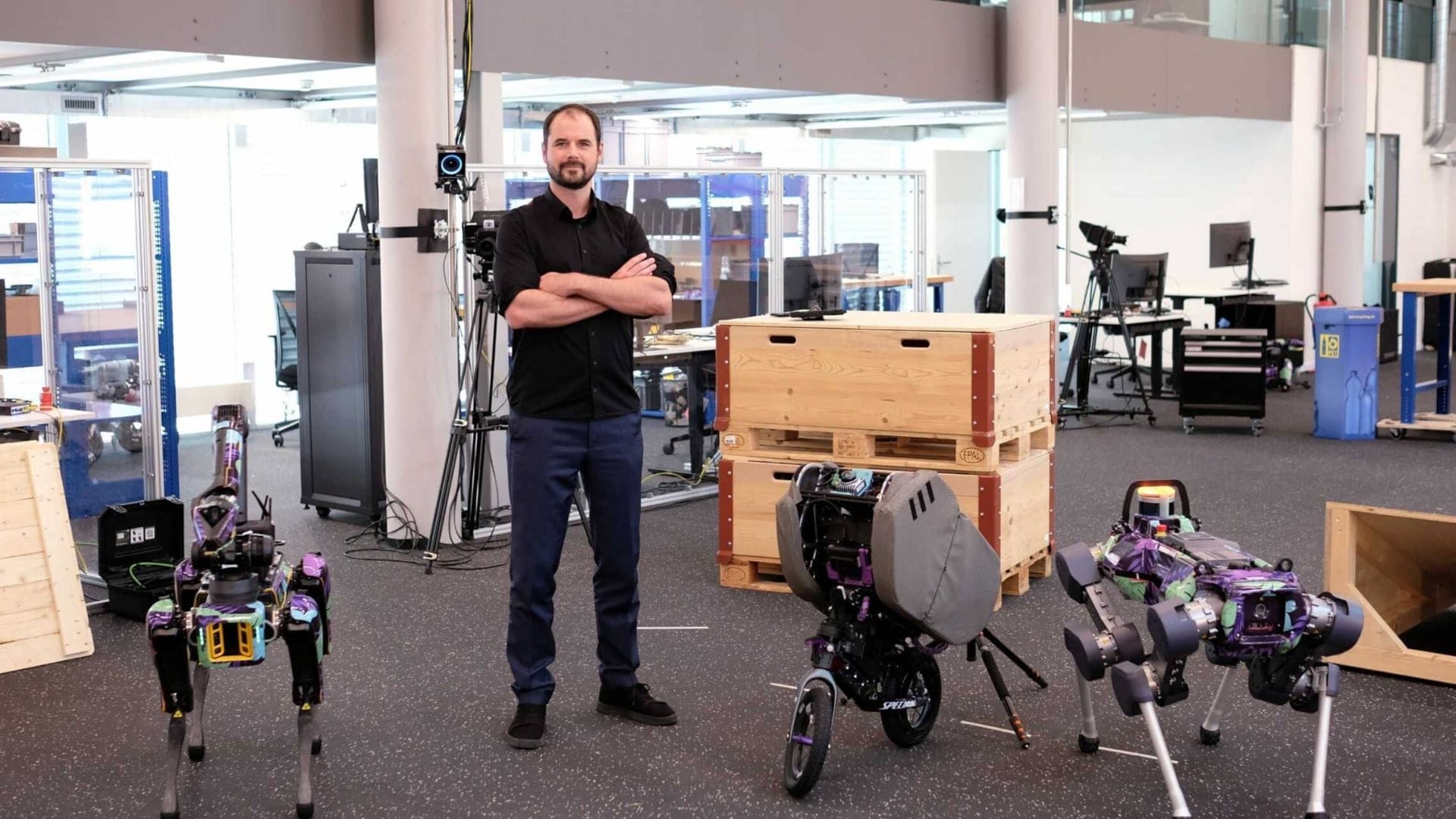
The Robotics and AI Institute (RAI Institute), founded by robotics pioneer Marc Raibert, has introduced a new experimental robot that could reshape how machines move in complex environments. Known as Roadrunner, the prototype combines wheels and legs in a single design, offering a level of versatility that challenges traditional humanoid robots.
Based in Massachusetts, the institute revealed the 15 kg robot as part of its ongoing efforts to advance robotics and artificial intelligence. The machine’s unusual structure, with symmetrical legs, knee joints, and wheels at the base, allows it to adapt quickly to different terrains while maintaining stability and speed.
A hybrid design focused on flexibility and performance
Roadrunner stands out for its ability to switch seamlessly between wheeled and legged movement. In demonstration footage released by the institute, the robot is shown launching itself upright from a resting position before smoothly rolling across flat ground. Its movements appear controlled and efficient, reflecting a design that prioritises both balance and agility.
Meet “Roadrunner,” a new 15kg (33 lb) bipedal wheeled robot prototype featuring multi-modal locomotion: side-by-side and inline wheel modes and and stepping. Its symmetric legs articulate at the knee for obstacle avoidance. pic.twitter.com/rcMW3DAEv3
— RAI Institute (@rai_inst) March 23, 2026
The robot’s wheels act as feet when climbing obstacles, enabling it to tackle stairs with surprising ease. It ascends step by step before transitioning back into a wheeled mode to descend a ramp. In a more striking sequence, Roadrunner reverses direction and descends the same set of steps, maintaining balance that resembles a skilled cyclist.
This combination of mobility modes allows the robot to handle environments that might challenge machines relying solely on wheels or legs. The symmetrical structure of its limbs ensures that it can maintain stability regardless of orientation, while the integrated joints provide the flexibility needed for complex manoeuvres.
Engineers at the RAI Institute have emphasised the importance of this hybrid approach. By merging different movement strategies into a single platform, the team aims to overcome the limitations typically associated with conventional robot designs. The result is a machine capable of navigating both smooth surfaces and uneven terrain without requiring major adjustments.
An advanced control system enables adaptive behaviour
A key element behind Roadrunner’s performance is its control system, which has been designed to manage multiple movement styles using a unified approach. According to the institute, a single control policy governs both side-by-side and in-line driving configurations, allowing the robot to adapt its behaviour depending on the situation.
“A single control policy was trained to handle both side-by-side and in-line driving,” the RAI Institute said in its statement. “Several behaviours, including standing up from various ground configurations and balancing on one wheel, were successfully deployed zero-shot on the hardware.”
The term “zero-shot” refers to the robot’s ability to perform tasks without additional training after deployment. This suggests that the system has been developed with a high degree of generalisation, enabling it to respond to new scenarios without extensive reprogramming.
Such capabilities are increasingly important in robotics, particularly for applications where conditions can change rapidly. By reducing the need for repeated training cycles, developers can create machines that are more efficient and easier to deploy in real-world settings.
The demonstration of balancing on a single wheel further highlights the system’s sophistication. Maintaining stability in such a configuration requires precise coordination between sensors, actuators, and control algorithms, indicating a high level of integration between hardware and software.
Future applications and research potential
The RAI Institute has described Roadrunner primarily as a research platform rather than a commercial product. Its purpose is to explore the limits of dynamic mobility and to test new approaches to robot control and design. However, the technology could have practical implications in the future.
Robots with this level of agility could be deployed in environments where traditional machines struggle. For example, they may be used for inspections in industrial facilities, where navigating stairs, ramps, and uneven surfaces is often required. Warehousing is another potential area, as the ability to move quickly and adapt to obstacles could improve logistics efficiency.
In some cases, such machines might offer an alternative to humanoid robots, which are often more complex and expensive to develop. By focusing on functionality rather than human-like appearance, engineers can prioritise performance and reliability in specific tasks.
The institute itself was established in 2022 by Marc Raibert, who previously founded Boston Dynamics, a company known for its highly dynamic robots. Drawing on this legacy, the RAI Institute has quickly gained attention for its work in combining robotics with advanced artificial intelligence.
Roadrunner reflects this broader mission, showcasing how new design philosophies and control techniques can expand the capabilities of robotic systems. While still in the experimental stage, the prototype demonstrates the potential of hybrid mobility and adaptive behaviour in next-generation machines.
As research continues, developments like Roadrunner may help redefine expectations for how robots move and interact with the world around them. By pushing beyond traditional designs, the RAI Institute is contributing to a shift towards more versatile and capable robotic platforms.