


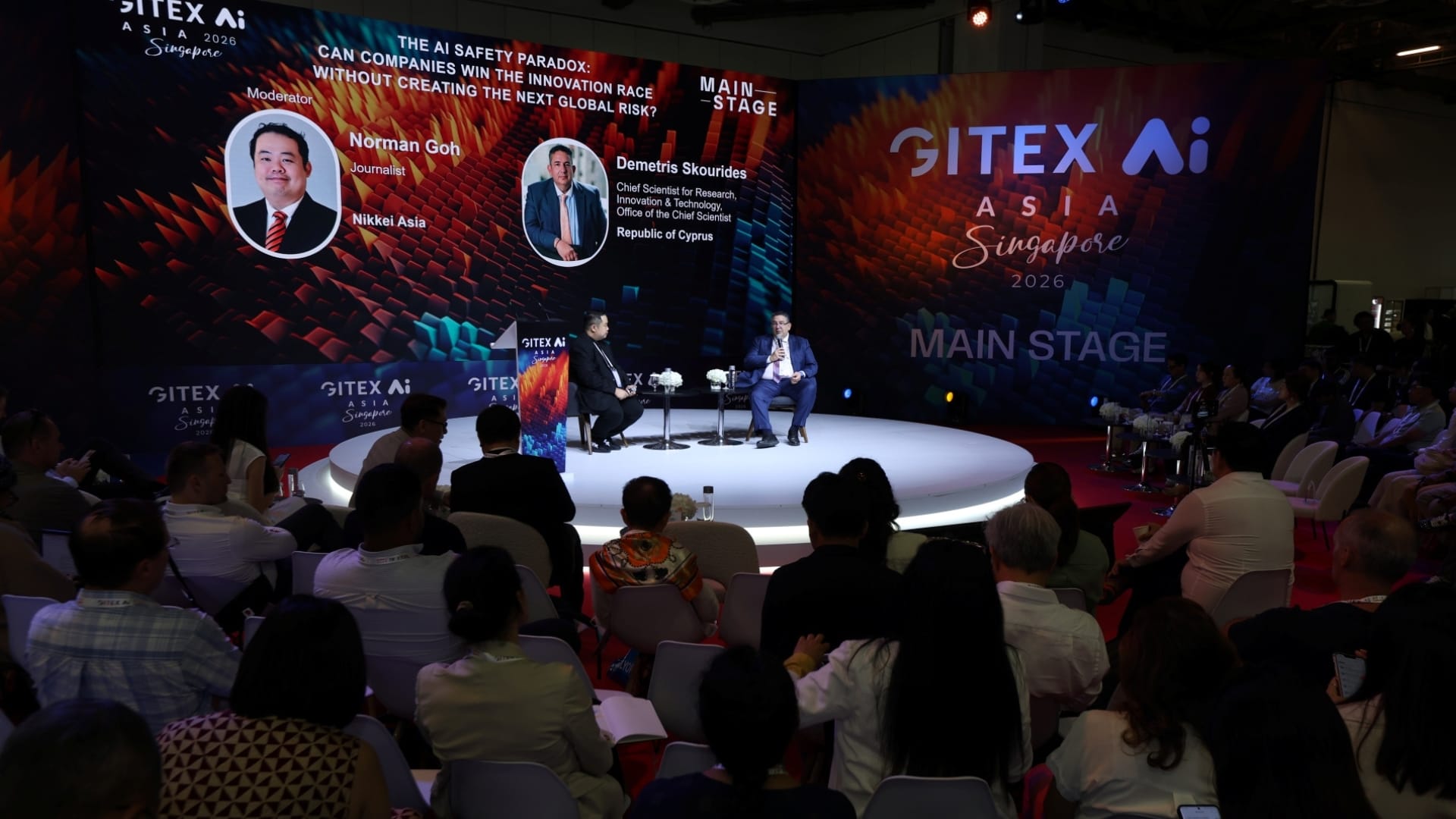
GITEX AI ASIA 2026 concluded in Singapore on 10 April after two days focused on startup commercialisation, sovereign AI governance, and digital infrastructure across Southeast Asia’s next growth phase.
The event brought together more than 550 enterprises and startups from over 110 countries, alongside investors managing more than US$350 billion in assets. Held at Marina Bay Sands, the summit examined the technologies, funding patterns, and policy shifts shaping a region projected to reach a US$2 trillion digital economy by 2030.
North Star Asia draws Belgium and Philippines delegations
More than 300 startups participated in North Star Asia, the event’s startup showcase presented by GITEX. Founders met investors across AI, quantum computing, cybersecurity, digital health, and industrial technology in one of the year’s largest gatherings for deep-tech matchmaking and commercial scrutiny in the region.
Alongside pavilions from Hong Kong, India, Japan, the Netherlands, Pakistan, and South Korea, first-time country delegations from Belgium and the Philippines reflected broader cross-border participation. Hub.Brussels brought companies working on digital product passports, AI-based compliance, and regulatory knowledge modelling aligned with European frameworks. AW Labs applied intelligent sensing and analytics to indoor air quality management.
From the Philippines, TAPI introduced startups spanning AgriTech, smart cities, education and SaaS. Cerebro unified school operating systems, while GreenVisionsPh focused on precision farming tools designed to restore soil health and improve productivity.
Ailytics wins Supernova Challenge
Ailytics, a Singapore-based workplace safety platform that converts standard CCTV into AI-powered monitoring tools, won the Supernova Challenge and S$30,000 in equity-free prize money. Japan’s health-tech company Lifescapes secured first runner-up with S$20,000, while South Korea’s talent upskilling platform Codepresso took second runner-up and S$10,000.
Tan Wei Zhuang, chief executive of Ailytics, said the quality of footfall had been strong. “From a tech campus perspective, the ROI has been extremely strong at GITEX AI ASIA Singapore,” he said.
Investors sharpen focus on commercialisation and execution
Investors from more than 30 countries arrived with sharper views on a tightening funding climate. Saemin Ahn, managing partner at Rakuten Capital, said capital is concentrating around startups solving mission-critical problems and proving themselves as indispensable business enablers rather than side experiments.
Yinghui Kuang, partner at Granite Asia, a venture capital firm behind 127 unicorns, addressed the difficulty of commercialising hard science. “One pragmatic path is to get commercial traction and scale first, then keep building on the technology,” Kuang said. “In the last 12 months alone, we have looked at more than 100 humanoid startups, and in many cases, we only write the cheque after knowing a company for three to five years and seeing how it executes.”
Sovereign AI and Industry 5.0 governance take centre stage
The event examined how organisations can govern AI systems as they make decisions and sit deeper inside national and industrial ecosystems. Demetris Skourides, chief scientist for research, innovation and technology at the Republic of Cyprus, addressed the governance challenges of Industry 5.0.
“Sovereign AI is about far more than just running a model in your own country. It’s about whether you control the data, the decisions, and the algorithms that define those decisions,” Skourides said. “Too often we treat AI as just the application layer and forget the full stack beneath it… That blind spot can create serious systemic risks, from bias in training data to over-reliance on specific infrastructure and vendors.”
Dr Arvind Bodhankar, chief sustainability officer at ArcelorMittal Nippon Steel, outlined how AI, robotics and next-generation materials are being used to build greener, circular factories. Manufacturing accounts for one-fifth of global emissions and more than 54 per cent of global energy use.
“We have adopted a three-pronged approach: reduce, recycle and repurpose, so that materials are fed back into the steel-making process or used as substitutes in cement and road-building,” Bodhankar said.
Cybersecurity market set to triple by 2031
Cybersecurity emerged as one of the event’s most pressing themes. ASEAN’s cybersecurity market, worth US$5.5 billion in 2025, is projected to nearly triple to US$14 billion by 2031 as governments and businesses confront risks created by cloud adoption, AI, IoT and increasingly connected economies.
David Koh, commissioner of cybersecurity and chief executive of the Cyber Security Agency of Singapore, opened the conference by pointing to a fourfold increase in advanced threat attacks between 2021 and 2024. He framed cybersecurity as a shared responsibility between government, industry and academia.
Dr Megat Zuhairy, chief executive of Malaysia’s National Cyber Security Agency, said digital growth is outpacing cyber resilience across ASEAN. “We must design tech-neutral laws, strengthen regional cooperation and ensure there is clear leadership and honest communication when incidents occur,” Zuhairy said.
Alvaro Garrido, chief operating officer for technology and operations and chief information officer for information security and data at Standard Chartered, examined what secure-by-design AI looks like in banking, focusing on training, trust and ethics in one of the world’s most tightly regulated sectors.
H3C, iFLYTEK and Forescout demonstrate AI infrastructure
On the show floor, the focus was on operationalising AI at scale across networks, enterprise systems, cybersecurity, and data infrastructure. H3C, a digital and AI solutions company and China’s leading player in the hyperconverged infrastructure market, presented full-stack digital infrastructure capabilities spanning computing, storage, networking, security, and edge.
iFLYTEK offered an exclusive preview of its new AI glasses ahead of their official launch in May. The lightweight wearable is designed for real-time translation and intelligent assistance.
Forescout, a global cybersecurity company working with Fortune 100 enterprises and government entities, demonstrated visibility, control, and asset intelligence in increasingly complex digital environments. Evan Duman, regional sales director for ASEAN at Forescout, said maintaining visibility into every device and system is critical to reducing cyber risk and strengthening operational resilience.
Datalec Precision Installations unveiled its integrated AI-ready data centre. Peter Cole, executive vice president for Asia-Pacific at the company, said Asia-Pacific is at the centre of the global AI and cloud revolution, and that transformation depends on robust, efficient and scalable data infrastructure.
Telkom Indonesia and DBS on 6G and regional scale
Dian Siswarini, president director of PT Telkom Indonesia, positioned the race to 6G as central to a unified roadmap for nationwide digitalisation and AI-led economies. “To compete in an AI native, 6G world, we must treat digital infrastructure as a strategic asset, not just for connectivity, but for national competitiveness,” Siswarini said.
Shih Guan Chua, managing director and global head of digital economy group at DBS, outlined how Singapore and wider Asia are evolving into command centres for globally scalable companies, citing political stability, strong infrastructure, and access to capital as key factors.
GITEX AI ASIA 2026 featured over 250 investors, 175 speakers, and participation from more than 110 countries. The event is powered by GITEX GLOBAL, described as the world’s largest tech and AI show.