

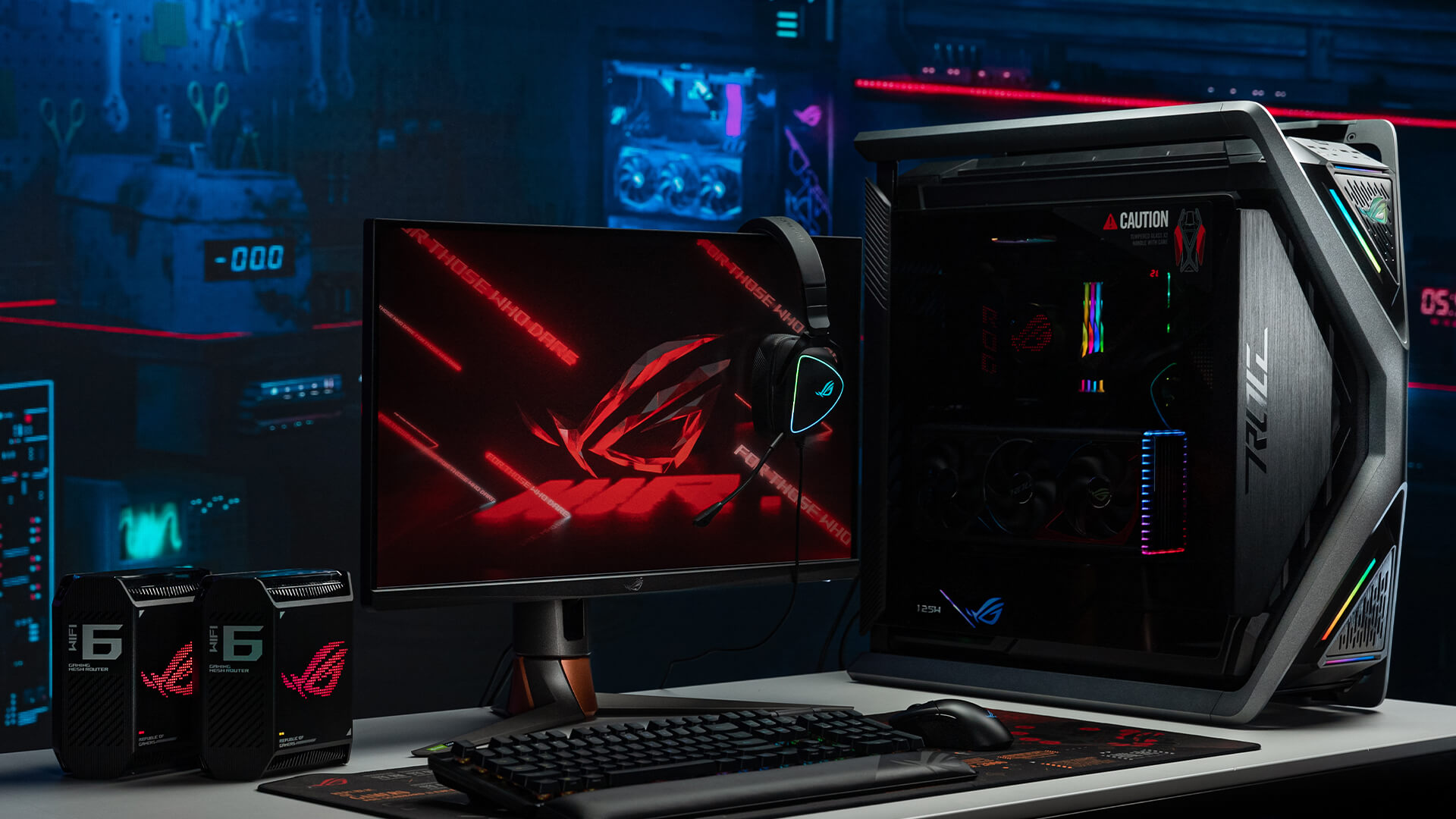
ASUS Republic of Gamers (ROG) today announced the ROG Hyperion GR701, a completely reimagined full tower gaming case that offers an uncompromising vision of luxury and performance, engineered to take DIY builds to new heights.
A new benchmark for airflow
The world of PC building has changed. From next-gen graphics cards like the NVIDIA GeForce RTX 4090 to faster-than-ever USB data rates and charging, a PC case needs to support the latest and greatest technologies. ASUS built the ROG Hyperion to be a durable, elegant chassis that is ready for the future of DIY gaming rigs — with an airflow-focused design that keeps components running in top shape.
This is the next generation of ROG chassis. The top priority with the Hyperion is airflow, with huge channels in the front for air to pass through alongside a grille along the top. Thanks to these channels plus support for up to two 420 mm radiators, users can rest assured that their components will stay frosty and perform their best, whether using heatsinks, all-in-one liquid cooling, or a fully custom loop designed from the ground up.
A vast and adaptable interior
The ROG Hyperion has also been designed with next-gen components in mind. It supports up to 12-inch E-ATX motherboards, dual USB 3.2 Gen 2×2 Type-C ports on the front, and plenty of expansion slots for future upgrades. The latest graphics cards, in particular, reach untold new levels of performance, with large heatsinks to keep them cool and quiet. And the Hyperion is spacious enough to fit even the largest graphics cards like the ROG Strix GeForce RTX 4090. Go with a traditional horizontal mount of up to 460 mm wide, or mount a card vertically with up to 130 mm of space for present and future cards. The built-in aluminum two-way graphics card holder will keep the card from sagging in either orientation, no matter how large it is — while also aiding in cable management for the rest of a build.
And users will not just be stuffing their cables behind the side panel and hoping it closes, either. ASUS has provided 34 mm of space behind the motherboard for all wiring, with multiple grommets and a wide panel along the back with built-in hook-and-loop cable ties to keep everything neat and tidy. Plus, with the translucent acrylic door, users can keep all cables contained before they ever put the back side panel on. This also provides more space for heat dissipation. A built-in ARGB controller provides a place for all Aura Sync devices to plug in, with support for up to eight ARGB devices and six PWM fans.
Designed for DIY builders
The Hyperion is a full-feature case with plenty of room to work — without being colossal. And the little conveniences are what really take the Hyperion to the next level. With most builds, users are stuck stashing extra screws, cable ties and PCIe slot covers in a box somewhere, hoping they do not get lost before the next upgrade. The ROG Hyperion offers a small embedded drawer along the bottom as dedicated storage for screws, accessories and even a small screwdriver. The side panels are completely tool-less, and the power supply shroud has been designed to allow airflow while keeping the holes small enough to prevent screws from falling through. There’s also a small opening in the shroud for the ROG Thor’s OLED panel, so users can see their power usage at all times.
The signature ROG experience
Finally, no case is complete without the aesthetic flourishes that help it stand out from the crowd. The interior panel next to the motherboard allows space for a radiator, ARGB fans, multiple 2.5-inch SSDs or — if users do not need that extra mounting space — they can install the included lighting board, which adds a bit of ROG visual flair to the otherwise empty space. The case’s aluminum frame also acts as a pair of sturdy handles, which travel down the front panel of the case and meet under a black-tinted ARGB logo.
As the DIY PC space rapidly changes, the ROG Hyperion is ready to accommodate all the latest components with exceptional cooling, and it’s ready to grow with a user’s needs over time.