

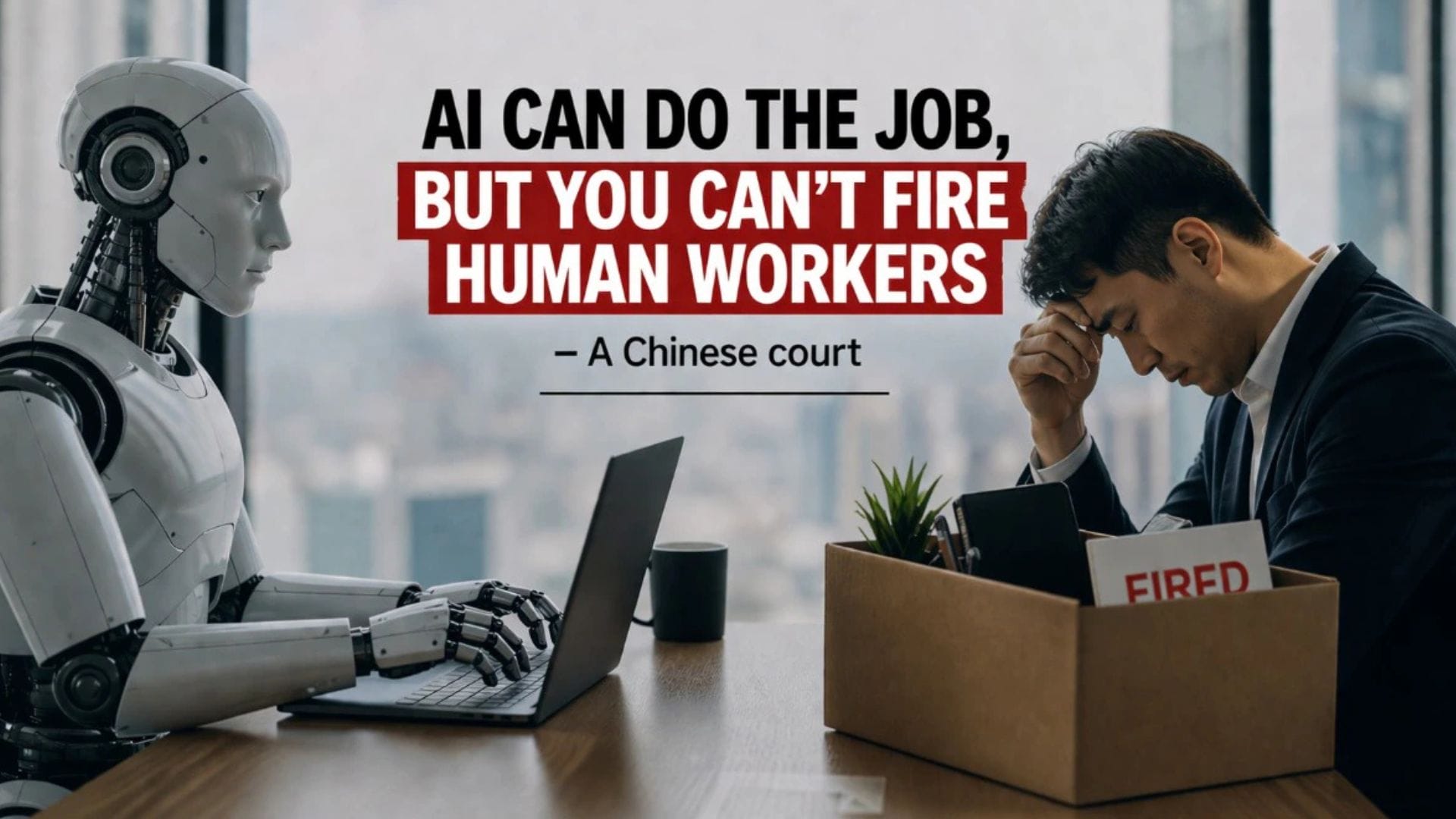
China has moved to strengthen labour protections in the age of artificial intelligence, with a court ruling that companies cannot dismiss employees simply because AI systems can perform their roles. The decision is seen as one of the earliest legal efforts globally to address the impact of automation on human employment.
The ruling was issued by the Hangzhou Intermediate People’s Court, which determined that replacing workers with AI does not qualify as a “major change in objective circumstances”. Under Chinese labour law, such a change is typically required for an employer to justify terminating a contract. The court’s interpretation effectively blocks businesses from using automation alone as a legal basis for redundancies.
The case emerged in Hangzhou, a city widely recognised as a centre for artificial intelligence development in China. The location adds weight to the decision, as it comes from a region at the forefront of the country’s technology sector. Observers say the ruling highlights a growing tension between rapid technological progress and the need to safeguard employment rights.
Legal boundaries set for automation-driven layoffs
The court made clear that employers must provide valid legal reasons beyond the introduction of AI when dismissing staff. It also ruled against the practice of reassigning workers to lower-paid roles without proper justification, stating that such measures fail to meet legal standards for fair treatment.
The judgment followed a dispute involving a technology worker who was dismissed and not offered adequate compensation. While the case focused on an individual complaint, it also referenced broader concerns about workers being displaced by automation across various industries. Legal experts believe the decision could influence how similar disputes are handled in the future.
Wang Tianyu, a researcher at the Chinese Academy of Social Sciences, highlighted the wider implications of the ruling. He stated, “Technological progress may be irreversible, but it cannot exist outside a legal framework.” His remarks underline the view that innovation must be balanced with social responsibility, particularly when it affects livelihoods.
Analysts note that the court’s position places a clear obligation on companies to consider the human impact of adopting AI technologies. Businesses are expected to manage transitions carefully, ensuring that workers are treated fairly and compensated appropriately if their roles are affected.
Workers urged to adapt alongside technological change
While the ruling strengthens protections for employees, the court also emphasised that workers themselves have a role to play in adapting to a changing job market. It is suggested that individuals continue to develop relevant skills and remain responsive to new technologies to stay competitive.
This dual approach reflects a broader policy stance in China, where authorities are encouraging both innovation and workforce resilience. By placing responsibility on both employers and employees, the ruling aims to create a more balanced transition into an AI-driven economy.
Experts say the decision could serve as a reference point for other jurisdictions grappling with similar challenges. As artificial intelligence becomes more integrated into workplaces worldwide, governments and courts are increasingly being called upon to define the limits of automation in relation to employment rights.
In Europe, for example, regulatory efforts such as the European Union’s AI Act already touch on workplace issues, including transparency and accountability in automated decision-making. Although the frameworks differ, the underlying concern is shared: how to harness the benefits of AI without undermining job security.
China’s ruling may therefore signal the beginning of a broader global trend towards tighter regulation of AI in employment contexts. As companies continue to invest in automation to improve efficiency, the legal landscape is likely to evolve in parallel, shaping how technology is deployed in the workplace.