

Optical computing is increasingly being viewed as a potential solution to the growing demands of artificial intelligence (AI) and deep learning applications. Unlike conventional electronic computing systems, optical computing uses the properties of light, such as interference and diffraction, to process information. This approach offers faster computation, improved energy efficiency, and greater parallel processing capabilities.
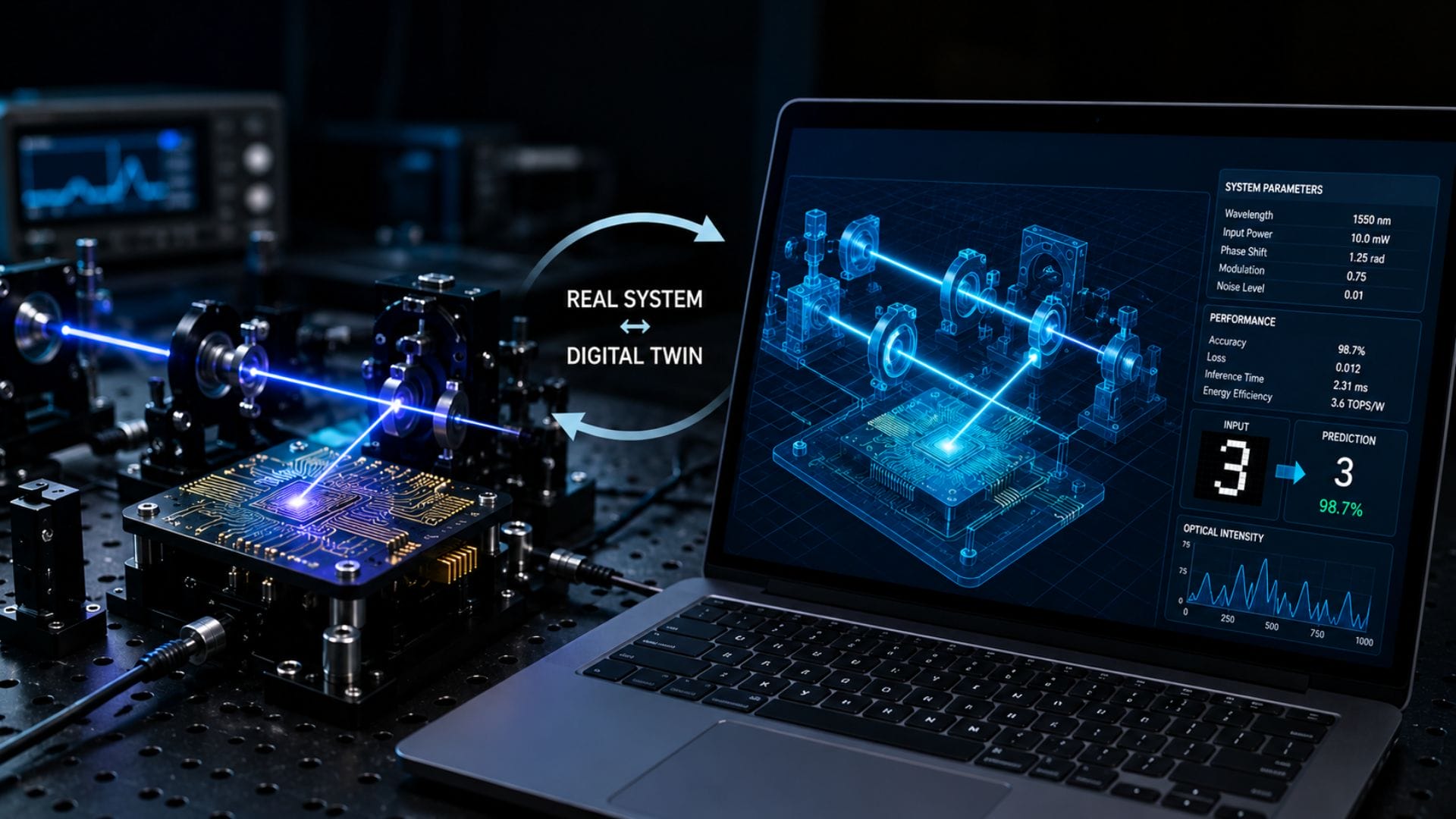
Researchers in China have now proposed a new framework designed to simplify the development and testing of optical computing systems. The approach, known as the Digital Twin Optical Computing System (DT-OCS), creates a software-based replica of a physical optical computing platform. The research, published in the journal Opto-Electronic Advances, aims to make optical computing more accessible and efficient for scientists working on a range of AI-related tasks.
Overcoming hardware limitations in optical computing research
Developing applications for optical computing systems has traditionally depended on direct access to specialised hardware. This has created significant challenges for researchers, particularly when several teams need to use the same equipment.
In many cases, scientists must wait for access to a shared system before beginning their work. Once access is granted, they often need to spend considerable time adjusting system parameters and performing calibration procedures before meaningful experiments can be conducted. When one research project is completed, the next user frequently has to repeat the same process, creating delays and reducing overall efficiency.
This reliance on physical hardware has limited the ability of multiple researchers to work on different projects simultaneously. The repeated cycle of waiting, tuning and recalibrating equipment increases development costs and slows the pace of innovation.
To address these issues, the research team developed DT-OCS. The framework creates a digital model capable of reproducing the behaviour of a physical optical computing system under different operating conditions. Instead of requiring continuous access to hardware, researchers can work within a software environment that accurately reflects how the physical system will respond.
The team describes the digital twin as a high-fidelity virtual counterpart to the real optical computing platform. While the physical hardware remains a valuable resource, the digital model enables much of the development and testing to take place without directly interacting with the equipment.
Digital twin successfully mirrors real-world performance
To evaluate the effectiveness of the new framework, the researchers conducted a series of experiments using a high-speed optical computing system combined with a silicon photonic feature-computing chip.
The team tested the digital twin on tasks including image classification and sequential decision-making. These applications were selected because they are commonly used in AI and machine learning research and require significant computational resources.
According to the study, configuration settings trained and optimised in the digital environment could be transferred directly to the physical hardware without requiring additional adjustments. This finding suggests that researchers can complete much of the development process virtually before deploying their work on real systems.
The experiments also demonstrated a close match between the performance predicted by the digital twin and the results achieved on the physical hardware. This alignment confirmed both the accuracy of the software model and its ability to represent the behaviour of the real optical computing platform.
Because optimisation and training can be performed primarily within the digital environment, multiple projects can be developed simultaneously. Researchers no longer need to rely solely on limited hardware availability, potentially accelerating progress across a wide range of optical computing applications.
The successful transfer of configurations from the digital model to the physical system highlights the potential of digital twin technology to reduce development time while improving accessibility for the wider research community.
Open framework aims to expand access to optical computing
In addition to presenting the DT-OCS framework, the research team has made the platform and its associated datasets publicly available. This decision allows researchers around the world to perform training, testing and validation activities without requiring direct access to specialised optical computing hardware.
The availability of an open digital model could significantly lower barriers to entry in the field. Researchers who previously lacked access to expensive equipment can now explore optical computing concepts and develop applications using the software-based environment.
According to the researchers, DT-OCS was designed as “a reproducible, accessible, and scalable software resource for wider sharing and validation.” The open nature of the framework supports collaboration and enables independent verification of research findings.
The team believes that future optical computing platforms should combine physical hardware with openly available digital twins that replicate the same computational behaviour. Such an approach would allow researchers to move seamlessly between virtual development environments and real-world systems.
To explain the concept, the researchers compared the relationship between hardware and digital twins to modern transportation networks. Just as continuously updated digital maps support physical roads, they argue that advanced optical computing systems will benefit from a similar combination of physical infrastructure and digital representation.
As AI workloads continue to grow, the introduction of digital twin technology could play an important role in making optical computing more practical, scalable and accessible. By reducing dependence on scarce hardware resources, the framework may help accelerate innovation in one of the most promising areas of next-generation computing research.