

OpenAI has introduced a preview of a new finance feature for ChatGPT that allows users to connect their financial accounts to the chatbot for tailored money advice. The feature is launching first for Pro subscribers in the United States and aims to provide more personalised guidance based on a user’s financial situation.
The company said millions of people already use ChatGPT to ask questions about budgeting, spending and financial planning. By allowing users to connect their bank accounts and financial services securely, OpenAI hopes the chatbot can move beyond general suggestions and provide more relevant recommendations.
The integration is powered through a partnership with Plaid, a financial technology platform that connects applications to banks and financial institutions. Plaid supports links to more than 12,000 institutions and services, including major banks such as Citi and Chase, as well as platforms including Affirm and Robinhood.
How the new finance feature works
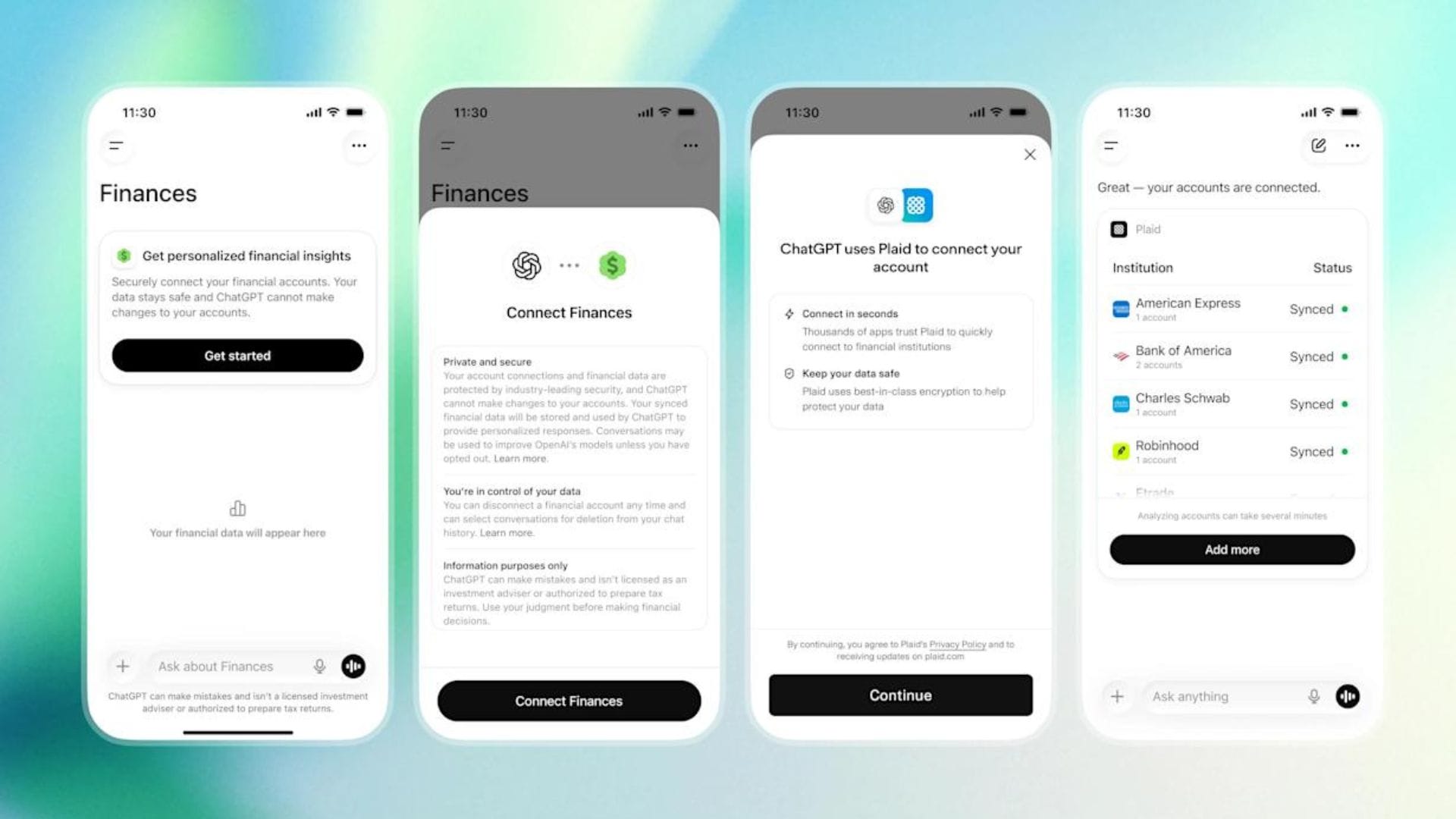
Users can begin using the feature by opening the new “Finances” section in ChatGPT’s sidebar or by entering prompts asking the chatbot to connect their accounts. ChatGPT then guides users through the process of securely linking their financial information through Plaid’s system.
Once the connection is complete, ChatGPT generates a visual dashboard that displays details such as balances, spending activity, investments, and liabilities. OpenAI said the dashboard may take several minutes to build, depending on the amount of financial information being processed.
After the setup process, users can either choose from a list of suggested prompts or ask their own questions. The chatbot is designed to provide advice and insights tailored to the financial information shared through the connected accounts.
OpenAI believes the feature could help users better understand their spending habits, savings and financial goals. The company also suggested the tool may eventually support a wider range of financial planning tasks as the system develops further.
According to OpenAI, the project was already underway before the company’s recent acquisition of fintech start-up Hiro, which specialised in AI-powered financial planning tools. The company said the new finance tools are part of a broader effort to make ChatGPT more useful in everyday life.
Privacy and security concerns remain central
The launch of the finance feature is likely to raise questions about privacy and data security, particularly given the sensitive nature of banking information. OpenAI acknowledged that some users may be cautious about sharing financial details with an AI chatbot and said safeguards have been built into the system.
The company stated that ChatGPT can only access limited financial information through Plaid. This includes balances, transactions, investments and liabilities. OpenAI said the chatbot cannot view full account numbers and cannot move money or make changes to connected accounts.
Users can also disconnect their financial accounts from ChatGPT at any time. OpenAI added that any financial memories saved by the chatbot can be reviewed or deleted directly from the Finances section within the app.
The company said temporary chat sessions offer an additional layer of privacy because ChatGPT cannot access saved financial memories during those conversations. Existing data control settings also apply to the finance feature, meaning users who have already disabled model training will not have their financial prompts or information used to train future AI systems.
OpenAI has increasingly focused on addressing concerns about trust and transparency as it expands ChatGPT into more personal and sensitive areas of daily life. Financial information is among the most tightly guarded forms of personal data, making user confidence a key challenge for the rollout.
OpenAI plans wider rollout after testing phase
At present, the finance integration is only available as a preview for Pro users in the United States. OpenAI said the limited release is intended to help the company gather feedback and improve the system before making it available to a broader audience.
The company indicated that future expansion could include Plus subscribers and potentially other regions, although no timetable has been announced. OpenAI said it plans to study how people use the feature in real-world situations before deciding on wider availability.
In a statement, the company said: “We’re starting with a preview to a smaller group so we can learn from real-world use, improve the experience, and expand thoughtfully.”
The finance feature reflects a growing trend among technology companies seeking to combine artificial intelligence with personal finance services. AI-powered budgeting and planning tools have become increasingly common in recent years as consumers seek simpler ways to manage their money and understand their financial decisions.
OpenAI’s move also places ChatGPT in more direct competition with digital banking assistants and financial planning apps that already offer automated spending analysis and budgeting recommendations. However, the company appears to be positioning ChatGPT as a broader conversational assistant capable of offering contextual advice across many areas of daily life.
Whether users are willing to trust an AI chatbot with sensitive financial information may ultimately determine the success of the feature. For now, OpenAI is taking a cautious approach, testing the system with a smaller group of users before a wider release.